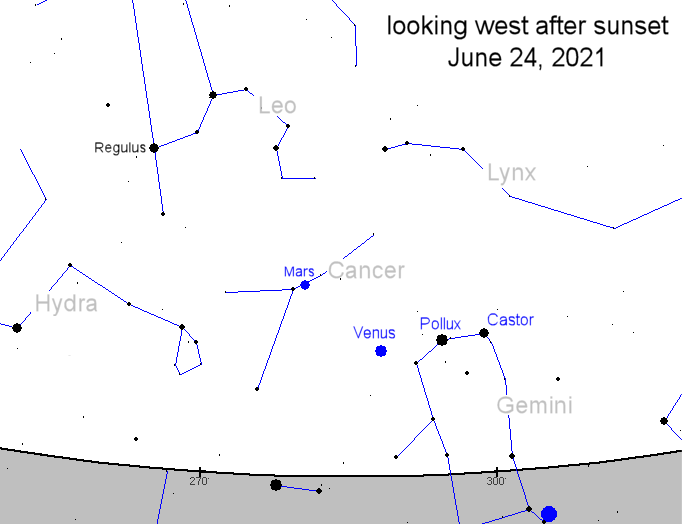
SUNSET SKY SHOW: When the sun goes down tonight, step outside and look west. Venus is lining up with Castor and Pollux, the brightest stars of the constellation Gemini. On June 24th, the trio will form an almost perfect Euclidean line not far above the horizon: sky map.
HUGE COMET DISCOVERY (UPDATED): Astronomers have just discovered a comet so big, it might actually be a minor planet. The object is named 2014 UN271. Astronomers Pedro Bernardinelli and Gary Bernstein found it in archival images from the Dark Energy Survey. It appears to be about 100 km wide, 2 or 3 times bigger than record-breaking Comet Hale-Bopp of the 1990s.
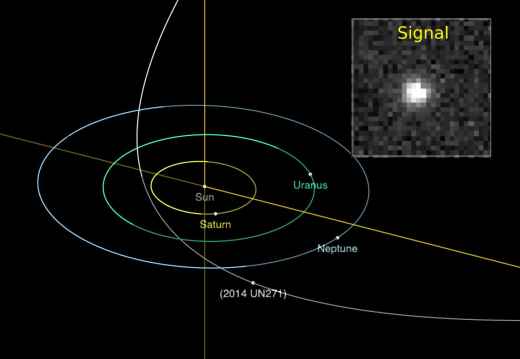
Above: A discovery image and orbit of huge Comet Bernardinelli-Bernstein.
Now for the bad news. Although 2014 UN271 is falling toward the sun, we may never see it with our naked eyes. At closest approach in early 2031, the behemoth comet will be just outside the orbit of Saturn, too far for naked-eye viewing. Some astronomers are estimating a maximum brightness near magnitude +17, about the same as Pluto's moon Charon.
It's still an amazing discovery. 2014 UN271 has an extremely elongated orbit stretching from ~the neighborhood of Saturn out to a staggering distance of almost a light year. At the far reaches of its orbit, 2014 UN271 barely feels the sun's gravity and could be snatched out of the Solar System altogether by the ephemeral pull of galactic tides. Discovering such a traveler during its brief time among the planets is very lucky indeed.
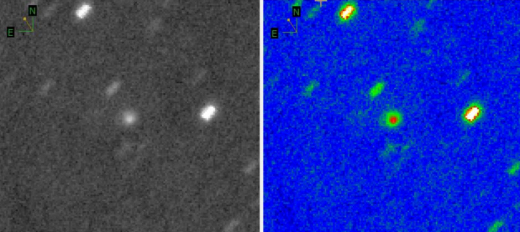
Above: Images of 2014 UN271 taken June 22, 2021. Credit: L. Demetz, L. Buzzi, A. Aletti
There is talk of a space mission to intercept 2014 UN271. The European Space Agency is building a probe called Comet Interceptor designed to investigate comets coming from deep space. It, or something like it, might be able to visit 2014 UN271 a decade from now.
With an object like this, we have to expect surprises. 2014 UN271 certainly poses no threat to Earth, but it could brighten more (or less) than expected. Multiple groups of astronomers have already detected signs of out-gassing even though 2014 UN271 is still beyond Uranus. Early signs of activity may bode well for future visibility through small telescopes if not the unaided eye.
Update: This object has been officially designated a comet and named Comet Bernardinelli-Bernstein (C/2014 UN271).
Realtime Space Weather Photo Gallery
Free: Spaceweather.com Newsletter
THIS IS *REAL* MONEY FROM SPACE: Earlier this year, the US Mint released a reverse-proof dollar coin honoring the Hubble Space Telescope. You can no longer buy these coins from the Mint, but you can get some from Earth to Sky Calculus. The students launched the coins to the stratosphere onboard a cosmic ray research balloon:
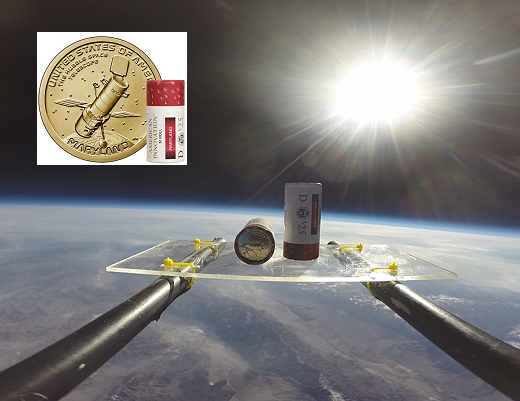
You can buy one coin for $49.95. Each coin comes with a greeting card showing the money in flight and telling the story of its trip to the stratosphere. Best of all, this is real money! You can actually spend it. All sales support hands-on STEM research.
Far Out Gifts: Earth to Sky Store
All sales support hands-on STEM education
Realtime Aurora Photo Gallery
Free: Spaceweather.com Newsletter
Realtime Noctilucent Cloud Photo Gallery
Free: Spaceweather.com Newsletter