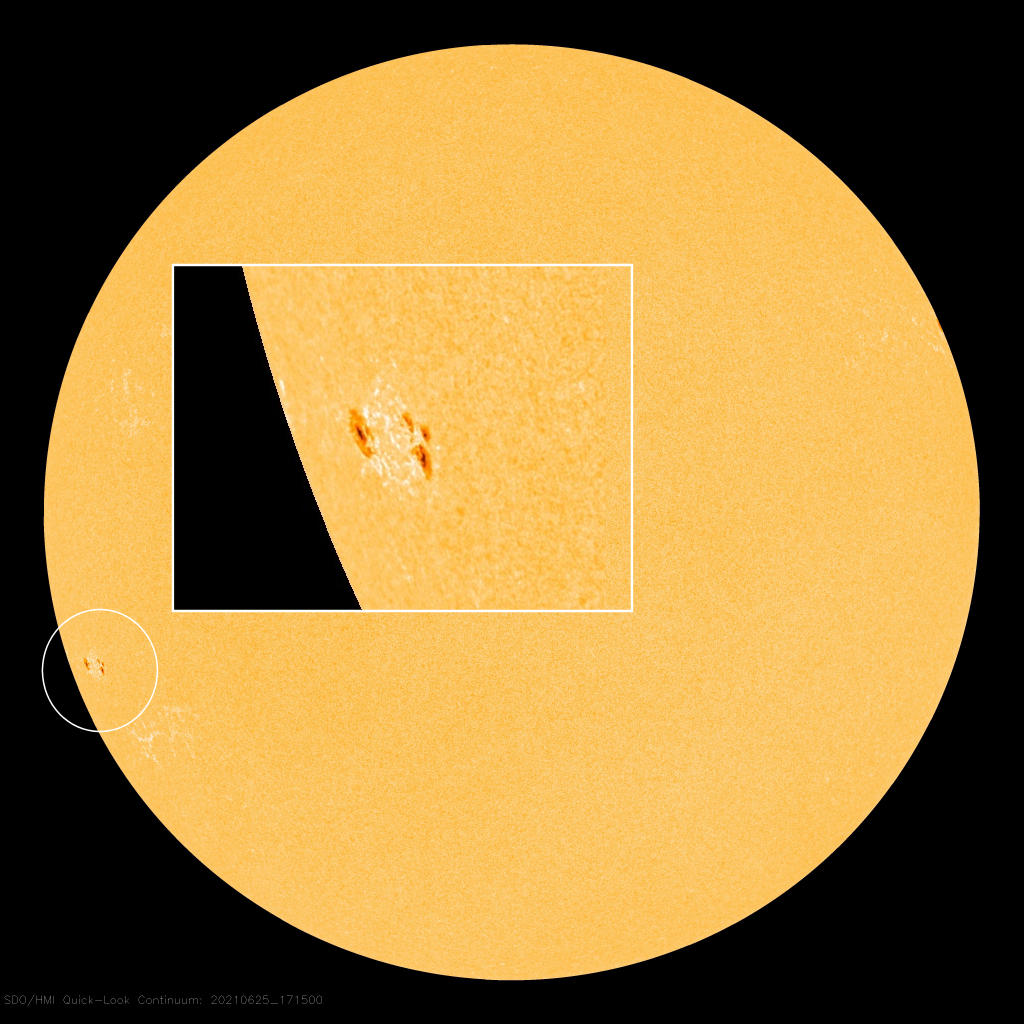
NEW SUNSPOT: A new sunspot is emerging in the sun's southern hemisphere, right here. The sunspot's dark cores have rapidly grown, expanding 5-fold in the past 24 hours. Soon it could be large and complex enough to produce solar flares. Stay tuned. Solar flare alerts: SMS Text.
LOW LATITUDE NOCTILUCENT CLOUDS: How low can they go? Noctilucent clouds (NLCs) are usually confined inside the Arctic Circle, but this year they have been sighted at mid-latitudes and below. The 2021 record-holder, so far, is this photo from the Observatorio de Sierra Nevada in Granada, Spain, at latitude +37N:
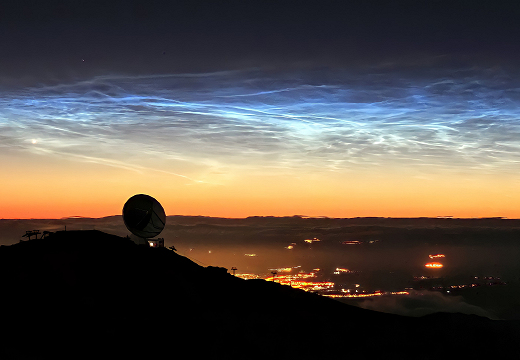
"This is the first time NLCs have been observed from Granada," according to the observatory's Science Directorate.
The picture was taken on June 20th by telescope operator Alfredo Sota. He was supervising the observatory's webcam when he saw "weird clouds" in the sunset. Soto grabbed his camera and ran out of the observatory to take the picture. "Watching them live was even more spectacular than the photo," says Soto.
Not quite matching the latitude of southern Spain, NLCs appeared last night in multiple US states including the Dakotas, Wisconsin, and Minnesota. Christian Roble sends this picture from Saint Paul (+45N):
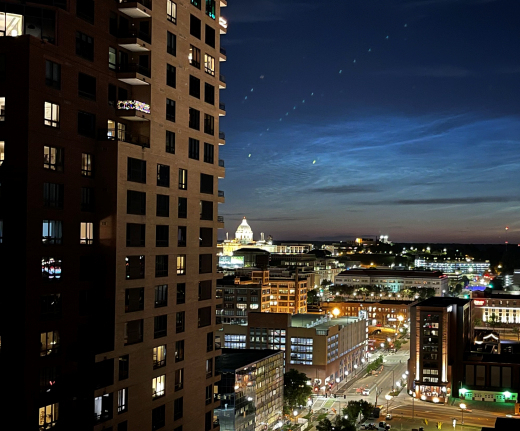
"I just happened to look north towards the Capitol and I saw them hovering high above!" says Roble. "I was excited to have finally seen them this year!"
NLCs are Earth's highest clouds. They form when summertime wisps of water vapor rise up to the edge of space and crystallize around disintegrated meteoroids. When you see one, you're literally seeing a cloud of frosted meteor smoke. Just after sunset or before sunrise is the best time to look.

Realtime Noctilucent Cloud Photo Gallery
Free: Spaceweather.com Newsletter
WHISKEY STONES FROM SPACE: It's the gift for the person who has everything: Whisky Stones from Space. These granite cubes have experienced the cold of the stratosphere, more than 50 degrees below zero! Put them in your cup for an truly out of this world drink:
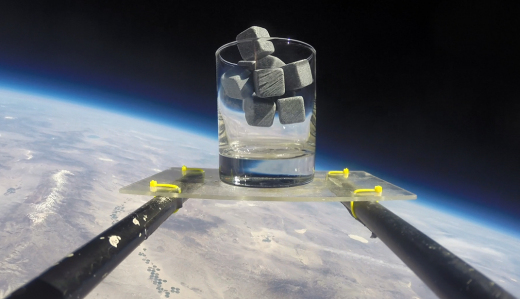
You can have a set of 9 cubes for $99.95 (glass not included). The students of Earth to Sky Calculus are selling whiskey stones to support their cosmic ray monitoring program. The ones picture above flew to the stratosphere onboard a cosmic ray research balloon on April 23, 2021, reaching an altitude of 97,543 feet.
Refrigerated whiskey stones cool a drink without diluting it, solving the problem of ordinary melting ice cubes. They make great Christmas and birthday gifts. All stones come with a greeting card showing the cubes in flight.
Far Out Gifts: Earth to Sky Store
All sales support hands-on STEM education
Realtime Aurora Photo Gallery
Free: Spaceweather.com Newsletter
Realtime Space Weather Photo Gallery
Free: Spaceweather.com Newsletter