FLARING SUNSPOT VANISHES: Yesterday, sunspot AR2838 burst through the surface of the sun and promptly unleashed the strongest solar flare in 4 years, an X1.5-class explosion. As quickly as it appeared, the sunspot is already gone. On July 4th it rotated over the sun's northwestern limb, and will spend the next two weeks transiting the farside of the sun. If AR2828 holds itself together, it will re-appear on the Earthside in late July. Solar flare alerts: SMS Text.
FIRST X-FLARE IN 4 YEARS: Now, Solar Cycle 25 has really begun. On July 3rd, new sunspot AR2838 produced the first X-class solar flare since Sept. 2017. NASA's Solar Dynamics Observatory recorded the extreme ultraviolet flash:
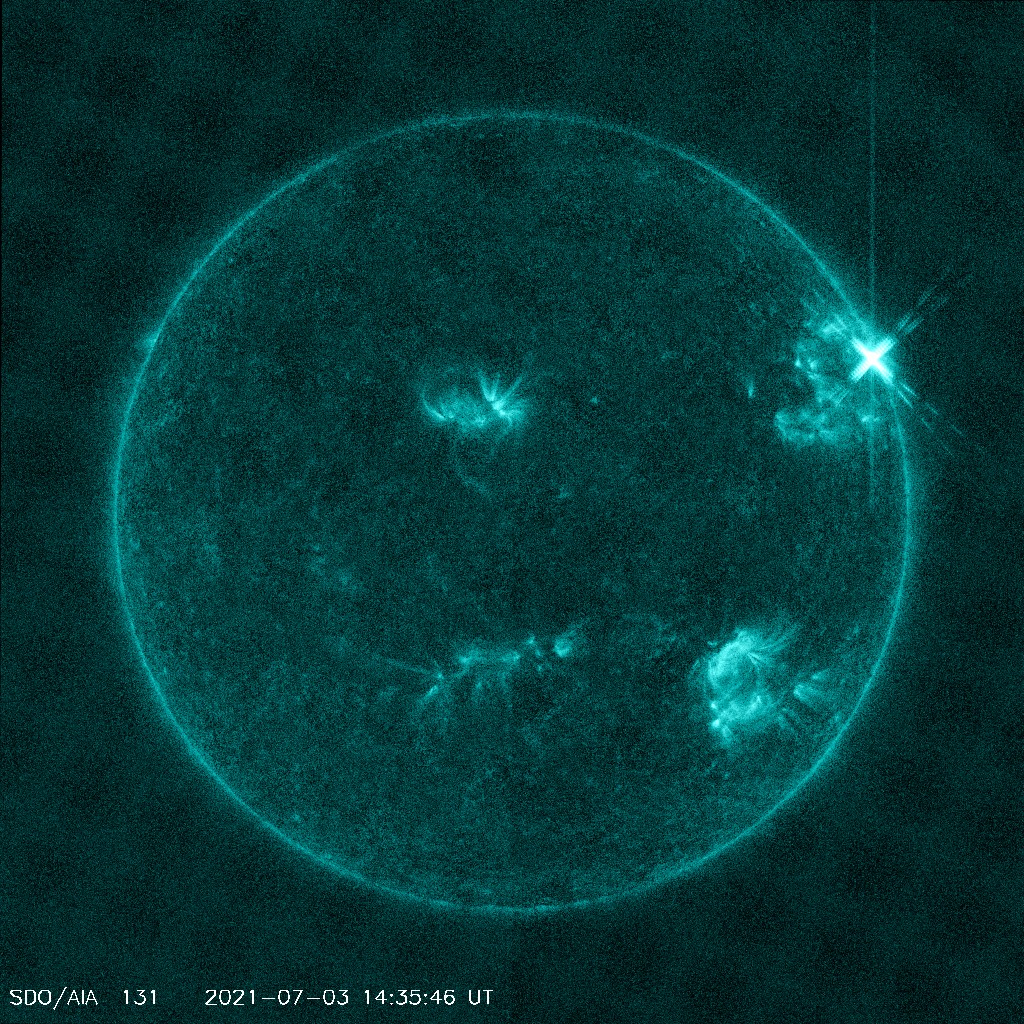
The July 3rd explosion registered X1.5 on the Richter Scale of Solar Flares
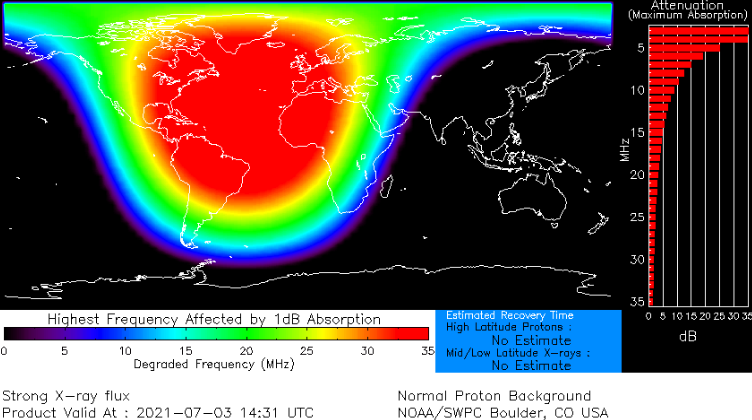
A pulse of X-rays ionized the top of Earth's atmosphere, causing a shortwave radio blackout over the Atlantic Ocean: blackout map. Mariners, aviators, and amateur radio operators may have noticed unusual propagation effects below 30 MHz just after 1429 UT.
X-flares are the strongest kind of solar flare. They are typically responsible for the deepest radio blackouts and the most intense geomagnetic storms. This is the first X-flare of young Solar Cycle 25. More are in the offing. During the previous solar cycle (Solar Cycle 24) the sun produced 49 of them. Forecasters believe that Solar Cycle 25 should be at least that active. We can therefore expect dozens more X-flares as the sun approaches Solar Maximum in the year ~2025. Solar flare alerts: SMS Text.
SOLAR FLARE CAUSES RARE 'MAGNETIC CROCHET': The X-flare of July 3rd did something rare. "It disturbed all of my instruments," reports Rob Stammes, who operates a space weather observatory in Lofoten, Norway. The flare produced a radio burst, an ionospheric disturbance, a surge of electrical currents in the ground, and a deflection of the observatory's local magnetic field. All of these are shown in the strip chart recording, below.
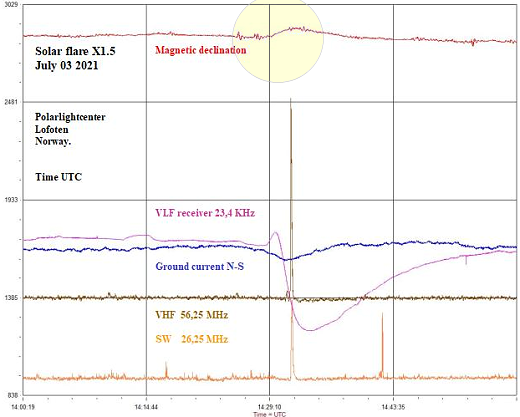
"This is a first in many years," says Stammes. "The magnetic disturbance (circled in yellow) is especially rare."
The phenomenon is called a 'magnetic crochet.' Radiation from the flare ionized the top of Earth's atmosphere and caused currents to flow 60 km to 100 km above Earth's surface. These currents, in turn, altered Earth's polar magnetic field. Unlike geomagnetic disturbances that arrive with CMEs days after a flare, a magnetic crochet occurs while the flare is in progress. They tend to occur during fast impulsive flares like this one.
Realtime Space Weather Photo Gallery
Free: Spaceweather.com Newsletter
WHERE NO MUG HAS GONE BEFORE: There's nothing like morning coffee in a cup from space. On April 23, 2021, this rare ceramic Capt. Kirk mug flew to the stratosphere onboard an Earth to Sky Calculus cosmic ray research balloon. At the apex of the flight, it floated 97,438 feet above the Sierra Nevada mountains of central California:
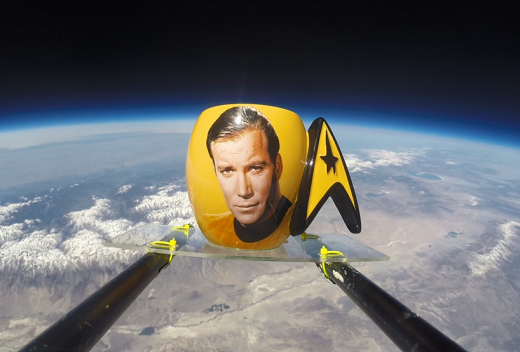
You can have it for $170.10. That's the serial number of the Enterprise divided by 10. The students are selling Star Trek mugs to support their cosmic ray ballooning program. Each one holds 16 oz. of steaming hot Raktajino (Klingon coffee) and comes with a greeting card showing the collector's item in flight.
Far Out Gifts: Earth to Sky Store
All sales support hands-on STEM education
Realtime Noctilucent Cloud Photo Gallery
Free: Spaceweather.com Newsletter
Realtime Aurora Photo Gallery
Free: Spaceweather.com Newsletter