FARSIDE SOLAR ACTIVITY: On July 3rd, sunspot AR2838 unleashed the first X-flare of Solar Cycle 25. Hours later, the sunspot disappeared--but it hasn't stopped flaring. Two CMEs just flew away from the farside of the sun where AR2838 is now located. If it holds together long enough, the sunspot will return to the Earthside in less than 2 weeks. Solar flare alerts: SMS Text.
ZODIACAL LIGHT COMES FROM MARS: Dust storms on Mars are bigger than we thought; they even spill into space. According to a recent paper in JGR Planets, Mars appears to be leaking dust, filling a huge volume of the inner solar system with gritty debris. You can see it with your naked eye. The bright triangle in this image from the Haleakalā Observatory in Hawaii is marsdust:
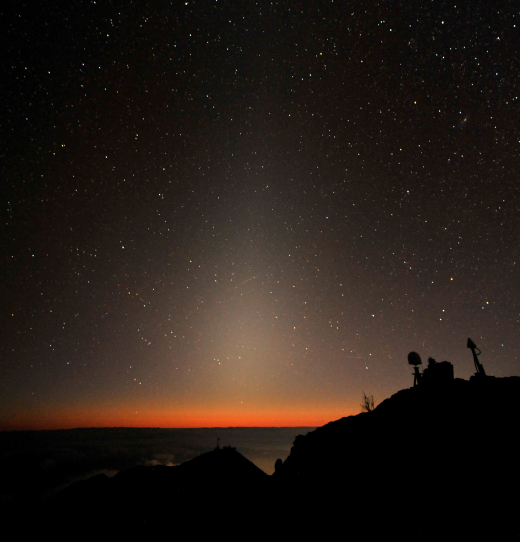
"A friend described it as blazing," says Rob Ratkowski, who took the picture on Feb. 10th. "It was bright and very obvious."
It's called Zodiacal Light, and astronomers have long wondered what causes it. The usually faint triangle is sunlight scattered by dust in the plane of our solar system. The dust, it turns out, comes from Mars.
NASA's Juno spacecraft flew through the dust cloud en route to Jupiter between 2011 and 2016. Dust grains smashed into Juno at about 10,000 mph, chipping off submillimeter pieces of spacecraft. Juno's oversized solar arrays turned out to be excellent dust detectors, registering as many as 200 hits per day.
Ironically, the sandblasting allowed researchers to map the cloud for the first time. One theory of Zodiacal Light held that asteroids were responsible. Yet, as Juno flew through the asteroid belt toward Jupiter, impact rates sharply dropped, sometimes to zero. Asteroids were not the answer. Instead, they realized, the dust must be coming from Mars. Orbital elements of the dust grains essentially match that of the Red Planet.
Mars is the dustiest place in the Solar System, with dust storms that envelop the entire planet for months. But how does this dust escape? During storms, dust is sometimes launched to very high altitudes in the Martian atmosphere; researchers call it 'rocket dust'. However, leaving Mars requires overcoming escape velocity (~5 km/s), and even rocket dust has trouble doing that. Dust grains would have an easier time launching from Phobos and Deimos; however, those small moons don't produce enough dust to explain the Zodiacal Light.
So, there's still a mystery here. Mars has the dust, but researchers haven't yet figured out how Mars delivers it. Lead author John Leif Jørgensen (Technical University of Denmark) and colleagues hope other scientists will help them solve this final piece of the puzzle.
Realtime Space Weather Photo Gallery
Free: Spaceweather.com Newsletter
WHERE NO MUG HAS GONE BEFORE: There's nothing like morning coffee in a cup from space. On April 23, 2021, this rare ceramic Capt. Kirk mug flew to the stratosphere onboard an Earth to Sky Calculus cosmic ray research balloon. At the apex of the flight, it floated 97,438 feet above the Sierra Nevada mountains of central California:
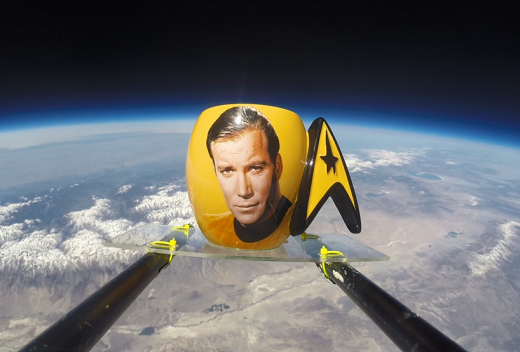
You can have it for $170.10. That's the serial number of the Enterprise divided by 10. The students are selling Star Trek mugs to support their cosmic ray ballooning program. Each one holds 16 oz. of steaming hot Raktajino (Klingon coffee) and comes with a greeting card showing the collector's item in flight.
Far Out Gifts: Earth to Sky Store
All sales support hands-on STEM education
Realtime Noctilucent Cloud Photo Gallery
Free: Spaceweather.com Newsletter
Realtime Aurora Photo Gallery
Free: Spaceweather.com Newsletter