CO-ROTATING INTERACTION REGION: NOAA forecasters say there is a chance of geomagnetic unrest on July 9th when a co-rotating interaction region (CIR) is expected to hit Earth's magnetic field. CIRs are transition zones between slow- and fast-moving solar wind. Solar wind plasma piles up in these regions, producing CME-like density gradients that can spark auroras. Aurora alerts: SMS Text.
A BIG GLOWING CLOUD OF MARSDUST: Dust storms on Mars are bigger than we thought; they even spill into space. According to a recent paper in JGR Planets, Mars appears to be leaking dust, filling a huge volume of the inner solar system with gritty debris. You can see it with your naked eye. The bright triangle in this image from the Haleakalā Observatory in Hawaii is marsdust:
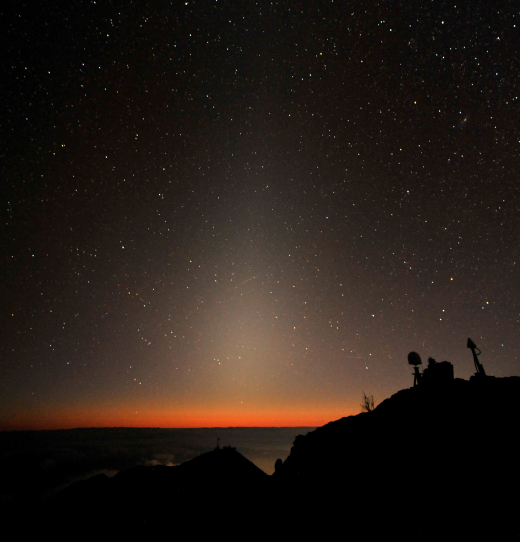
"A friend described it as blazing," says Rob Ratkowski, who took the picture on Feb. 10th. "It was bright and very obvious."
It's called Zodiacal Light, and astronomers have long wondered what causes it. The usually faint triangle is sunlight scattered by dust in the plane of our solar system. The dust, it turns out, comes from Mars.
NASA's Juno spacecraft flew through the dust cloud en route to Jupiter between 2011 and 2016. Dust grains smashed into Juno at about 10,000 mph, chipping off submillimeter pieces of spacecraft. Juno's oversized solar arrays turned out to be excellent dust detectors, registering as many as 200 hits per day.
Ironically, the sandblasting allowed researchers to map the cloud for the first time. One theory of Zodiacal Light held that asteroids were responsible. Yet, as Juno flew through the asteroid belt toward Jupiter, impact rates sharply dropped, sometimes to zero. Asteroids were not the answer. Instead, they realized, the dust must be coming from Mars. Orbital elements of the dust grains essentially match that of the Red Planet.
Mars is the dustiest place in the Solar System, with dust storms that envelop the entire planet for months. But how does this dust escape? During storms, dust is sometimes launched to very high altitudes in the Martian atmosphere; researchers call it 'rocket dust'. However, leaving Mars requires overcoming escape velocity (~5 km/s), and even rocket dust has trouble doing that. Dust grains would have an easier time launching from Phobos and Deimos; however, those small moons don't produce enough dust to explain the Zodiacal Light.
So, there's still a mystery here. Mars has the dust, but researchers haven't yet figured out how Mars delivers it. Lead author John Leif Jørgensen (Technical University of Denmark) and colleagues hope other scientists will help them solve this final piece of the puzzle.
Realtime Space Weather Photo Gallery
Free: Spaceweather.com Newsletter
LIMITED EDITION MIRROR KIRK: In 1967, a transporter accident sent James T. Kirk into a parallel universe, swapping the captain of the Enterprise with his evil twin. We just found him ... in the stratosphere. Here is "Mirror Kirk" floating 95,254 feet high onboard an Earth to Sky Calculus cosmic ray research balloon:
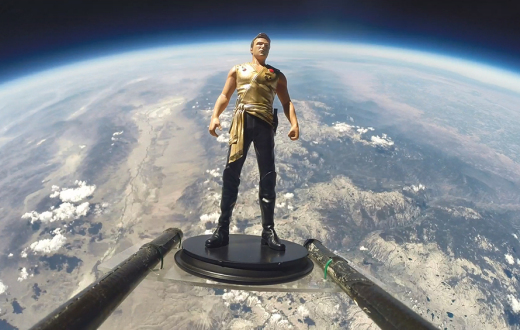
You can have him for $170.10 (the serial number of the Enterprise divided by 10). Inspired by the classic "Mirror, Mirror" episode of Star Trek first broadcast on Oct. 6, 1967, this 8" statue is made of high-quality polystone resin and expertly painted. It comes with a greeting card showing Kirk in flight and a certificate of authenticity.

To celebrate the 50th anniversary of Star Trek, only 1000 limited edition Mirror Kirk statues were manufactured and sold at sci-fi conventions in 2016. We've collected a few of these rarities to fly to the stratosphere. Get yours now.
Far Out Gifts: Earth to Sky Store
All sales support hands-on STEM education
Realtime Noctilucent Cloud Photo Gallery
Free: Spaceweather.com Newsletter
Realtime Aurora Photo Gallery
Free: Spaceweather.com Newsletter