THE SOLAR WIND HAS ARRIVED: Earth is entering a dense and strongly magnetized stream of solar wind. We've been waiting for this stream to arrive for 3 days. Better late than never? South-pointing fields in the stream are opening a crack in Earth's magnetosphere, setting the stage for possible high-latitude auroras on July 14-15. Aurora alerts: SMS Text.
COSMIC RAY UPDATE: New data from cosmic ray balloons show that Solar Cycle 25 is having an effect on Earth's atmosphere. Radiation levels in the air above our heads is decreasing as the new solar cycle gains strength. Spaceweather.com and the students of Earth to Sky Calculus have been monitoring the situation for more than 6 years, and here are the latest data:

The plot shows cosmic rays in the stratosphere, measured by radiation sensors we launch almost once a week from the Sierra Nevada mountains in California. Recent flights confirm that radiation levels are decreasing for the first time since 2015.
Cosmic rays come from deep space--mostly from supernova explosions. To reach the inner solar system, they have to fight their way through the sun's protective magnetic field. Once cosmic rays reach Earth, they crash into the top of our atmosphere, creating a spray of secondary radiation, which we measure using high-altitude balloons.
Atmospheric radiation shot up in 2015-2019 because then-Solar Cycle 24 was decaying. The sun's magnetic field became weak and uncomplicated; cosmic rays from deep space found it easier to reach us. Our highest measurements in late 2019 correspond with NOAA's official date of Solar Minimum. Now the sun is waking up again. New Solar Cycle 25 is strengthening the sun's magnetic shield, and atmospheric radiation is dropping.

Above: In search of data, Earth to Sky student Joey Harvey hikes through the Saline Range in Death Valley National Park.
Every time we launch a balloon we have to recover the payload to get the results--often from rugged mountain peaks and remote deserts. There's a little blood, sweat and/or tears in each data point. For many of us, this is the best part of the program. Our adventures have resulted in an uninterrupted record of in situ atmospheric radiation measurements now straddling two solar cycles.
More information and some technical details may be found here.
Realtime Space Weather Photo Gallery
Free: Spaceweather.com Newsletter
RARE SCOTTY MUG (COLLECTOR'S ITEM): There's nothing like morning coffee in a cup from space. On June 3, 2021, this rare ceramic Montgomery Scott mug flew to the stratosphere onboard an Earth to Sky Calculus cosmic ray research balloon. At the apex of the flight, it floated 101,243 feet above the Sierra Nevada mountains of central California:
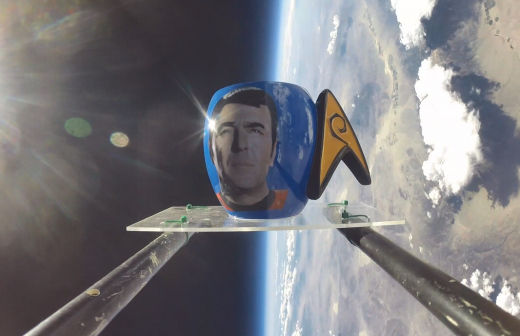
You can have it for $170.10. That's the serial number of the Enterprise divided by 10. The students are selling Star Trek mugs to support their cosmic ray ballooning program. Each one holds 16 oz. of steaming hot Raktajino (Klingon coffee) and comes with a greeting card showing the collector's item in flight.
Far Out Gifts: Earth to Sky Store
All sales support hands-on STEM education
Realtime Noctilucent Cloud Photo Gallery
Free: Spaceweather.com Newsletter
Realtime Aurora Photo Gallery
Free: Spaceweather.com Newsletter