CHANCE OF MINOR STORMS TODAY: Later today, a CME might sideswipe Earth's magnetic field. NOAA forecasters say the glancing blow could spark minor G1-class geomagnetic storms. High-latitude sky watchers should be alert for auroras mixed with bright moonlight on July 23-24. Aurora alerts: SMS Text.

ALPHA CAPRICORNID METEOR SHOWER: Today, meteor storms are rare, but a few hundred years from now they could be commonplace. Consider this fireball, recorded by Thomas Ashcraft on July 21st, a preview of things to come:
"This is a probable alpha Capricornid," says Ashcraft, who operates an automated meteor camera in rural New Mexico. "It was magnitude -11, about as bright as a waxing gibbous Moon." Next: Turn up the volume. The soundtrack is a 54.309 MHz digital TV signal reflected from the fireball's ionized trail.
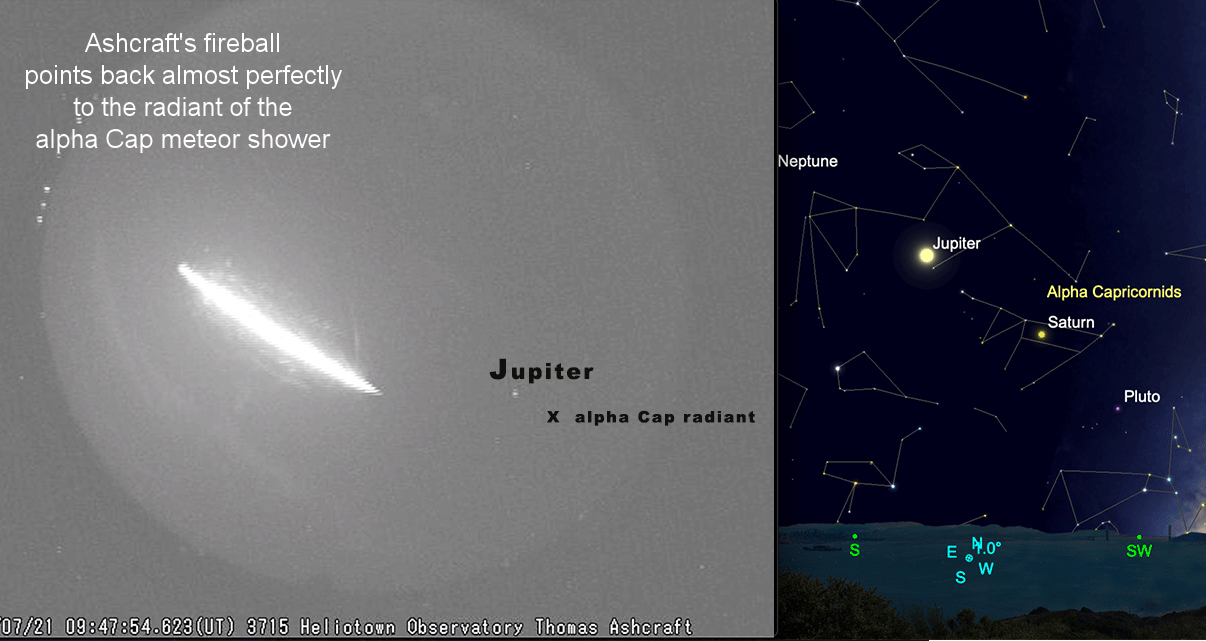
Alpha Capricornid meteors are debris from Comet 169P/NEAT. They appear every year in late July, peaking around the July-August boundary with 5 to 9 meteors per hour. Many "alpha Caps" are slow, bright fireballs.
This is a minor shower today, but in the not-too-distant future, it could turn into a regular meteor storm. Researchers Peter Jenniskens (SETI Institute) and Jeremie Vaubaillon (Paris Observatory) have studied the alpha Capricornid debris stream. They believe it resulted from a major fragmentation event ~5000 years ago when as much as half of the original comet disintegrated. Since then, the debris has been drifting toward Earth.
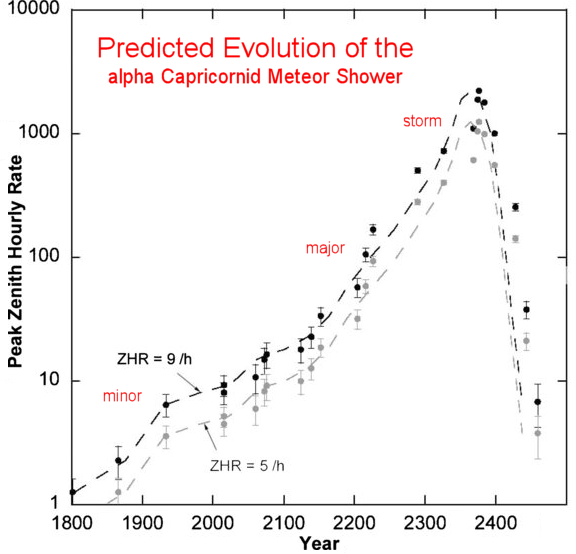
"In the next 300 years, the alpha Capricornids are likely to grow into a major annual shower," they write in an article in the Astronomical Journal. "Rates will increase dramatically in the 23rd and 24th centuries to a peak of ZHR = 2200/hr on an annual basis, half the visible shower peak rate during the 1999 Leonid storm."
If they're right, every alpha Capricornid we see today heralds a storm to come. Watch for them in the nights ahead slowly spilling out of the constellation Capricornus. The best time to look is during the hours around midnight when the shower's radiant may be found in the southern sky beautifully bracketed by Jupiter and Saturn: sky map.
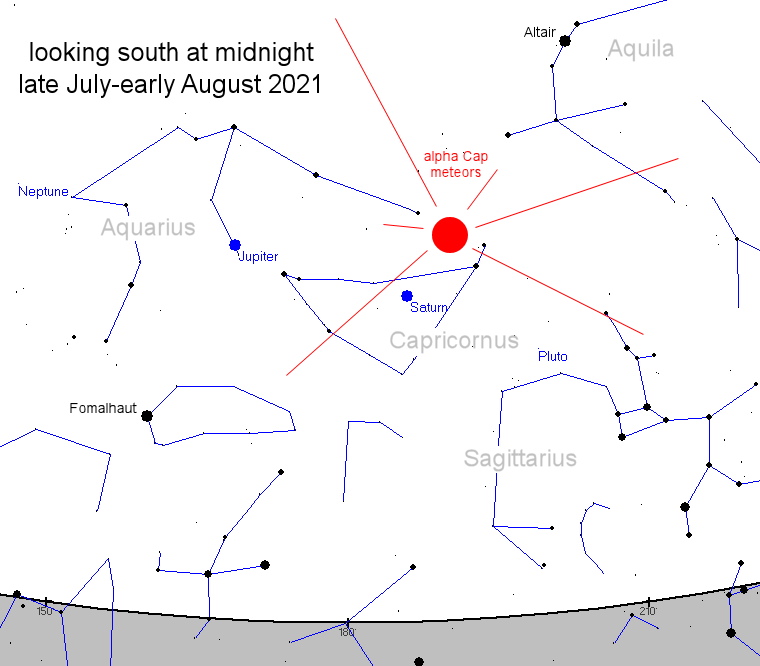
Bonus: Another meteor shower, the southern Delta Aquarids (SDAs), also peaks in late July, sending streaks of light from the same general part of the sky. SDAs zip along ~twice as fast as alpha Caps and tend to be fainter. Nevertheless, they will add to your midnight meteor count. Enjoy!
Realtime Space Weather Photo Gallery
Free: Spaceweather.com Newsletter
A BEAGLE AT THE EDGE OF SPACE: Snoopy has been to the stratosphere. On July 16, 2021, the students of Earth to Sky Calculus launched everyone's favorite Beagle onboard a cosmic ray research balloon. Here is astronaut Snoopy floating more than 105,315 feet above Earth's surface:
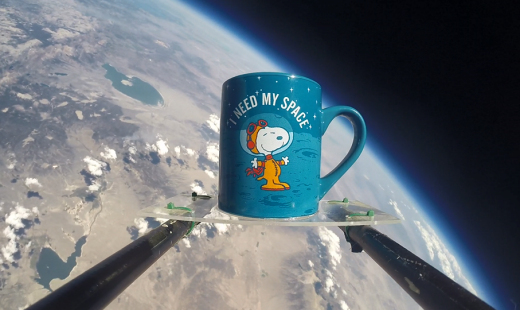
You can have it for $99.95. It's Peanuts for a cup from space! The students are selling Snoopy cups to support their cosmic ray monitoring program. Each one comes with a greeting card showing the cup in flight and telling the story of its trip to the stratosphere and back again.
Far Out Gifts: Earth to Sky Store
All sales support hands-on STEM education
Realtime Noctilucent Cloud Photo Gallery
Free: Spaceweather.com Newsletter
Realtime Aurora Photo Gallery
Free: Spaceweather.com Newsletter