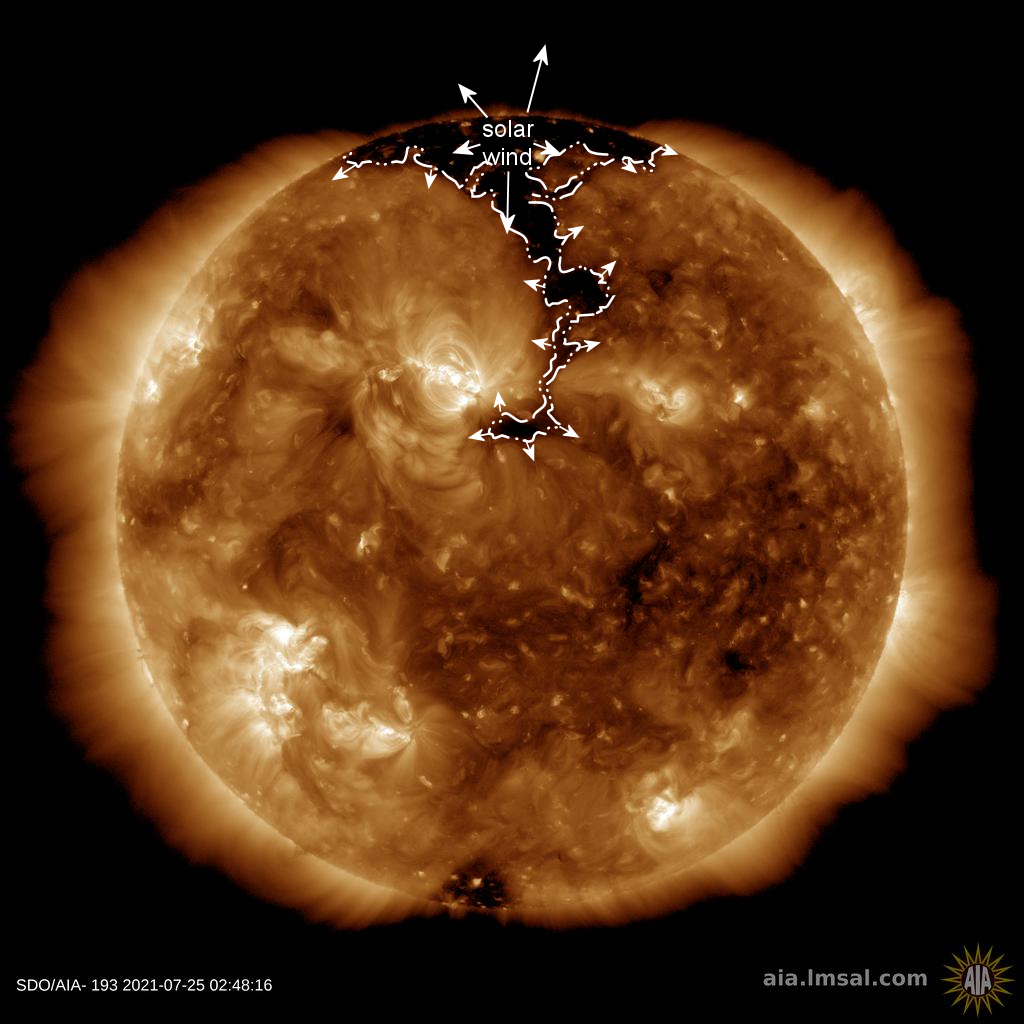
NO STORMS, JUST A LITTLE UNREST: Minor geomagnetic unrest is expected tomorrow, July 28th, when a narrow stream of solar wind hits Earth's magnetic field. The gaseous material is flowing from a sinuous hole in the sun's atmosphere. Faint auroras might be visible at high latitudes *if* the nearly full Moon is below the horizon. Aurora alerts: SMS Text.
MERCURY AND A CME: Looking for Mercury? Don't. It's blindingly close to the sun. Today the Solar and Heliospheric Observatory (SOHO) photographed Mercury only 6 degrees from the solar disk. Play the movie and watch a CME target the first planet:

No, the CME didn't actually hit Mercury. Mercury is at the farside of its orbit, preparing to pass behind the sun (astronomers call this "superior solar conjunction"). The narrow CME passed between us and Mercury, creating only the appearance of impact.
At closest approach on Aug. 1st, Mercury will be just 1.7 degrees from the sun. The day before, Mercury will skim the outskirts of the Beehive star cluster. Human eyes cannot see these events, but coronagraphs can. Join SOHO for a ringside seat.
SOUTHERN DELTA AQUARID METEOR SHOWER: Last night, NASA's network of all-sky meteor cameras detected five southern delta Aquarid fireballs over the USA. This one, photographed from Mt. Lemmon in Arizona, was easily visible in full moonlight:
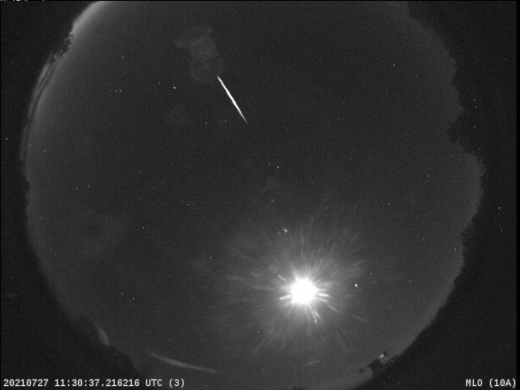
Five fireballs in one night is a good sign. Even more may be expected when the shower peaks on July 29-30. The southern delta Aquarid meteor shower happens every year in late July when Earth passes through a stream of debris from sungrazing Comet 96P/Machholz. It is known for its fast bright fireballs, best seen during the hours around local midnight when the constellation Aquarius is above the southern horizon: sky map.
Realtime Space Weather Photo Gallery
Free: Spaceweather.com Newsletter
MIDNIGHT BLACK PEARL: Space is black--and so is this pearl. On July 22, 2021, the students of Earth to Sky Calculus launched the Midnight Pearl to the stratosphere onboard a cosmic ray research balloon. Here it is floating 96,785 feet above the Sierra Nevada mountains of central California:
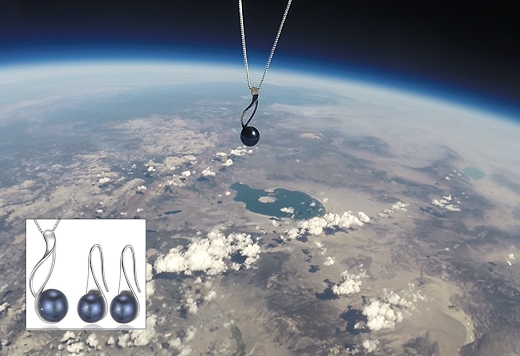
You can have it for $179.95--earrings included! Matching pearl earrings flew inside the payload among the cosmic ray sensors.
The students are selling space pearls to support their cosmic ray ballooning program. Wrapped in a sterling silver infinity twist, each Midnight Pearl comes with a greeting card showing the pendant in flight and telling the story of its trip to the edge of space.
Far Out Gifts: Earth to Sky Store
All sales support hands-on STEM education
Realtime Noctilucent Cloud Photo Gallery
Free: Spaceweather.com Newsletter
Realtime Aurora Photo Gallery
Free: Spaceweather.com Newsletter