ALPHA CAPRICORNID METEOR SHOWER: Last night NASA's network of all-sky meteor cameras detected 4 alpha Capricornid fireballs over the USA. This is a sign that the shower will peak, as expected, on the nights around the July-August boundary. Alpha Capricornids are notable for their leisurely pace, bright trails, and potential future storminess. Full story.
RARE BLUE AURORAS OVER CANADA: A solar wind stream hit Earth during the early hours of July 28th. First contact rattled Earth's magnetic field and sparked rare blue auroras over Canada. Joel Weatherly sends this picture of the colorful spray just outside Edmonton:
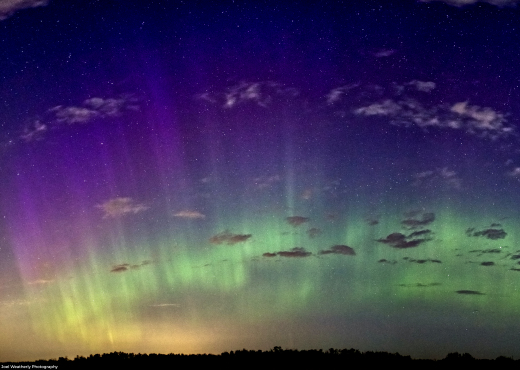
"Despite light pollution, clouds, and bright moonlight, the auroras put on a spectacular show," says Weatherly. "Note the blue on top!"
Auroras are almost always green, and sometimes red or purple. Blue, however, is rare. Weatherly can thank the Moon for its appearance.
Blue is a sign of bright moonlight hitting the top of the auroras. The process is called "resonant scattering." High up in the aurora zone, ionized nitrogen molecules (N2+) naturally produce blue light, just a little; the geomagnetic glow is usually too faint to see. But when these ions get hit by moonlight, they capture and re-emit blue photons from the Moon. Voilà!--extra blue.
Take some nitrogen, add solar wind, mix with moonlight. That's the recipe for aurora blues. Aurora alerts: SMS Text.
Realtime Aurora Photo Gallery
Free: Spaceweather.com Newsletter
MERCURY AND A CME: Looking for Mercury? Don't. It's blindingly close to the sun. Yesterday, the Solar and Heliospheric Observatory (SOHO) photographed Mercury only 6 degrees from the solar disk. Play the movie and watch a CME target the first planet:

No, the CME didn't actually hit Mercury. Mercury is at the farside of its orbit, preparing to pass behind the sun (astronomers call this "superior solar conjunction"). The narrow CME passed between us and Mercury, creating only the appearance of impact.
At closest approach on Aug. 1st, Mercury will be just 1.7 degrees from the sun. The day before, Mercury will skim the outskirts of the Beehive star cluster. Human eyes cannot see these events, but coronagraphs can. Join SOHO for a ringside seat.
Realtime Space Weather Photo Gallery
Free: Spaceweather.com Newsletter
MIDNIGHT BLACK PEARL: Space is black--and so is this pearl. On July 22, 2021, the students of Earth to Sky Calculus launched the Midnight Pearl to the stratosphere onboard a cosmic ray research balloon. Here it is floating 96,785 feet above the Sierra Nevada mountains of central California:
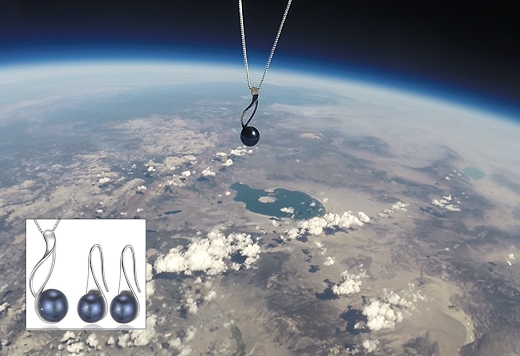
You can have it for $179.95--earrings included! Matching pearl earrings flew inside the payload among the cosmic ray sensors.
The students are selling space pearls to support their cosmic ray ballooning program. Wrapped in a sterling silver infinity twist, each Midnight Pearl comes with a greeting card showing the pendant in flight and telling the story of its trip to the edge of space.
Far Out Gifts: Earth to Sky Store
All sales support hands-on STEM education
Realtime Noctilucent Cloud Photo Gallery
Free: Spaceweather.com Newsletter