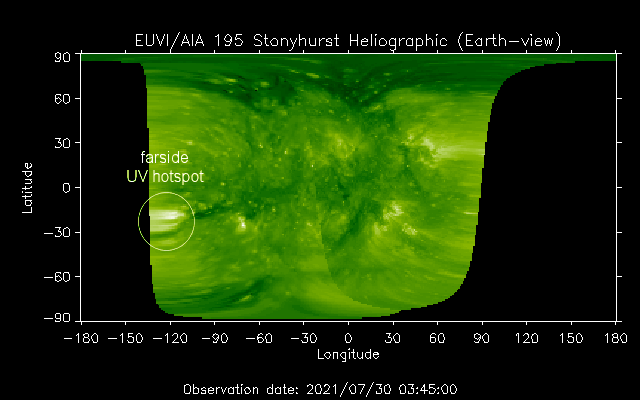
THE SUN IS BLANK: For the second day in a row, the sun is blank--no sunspots. Solar Cycle 25 is sputtering as July comes to an end. It won't last long. A new sunspot appears set to rotate over the sun's eastern limb, according to farside images from NASA's STEREO-A spacecraft. Aurora alerts: SMS Text.
NUCLEAR BOMBS CAN CAUSE GEOMAGNETIC STORMS: They called it "Starfish Prime." On July 9, 1962, the US military exploded a thermonuclear warhead 250 miles above the Pacific Ocean. What happened next surprised everyone.
Witnesses from Hawaii to New Zealand reported auroras dancing overhead, magnificent midnight "rainbow stripes" that tropical sky watchers had never seen before. Radios fell silent, then suddenly became noisy. Burglar alarms sounded as local streetlights in Honolulu went black.
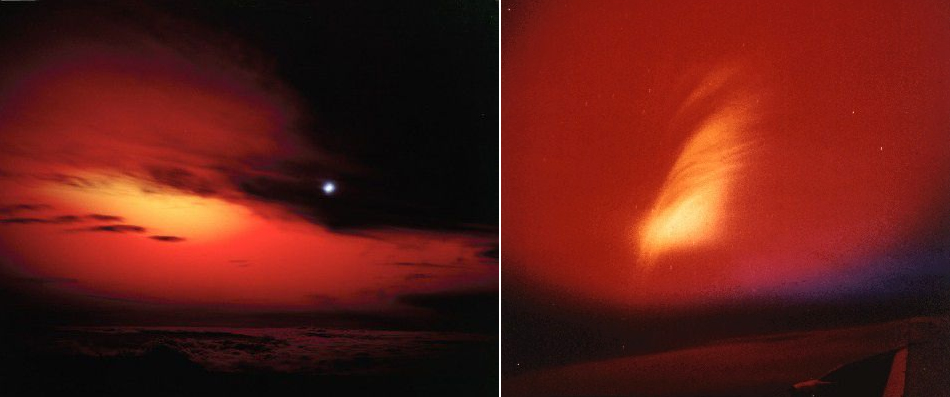
Above: 'Nuclear auroras' over Honolulu (L) and a Pacific surveillance aircraft (R) on July 9, 1962.
Starfish Prime essentially created an artificial solar storm complete with auroras, geomagnetic activity, and blackouts. Much of the chaos that night was caused by the electromagnetic pulse (EMP)--a ferocious burst of radiation that can ionize the atmosphere and pepper the ground below with secondary particles akin to cosmic rays. Government and industry researchers have been studying the Starfish Prime EMP for decades.
A new paper just published in the research journal Earth and Space Science suggests they might be overlooking something.
"Typical EMP simulations found in government and industry reports use over-simplified models of the Earth," says lead author Jeffrey Love of the United States Geological Survey (USGS). "They do not provide accurate estimates of the hazard in complex geological settings."
In their paper, Love et al describe how a high-altitude nuclear blast jerks Earth's magnetic field. First, the EMP ionizes a layer of air underneath the bomb. This layer presses downward, pinning Earth's magnetic field lines in their pre-blast locations. Next, as the ionization subsides, the magnetic field springs back. It's a sort of heaving, lurching geomagnetic storm.
Geomagnetic storms are famous for causing power blackouts. Usually the sun is to blame, but EMPs can do it, too. Lurching magnetic fields cause electrical currents to flow through the ground. Literally, rocks beneath your feet begin to tingle with electricity. These currents, in turn, make their way into grounded electric-power grids, potentially damaging transformers and blacking out power supplies.
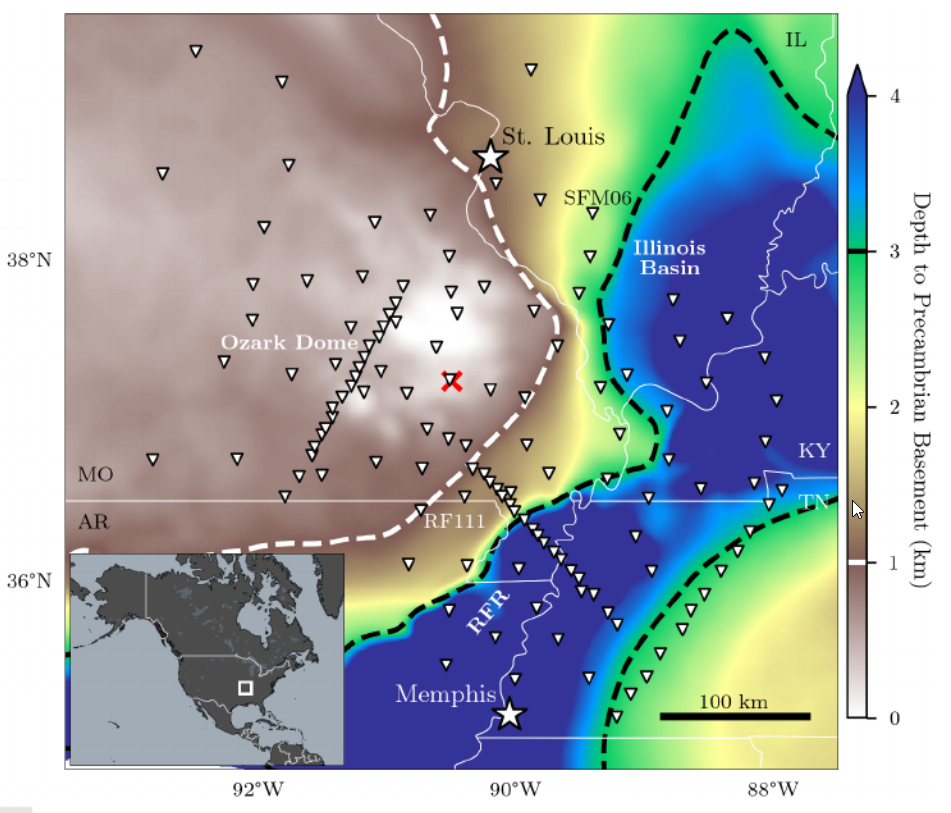
Above: A geological map of the eastern midcontinental USA. Triangles mark the locations of recent magnetotelluric measurements.
The crucial point of Love's paper: Earth is not the same everywhere. In recent years, researchers have been sounding Earth's crust to determine the 3D electrical properties of our planet. These magnetotelluric surveys reveal huge variations in conductivity from place to place, depending on the mix of underlying rock. Love has been one of the pioneers in applying this type of Earth data to space weather, predicting how global geomagnetic storms might affect local power lines. Now he and his colleagues are doing the same with EMPs.
The team focused their attention on the eastern midcontinental USA, a region bracketed by St. Louis, Missouri, and Memphis, Tennessee. Between 2016 and 2019, the USGS conducted a magnetotelluric survey of the area, so the data are fresh. The terrain is remarkable for its mix of rock types. Underneath it all is a layer of Precambrian basement rock, which is electrically resistive; this is overlain by differing depths of younger, electrically conductive sedimentary rock. Notable features include the Ozark Dome, where the sedimentary layer is thin, and the Reelfoot Rift, which is deeply filled with sedimentary rock.
Love's team simulated a nuclear explosion about 300 km above this region. They found a huge range of geoelectric responses. Some power lines in the simulation had excess voltages near 2000 V, while others were closer to 0 V. Both were sharp departures from previous studies.
The authors note that the Eastern Midcontinent is just a small fraction of the USA. Similar studies need to be done elsewhere. Researchers still have a lot of ground to cover when it comes to nuclear geomagnetic storms.
A sharable link to this story may be found here.
Realtime Space Weather Photo Gallery
Free: Spaceweather.com Newsletter
THE MIDNIGHT BLACK PEARL: Space is black--and so is this pearl. On July 22, 2021, the students of Earth to Sky Calculus launched the Midnight Pearl to the stratosphere onboard a cosmic ray research balloon. Here it is floating 96,785 feet above the Sierra Nevada mountains of central California:
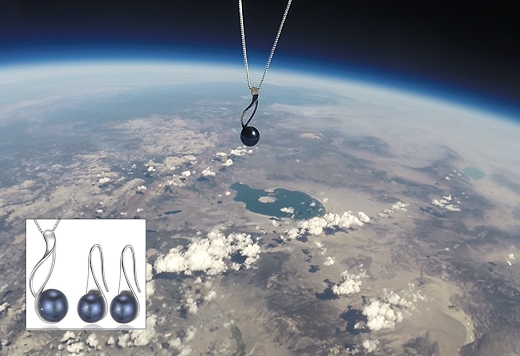
You can have it for $179.95--earrings included! Matching pearl earrings flew inside the payload among the cosmic ray sensors.
The students are selling space pearls to support their cosmic ray ballooning program. Wrapped in a sterling silver infinity twist, each Midnight Pearl comes with a greeting card showing the pendant in flight and telling the story of its trip to the edge of space.
Far Out Gifts: Earth to Sky Store
All sales support hands-on STEM education
Realtime Noctilucent Cloud Photo Gallery
Free: Spaceweather.com Newsletter
Realtime Aurora Photo Gallery
Free: Spaceweather.com Newsletter