CO-ROTATING INTERACTION REGION: A co-rotating interaction region (CIR) might hit Earth's magnetic field during the late hours of Aug. 6th. CIRs are transition zones between solar wind streams, fast vs. slow. They contain density gradients and compressed magnetic fields that can do a good job sparking high-latitude auroras. Aurora alerts: SMS Text.
THE PERSEID METEOR SHOWER IS UNDERWAY: Earth is entering a stream of debris from Comet 109P/Swift-Tuttle, source of the annual Perseid meteor shower. Although it won't peak until mid-next week, the shower is already active. Last night alone NASA cameras detected more than a dozen Perseid fireballs over the USA, and Petr Horálek photographed this beauty burning up over the Czech Republic:
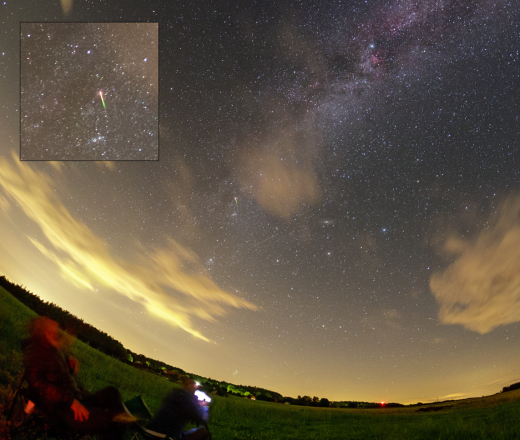
"I captured our first Perseid of the year over Proseč on Aug. 3rd," reports Horálek. "Its rainbow hues were visible despite suburban light pollution."
109P/Swift-Tuttle is a huge comet with a broad debris stream. It takes Earth weeks to cross it. The shower will probably be most intense on Aug. 11-12 (Wednesday night through Thursday morning) when our planet is closest to the stream's dusty core. Adjacent nights could be almost equally good.
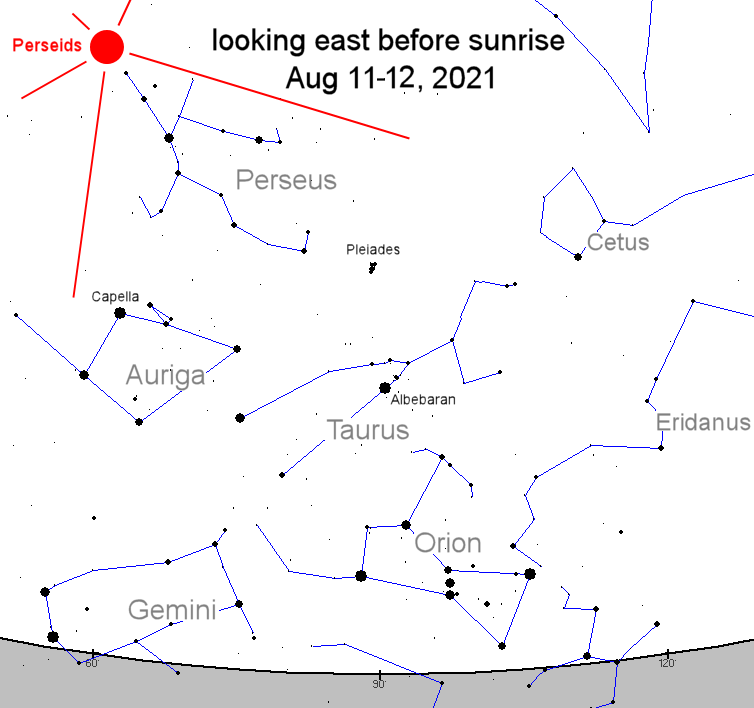
When should you look? Perseids may be seen any time after ~10 pm. Rates increase sharply after local midnight when the constellation Perseus is high in the sky (sky map). Observers in dark-sky sites can expect to count dozens of meteors during the moonless hours before sunrise.
Pro tip: Get away from city lights! Light pollution kills meteors, as shown this composite image of last year's Perseid shower:
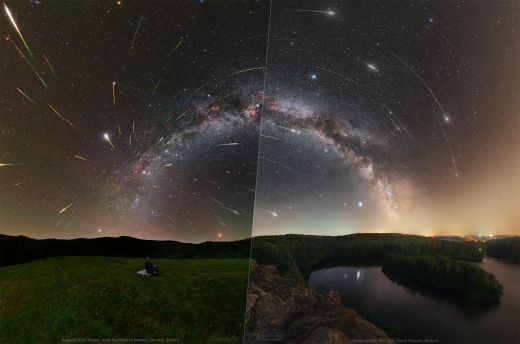
Tomáš Slovinský and Petr Horálek took the pictures last August from widely spaced locations in eastern Europe. "The left photograph comes from the darkest area of Slovakia – Dark Sky Park Poloniny with a Bortle 2 sky," explains Horálek. "The right image is from Seč lake in the Czech Republic, where you can find a less-dark Bortle 4 sky. The difference between these two classes of sky is about a thousand naked-eye stars and innumerable faint meteors."
"To enjoy the 2021 Perseids," he urges, "find the darkest skies possible!"
Realtime Perseid Photo Gallery
Free: Spaceweather.com Newsletter
THE MIDNIGHT SPACE PEARL: Space is black; so is this pearl. On July 22, 2021, the students of Earth to Sky Calculus launched the Midnight Pearl to the stratosphere onboard a cosmic ray research balloon. Here it is floating 96,785 feet above the Sierra Nevada mountains of central California:
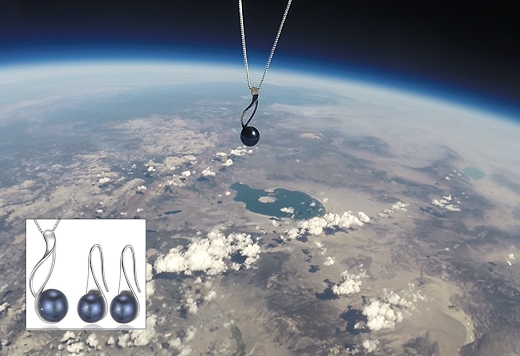
You can have it for $179.95--earrings included! Matching pearl earrings flew inside the payload among the cosmic ray sensors.
The students are selling space pearls to support their cosmic ray ballooning program. Wrapped in a sterling silver infinity twist, each Midnight Pearl comes with a greeting card showing the pendant in flight and telling the story of its trip to the edge of space.
Far Out Gifts: Earth to Sky Store
All sales support hands-on STEM education
Realtime Noctilucent Cloud Photo Gallery
Free: Spaceweather.com Newsletter
Realtime Aurora Photo Gallery
Free: Spaceweather.com Newsletter
Realtime Space Weather Photo Gallery
Free: Spaceweather.com Newsletter