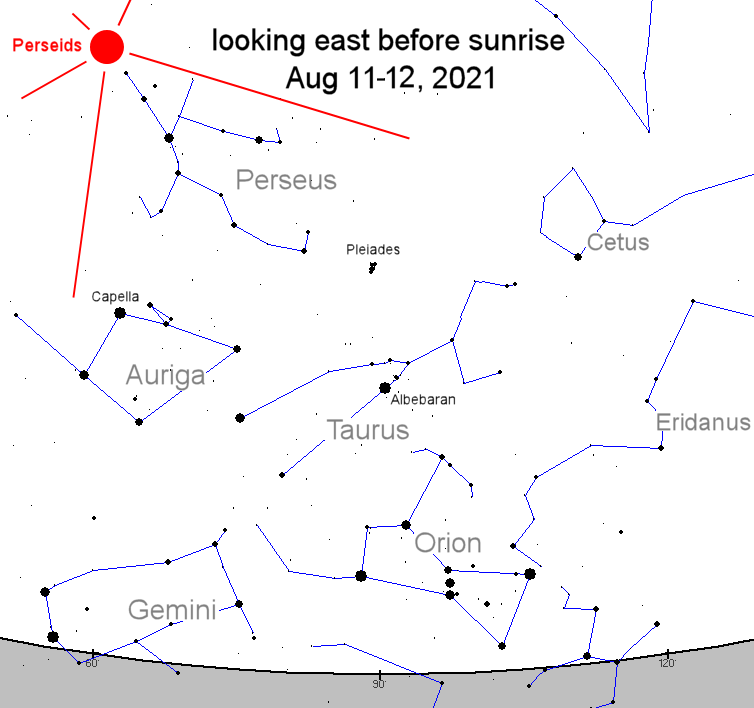
PERSEID METEOR ALERT: Earth is enteriing a stream of debris from Comet 109/P Swift-Tuttle, source of the annual Perseid meteor shower. Forecasters expect the shower to peak on the night of Aug. 11-12, with Aug. 12-13 a possible close second. On both dates, meteor rates could exeed 100/hr during the dark hours before sunrise. Sky map.
SOLAR WIND SPARKS AURORAS: As Aug. 6th turned into 7th, Earth found itself surrounded by a co-rotating interaction region (CIR). This is what happened next:
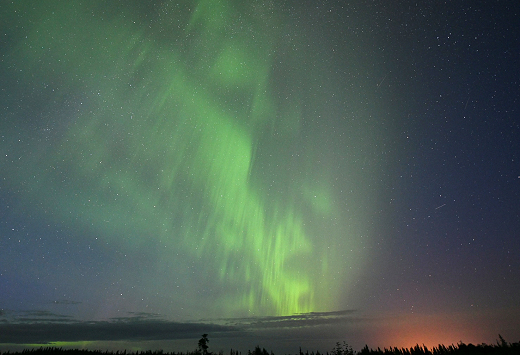
"The show started as soon as darkness fell," reports Catalin Tapardel of Alberta, Canada (Municipal district of Opportunity No. 17). "Just before midnight we were seeing auroras all over the sky--beautiful coronas!"
CIRs are transition zones between fast and slow-moving solar wind streams. They contain density gradients and compressed magnetic fields that often do a good job sparking high-latitude auroras. A solar wind stream following behind the CIR could spark more high-latitude auroras on Aug. 7th. Aurora alerts: SMS Text.
Realtime Aurora Photo Gallery
Free: Spaceweather.com Newsletter
200 DAYS OF SUNSPOTS: Soumyadeep Mukherjeee never misses a day. The indefatigable astronomer in Kolkata, India, has photographed the sun for 200 days in a row--and this is the result:
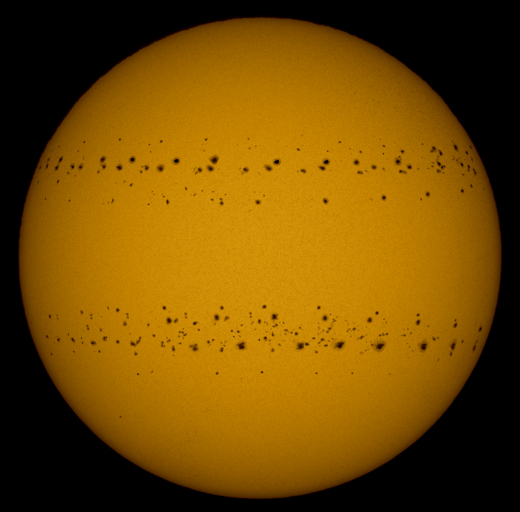
"This image is a blend showing every sunspot that has appeared on the solar disk from Dec. 25, 2020, to July 12, 2021," explains Mukherjeee. "Solar Cycle 25 is starting to produce a lot of sunspots."
His composite shows that sunspot activity is clustered in two narrow bands approximately 25 degrees north and 25 degrees south of the sun's equator. This is typical of young solar cycles. As Solar Cycle 25 matures, the bands will converge toward the equator, and become more densely populated. By the time Solar Maximum arrives in 2024 or 2025, such composites will become very congested, indeed.
Mukherjeee will probably create one. "My solar project is continuing," he says. Only ~1000 days to go....
Realtime Space Weather Photo Gallery
Free: Spaceweather.com Newsletter
THE MIDNIGHT SPACE PEARL: Space is black; so is this pearl. On July 22, 2021, the students of Earth to Sky Calculus launched the Midnight Pearl to the stratosphere onboard a cosmic ray research balloon. Here it is floating 96,785 feet above the Sierra Nevada mountains of central California:
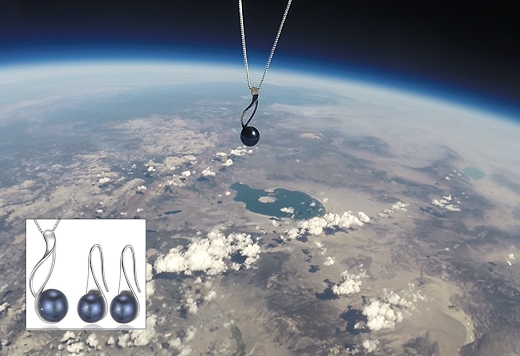
You can have it for $179.95--earrings included! Matching pearl earrings flew inside the payload among the cosmic ray sensors.
The students are selling space pearls to support their cosmic ray ballooning program. Wrapped in a sterling silver infinity twist, each Midnight Pearl comes with a greeting card showing the pendant in flight and telling the story of its trip to the edge of space.
Far Out Gifts: Earth to Sky Store
All sales support hands-on STEM education
Realtime Noctilucent Cloud Photo Gallery
Free: Spaceweather.com Newsletter