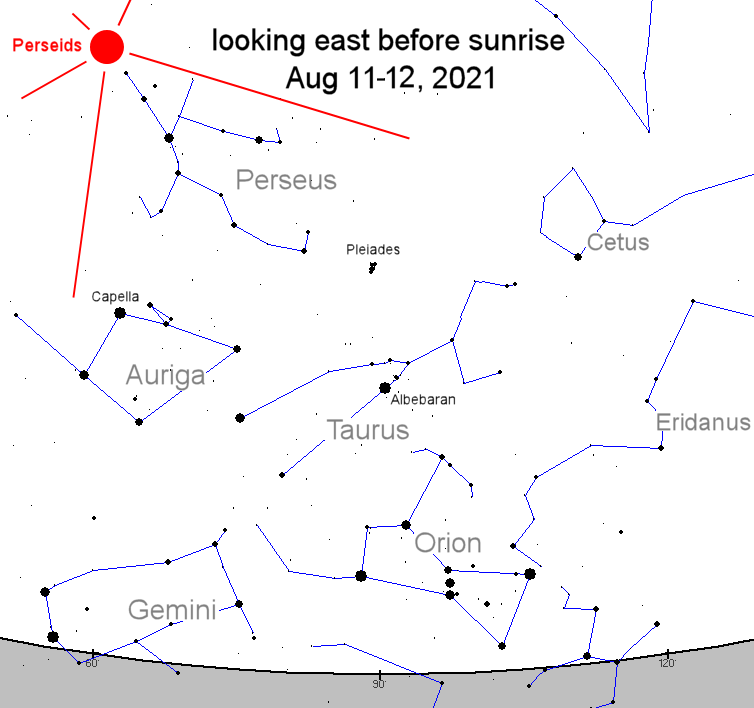
PERSEID METEOR ALERT: Earth is enteriing a stream of debris from Comet 109/P Swift-Tuttle, source of the annual Perseid meteor shower. Forecasters expect the shower to peak on the nights of Aug. 11-12 and Aug. 12-13. Meteor rates could exceed 100 per hour during the darkest hours before sunrise. Sky map.
THE NIGHT SKY IS NOT DARK: Yesterday in Estonia, photographer Märt Varatu pointed his camera at the night sky. The resulting exposure was anything but dark. "Red and green bands of light crossed the sky," says Varatu. "It was a strong display of airglow."

Yes, air glows. You can photograph it on almost any dark and moonless night. Airglow is caused by chemical reactions in the upper atmosphere; the reactions get started during the day when the atmosphere is bathed in strong UV radiation from the sun. At night they subside, but we can see the afterglow, colored green by oxygen atoms 90-100 km high and sometimes red by hydroxyl ions 86-87 km high.
Tonight is a good time to photograph airglow. The Moon is new on Aug. 8th, providing a velvety backdrop for this faint but beautiful phenomenon.
Realtime Airglow Photo Gallery
Free: Spaceweather.com Newsletter
THE BEAUTY OF A SPOTLESS SUN: Just like young people, young solar cycles occasionally require a nap. The sun is taking one now, declining to produce a sunspot for the past 48 hours. In Rafaela, Argentina, Eduardo Schaberger Poupeau decided to photograph the spotless sun. "It was beautiful," he says.

Only a few days ago, Spaceweather.com reported that Solar Cycle 25 was overperforming, so much so that Solar Maximum might arrive a year early in 2024. "But it seems that our star did not know about this," says Poupeau. Indeed!
Naptime may be over soon as a new sunspot shows signs of emerging in the sun's southern hemisphere. Stay tuned.
Realtime Space Weather Photo Gallery
Free: Spaceweather.com Newsletter
LIMITED EDITION MIRROR KIRK: In 1967, a transporter accident sent James T. Kirk into a parallel universe, swapping the captain of the Enterprise with his evil twin. We just found him ... in the stratosphere. Here is "Mirror Kirk" floating 95,254 feet high onboard an Earth to Sky Calculus cosmic ray research balloon:
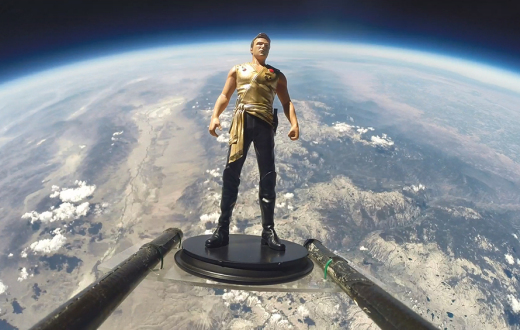
You can have him for $170.10 (the serial number of the Enterprise divided by 10). Inspired by the classic "Mirror, Mirror" episode of Star Trek first broadcast on Oct. 6, 1967, this 8" statue is made of high-quality polystone resin and expertly painted. It comes with a greeting card showing Kirk in flight and a certificate of authenticity.

To celebrate the 50th anniversary of Star Trek, only 1000 limited edition Mirror Kirk statues were manufactured and sold at sci-fi conventions in 2016. We've collected a few of these rarities to fly to the stratosphere. Get yours now.
Far Out Gifts: Earth to Sky Store
All sales support hands-on STEM education
Realtime Noctilucent Cloud Photo Gallery
Free: Spaceweather.com Newsletter
Realtime Aurora Photo Gallery
Free: Spaceweather.com Newsletter