PERSEID METEOR SHOWER: The staff of Spaceweather.com spent last night (Aug. 11-12) watching the Perseid meteor shower from Milky Way Meadows. Our conclusion: The shower hasn't peaked yet. Meteor rates were no more than 20 to 30 per hour, a fraction of the expected maximum. This means sky watchers should be alert for a delayed peak on Aug. 12-13. The hours before local sunrise on Friday may be best, after all. More: observing tips, sky map.
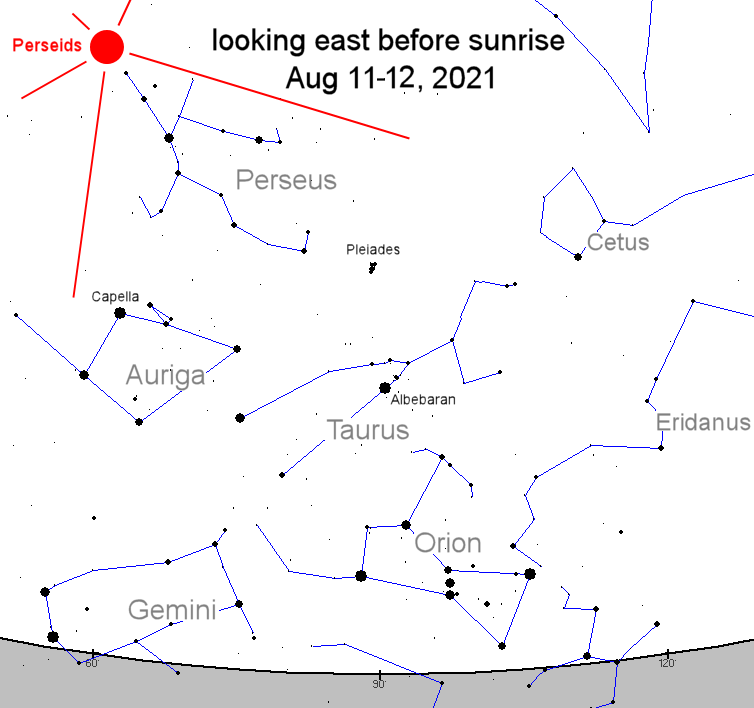
"The night of Aug. 11-12 showed only a few dim meteors that traced back to Perseus," reports John Ashley of Marion, Montana. "The handful of brightest meteors that I saw came through at other angles, like this one."

"This was probably a sporadic--that is, a random meteor not associated with the Perseid debris stream. Jupiter and Saturn also appear in the left."
Realtime Perseid Photo Gallery
Free: Spaceweather.com Newsletter
NOCTILUCENT CLOUDS PERSIST: Generally speaking, August is not a good month for noctilucent clouds (NLCs). The silvery clouds, made of frosted meteor smoke, begin to melt away as the mesosphere warms up in late summer. This August, however, the clouds are still being seen. Nadja Maletzki spotted them on Aug. 12th over Zürich, Switzerland:

"It was a very nice display," says Maletzki.
The significance of this picture is not that NLCs exist in August. They often do. Rather, it is the latitude of the display: +47 N. The clouds are usually retreating toward the Arctic Circle by mid-August, not showing up in the middle of Europe.
All summer long, NLCs have been descending farther south than they are "supposed to." At one point in June they were sighted near the Mediterranean coast of Spain, almost setting an all-time record. Forget about August. Will this be the year that NLCs are seen in September? Stay tuned.
Realtime Noctilucent Cloud Photo Gallery
Free: Spaceweather.com Newsletter
THIS MOONSTONE HAS TOUCHED SPACE: Are you looking for a far-out gift? Nothing says "I love you" like a moonstone from the edge of space. The students of Earth to Sky Calculus flew this one wrapped in a hand-crafted sterling silver Celtic love knot 35.1 km (115,158 feet) above Earth's surface:
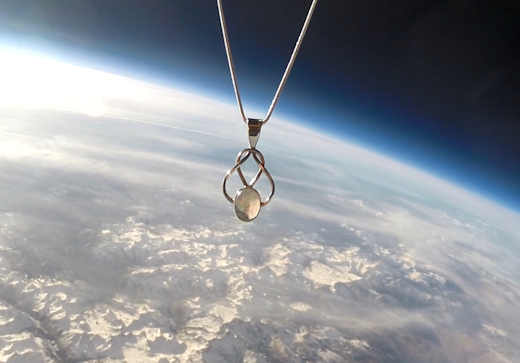
You can have it for $179.95. The students are selling these pendants to support their cosmic ray ballooning program. Each one comes with a greeting card showing the item in flight and telling the story of its journey to the edge of space. All sales support the Earth to Sky Calculus cosmic ray ballooning program and hands-on STEM research.
Far Out Gifts: Earth to Sky Store
All sales support hands-on STEM education
Realtime Space Weather Photo Gallery
Free: Spaceweather.com Newsletter
Realtime Aurora Photo Gallery
Free: Spaceweather.com Newsletter