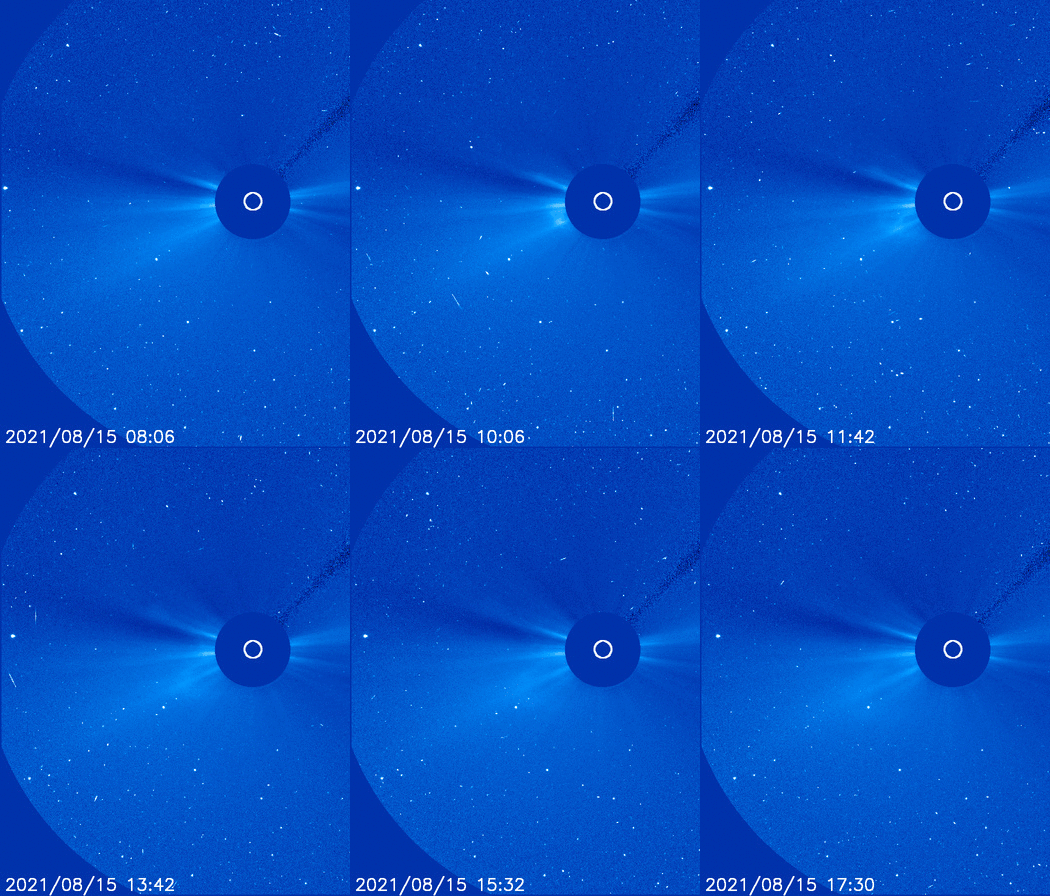
FARSIDE EXPLOSION: Yesterday, Aug. 15th (0508 UT), a gigantic filament of magnetism erupted from the farside of the sun: movie. SOHO saw a CME fly away from the blast site, but it will not hit Earth. The explosion is interesting because it signals the presence of an active region on the farside of the sun, which could turn to face us later this week. Solar Flare alerts: SMS Text.
GIANT SOLAR PROMINENCE: For the 3rd day in a row, a fiery prominence is dancing along the sun's northeastern limb. The shapeshifting structure has grown taller each day. Today, says photographer Maximilian Teodorescu, "it looks like a ghost rider on a horse."
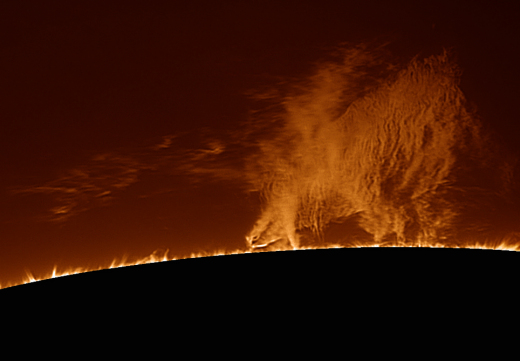
A really, really big horse. It's almost 10 times taller than Earth and 15 times as wide. These dimensions make it an easy target for backyard solar telescopes.
Solar prominences are clouds of hydrogen gas held up by magnetic fields. The dynamics of this one suggest it is unstable. The next photo of this prominence, whoever takes it, might capture an explosion.
Realtime Space Weather Photo Gallery
Free: Spaceweather.com Newsletter
PERSEID METEOR SMOKE: Photographer James W. Young was watching the sky on Aug. 13th when a fragment of Comet 109P/Swift-Tuttle hit the atmosphere over Oregon traveling 130,000 mph. This is what happened:
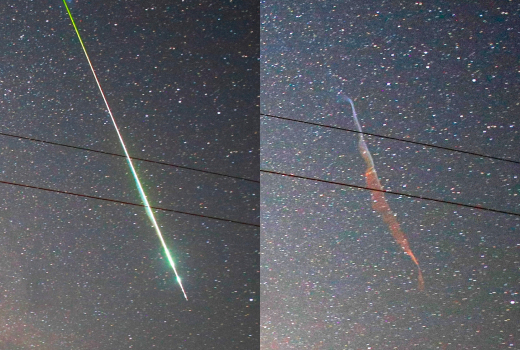
"This -6 magnitude Perseid fireball disintegrated in front of my camera and left a smokey trail that lingered for nearly 3 minutes," says Young.
The comet fragment was probably the size of a pebble or, at most, a golf ball. Slicing through the atmosphere, its surface rapidly ablated, vaporizing to form a trail of dust-sized specks and molten microdroplets almost 30 km long. As Young watched, the "Perseid smoke" diffused into the mesosphere where, one day, it might catch a wisp of water vapor and turn into a noctilucent cloud.
Realtime Perseid Photo Gallery
Free: Spaceweather.com Newsletter
THE PINK AURORA PEARL: Inspired by the color of rare pink auroras, Spaceweather.com and the students of Earth to Sky Calculus launched a pink pearl to the stratosphere. It hitched a ride onboard a cosmic ray research balloon, flying 112,205 feet above the Sierra Nevada mountains of central California:
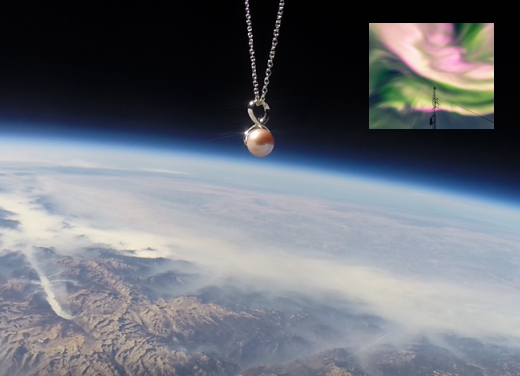
You can have it for $249.95. The students are selling space pearls to support their cosmic ray monitoring program. Measuring 9 mm in diameter, the Aurora Pearl is mounted on a sterling silver infinity twist and suspended on a matching 17 inch long sterling silver chain. Each pearl comes with a greeting card showing the pendant in flight and telling the story of its journey to the edge of space.
Far Out Gifts: Earth to Sky Store
All sales support hands-on STEM education
Realtime Noctilucent Cloud Photo Gallery
Free: Spaceweather.com Newsletter