SOLAR PHOTO-OP: If you have a solar telescope, point it at the sun's northeastern limb. A huge shapeshifting prominence is dancing there for the 4th day in a row. It's a good photo-op, unless the prominence explodes, then it will be a great photo-op. Submit your photos here. Solar Flare alerts: SMS Text.
BLUE LIGHTNING IN THE STRATOSPHERE:Rain. Clouds. Thunder. The stratosphere has none of those things. Weather up there is pretty dull. Except when the lightning starts...
Researchers call them "blue jets." The elusive discharges leap into the stratosphere from thunderstorms far below. They are rarely seen, but storm chaser Rob Neep was able to capture some over Sonora, Mexico, on August 3rd:
"I couldn't believe my eyes," says Neep, a former TV photojournalist. "I was actually looking for sprites when the jets appeared. They were definitely visible to the naked eye, both my cousin and I observed them."
Oscar van der Velde of the Lightning Research Group at the Universitat Politècnica de Catalunya watched Neep's video and says it is "Excellent--perhaps the best example of classic blue jets we've seen in a long time!"
First recorded by cameras on the space shuttle in 1989, blue jets are part of a growing menagerie of transient luminous events (TLEs) in the upper atmosphere. They appear alongside sprites, ELVES, and other lightning-like forms. Blue jets, however, seem to be more elusive than the others, often frustrating photographers who try to catch them.

"We're not sure why ground-based observers see them so rarely," says van der Velde. "It might have something to do with their blue color. Earth's atmosphere naturally scatters blue light, which makes them harder to see. Blue jets may be much more common than we think."
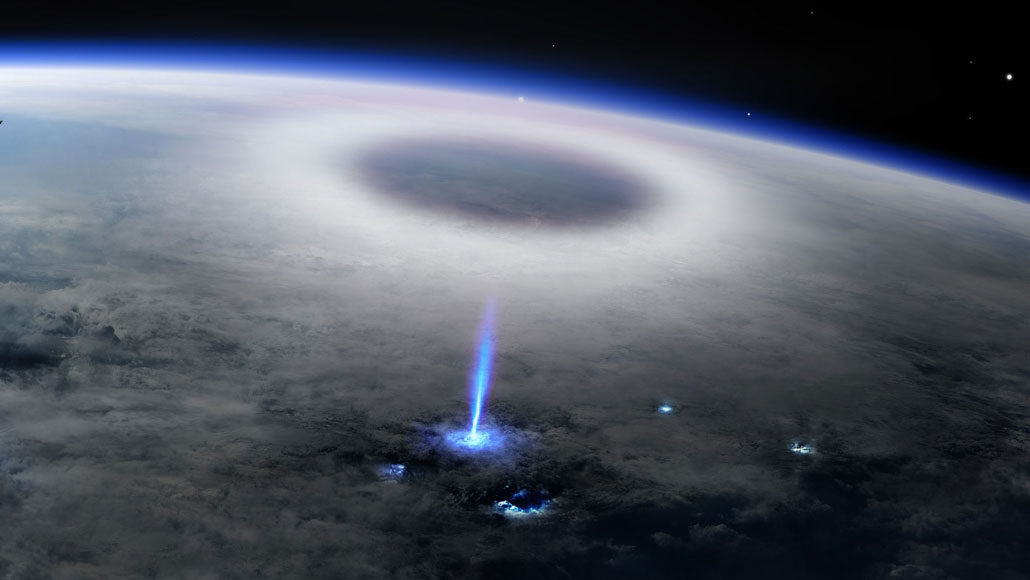
Above: Artist's concept of a blue jet observed from the ISS. Credit: DTU Space, Daniel Schmelling/Mount Visual
In 2018, SpaceX launched Europe's Atmosphere-Space Interactions Monitor (ASIM) to the International Space Station to study TLEs from space. Data from ASIM show that blue jets can leap as high as 170,000 feet above the ground. They're sparked by mysterious "blue bangs"--brilliant blue flashes in the tops of thunderclouds possibly caused by intense turbulence.
It's important to study blue jets because, according to van der Velde, "there can be considerable production of NOx and ozone by these discharges, potentially affecting the chemistry of the atmosphere." Also, some blue jets might rise high enough to touch the ionosphere, forming a new and poorly understood branch of the global electrical circuit.
And on top of everything else, "they're beautiful," says Neep. "I was lucky to catch some."
A sharable version of this story may be found here.
Realtime Space Weather Photo Gallery
Free: Spaceweather.com Newsletter
STERLING SILVER HUMMINGBIRD:This hummingbird has touched space. The sterling silver pendant hitched a ride to the stratosphere onboard an Earth to Sky Calculus cosmic ray research balloon. At the apex of the flight, it floated 111,202 feet above the Sierra Nevada mountains of central California:
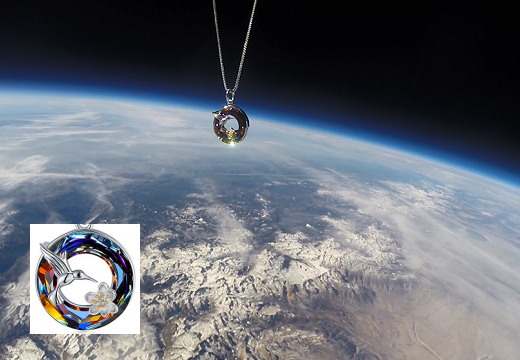
You can have it for $142.95. The students are selling hummingbird pendants to support their cosmic ray ballooning program. Each one comes with a greeting card showing the hummingbird in flight and telling the story of its journey to the edge of space. It makes an out-of-this-world birthday, anniversary, or Christmas gift!
Far Out Gifts: Earth to Sky Store
All sales support hands-on STEM education
Realtime Noctilucent Cloud Photo Gallery
Free: Spaceweather.com Newsletter