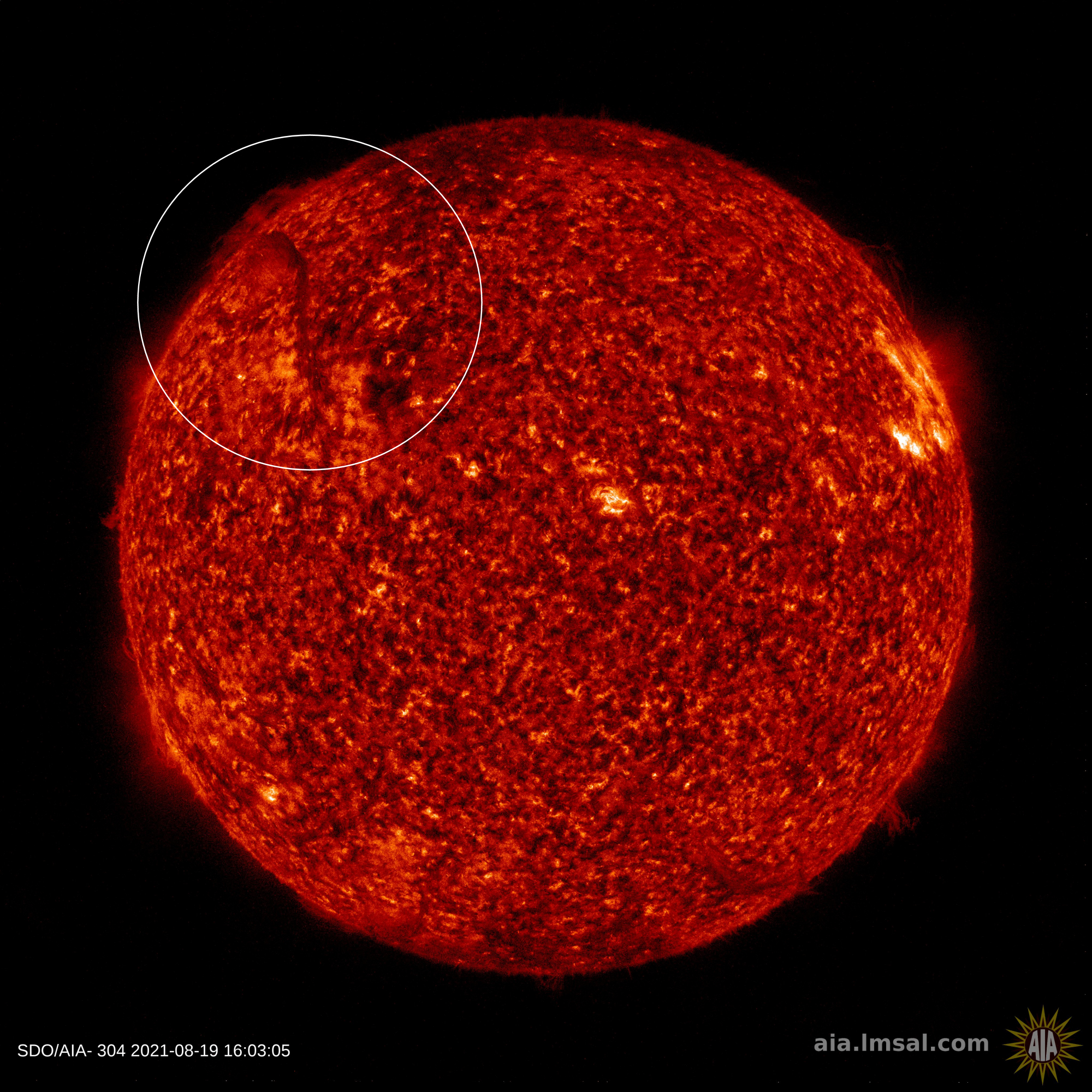
HUGE SOLAR FILAMENT: The biggest thing on the sun today is not a sunspot; it's a dark filament of magnetism: SDO image. Stretching more than 350,000 km from end to end, the structure dwarfs any sunspot. It is noteworthy not only for its size, but also for its explosive potential. Oversized filaments like this one can become unstable and collapse, sparking Hyder flares and hurling CMEs into space. Aurora alerts: SMS Text.
PERSEID METEOR OUTBURST: 28 years ago, the Perseid meteor shower killed a satellite. On Aug. 11, 1993, a Perseid meteoroid hit the Olympus-1 telecommunications satellite, making it spin. The $850 million spacecraft was lost after it ran out of fuel trying to regain control. Many researchers blame a dense ribbon of comet dust now known as "the Perseid Filament."
This week, the Perseid Filament came back. Probably.

Above: The Perseid outburst of Aug. 14, 2021, captured by Carl Bracken of the Cedar Amateur Astronomers in Iowa using his AMS42 camera. More images.
On Aug. 14, 2021, night skies over North America filled with meteors. P. Martin of Ottawa, Canada, reported "multiple Perseids per minute with many bursts, sometimes 3-4 in a second." In San Diego, Robert Lunsford of the International Meteor Organization also witnessed rapidfire streaks, 2 to 3 at a time. "It made me realize something unusual was going on," Lunsford says, "especially so far from the predicted maximum."
To say that astronomers were surprised would be an understatement. The Perseid's annual peak had occurred the night before. Most observers had already given up watching. Fortunately, a network of automated cameras operated by the Cedar Amateur Astronomers in Iowa captured the display. Overnight they recorded more than 1000 meteors.
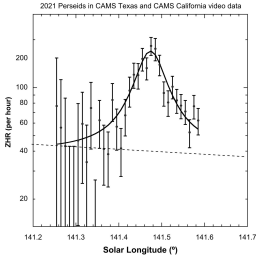 Peter Jenniskens, an astronomer at the SETI Institute and NASA/Ames, believes it may have been the Perseid Filament. "I think so," he says. "The width of the outburst is similar to that of past Perseid Filament returns."
The Perseid Filament is a ribbon of dust inside the broader Perseid debris zone. Comet 109P/Swift-Tuttle supplies the raw material. The comet loops around the sun every 133 years, shedding dust as it goes. Over time, much of Swift-Tuttle's dust is perturbed by the gravity of Jupiter, helping scatter it into the diffuse cloud that we experience every year as the Perseid meteor shower. But there is a part of the comet's orbit in a "mean motion resonance" with Jupiter where dust can accumulate instead of dispersing. This is the Perseid Filament.
Forecasters still can't predict when the Perseid Filament will return. It came for many years in a row around 1993, and it may have grazed Earth again, slightly, in 2018, 2019 and 2020. No one predicted a direct hit in 2021.
This uncertainty begs the question: Was it really the Filament? The jury's still out. Observers may have stumbled upon an entirely new ribbon of Perseid dust. Either way, researchers are looking forward to next year to see if it comes back again. And they probably won't stop watching when the peak is "done."
A sharable version of this story may be found here.
Realtime Space Weather Photo Gallery
Free: Spaceweather.com Newsletter
TO BOLDLY GO WHERE NO MUG HAS GONE BEFORE:There's nothing like morning coffee in a cup from space. On April 23, 2021, this rare ceramic Capt. Kirk mug flew to the stratosphere onboard an Earth to Sky Calculus cosmic ray research balloon. At the apex of the flight, it floated 97,438 feet above the Sierra Nevada mountains of central California:
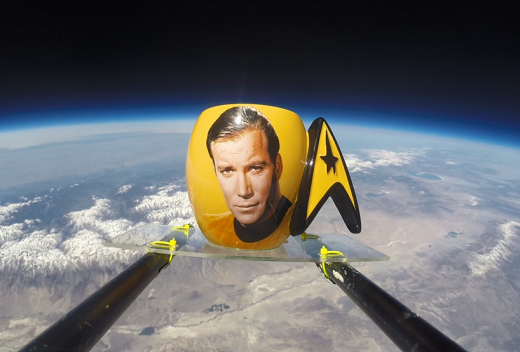
You can have it for $170.10. That's the serial number of the Enterprise divided by 10. The students are selling Star Trek mugs to support their cosmic ray ballooning program. Each one holds 16 oz. of steaming hot Raktajino (Klingon coffee) and comes with a greeting card showing the collector's item in flight.
Far Out Gifts: Earth to Sky Store
All sales support hands-on STEM education
Realtime Noctilucent Cloud Photo Gallery
Free: Spaceweather.com Newsletter