FARSIDE SOLAR ACTIVITY: Earth-orbiting satellites have just detected a C3-class solar flare (Aug. 20 @ 1557 UT): movie. The source is an active region located just behind the sun's northeastern limb. Partially eclipsed by the edge of the sun, the flare was probably stronger than it appeared. Soon, perhaps within 24 hours, the blast site will rotate into view, so stay tuned for updates. Solar flare alerts: SMS Text.
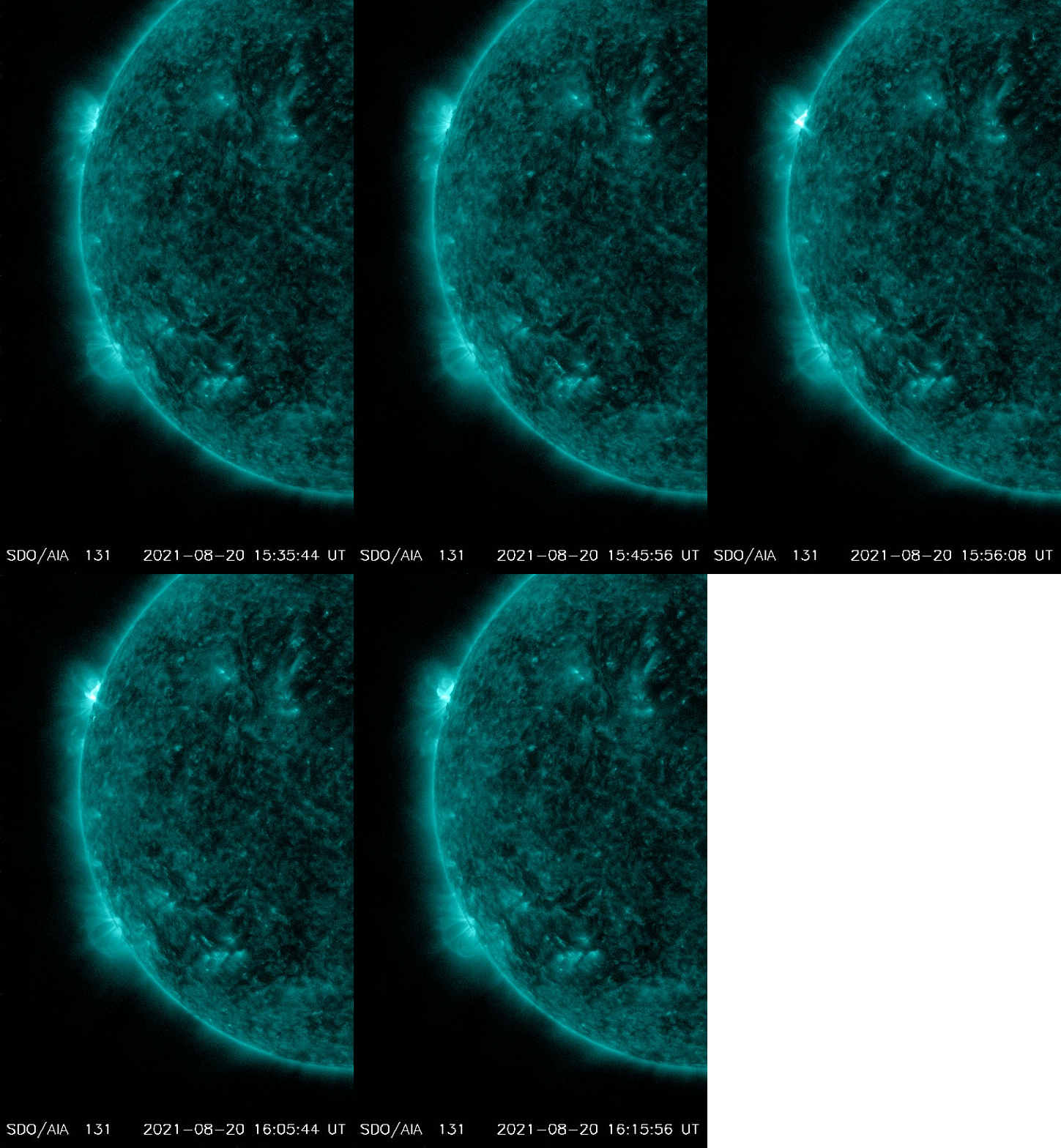
HUGE SOLAR FILAMENT: The biggest thing on the sun today is not a sunspot; it's a dark filament of magnetism. Earlier today, NASA's Solar Dynamics Observatory photographed the structure curling over the sun's northeastern imb:

Stretching more than 350,000 km from end to end, the structure dwarfs any sunspot. It is noteworthy not only for its size, but also for its explosive potential. Oversized filaments like this one can become unstable and collapse, sparking Hyder flares and hurling CMEs into space. Amateur astronomers, monitoring is encouraged. Solar flare alerts: SMS Text.
Realtime Space Weather Photo Gallery
Free: Spaceweather.com Newsletter
SPRITES ABOVE TROPICAL STORM GRACE: You know what comes out of the bottom of a tropical storm: Rain, lightning and floods. But what comes out of the top? Frankie Lucena found out on Aug. 15th when Tropical Storm Grace approached Puerto Rico. "I pointed my Sony A7s camera above the cloudtops and captured a negative polarity sprite, a Jellyfish sprite, and then a huge Gigantic Jet."

"There were also ELVES and a halo, but my Sony couldn't detect them through the heavy light pollution from a nearby town," says Lucena. "I was happy with what I got! When Tropical Storm Fred was in the area, just before Grace, it didn't produce any transient luminous events (TLEs). I guess not all Tropical Storm systems have the DNA to produce TLEs."
Realtime Sprite Photo Gallery
Free: Spaceweather.com Newsletter
MIDNIGHT BLACK PEARL: Space is black--and so is this pearl. On July 22, 2021, the students of Earth to Sky Calculus launched the Midnight Pearl to the stratosphere onboard a cosmic ray research balloon. Here it is floating 96,785 feet above the Sierra Nevada mountains of central California:
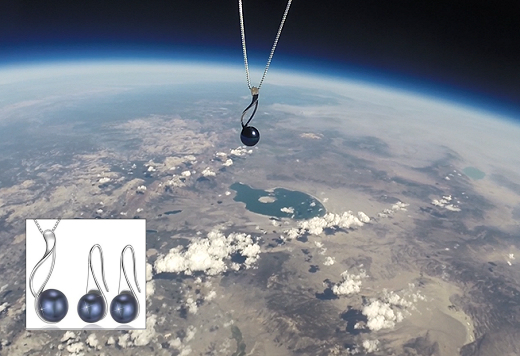
You can have it for $179.95--earrings included! Matching pearl earrings flew inside the payload among the cosmic ray sensors.
The students are selling space pearls to support their cosmic ray ballooning program. Wrapped in a sterling silver infinity twist, each Midnight Pearl comes with a greeting card showing the pendant in flight and telling the story of its trip to the edge of space.
Far Out Gifts: Earth to Sky Store
All sales support hands-on STEM education
Realtime Noctilucent Cloud Photo Gallery
Free: Spaceweather.com Newsletter