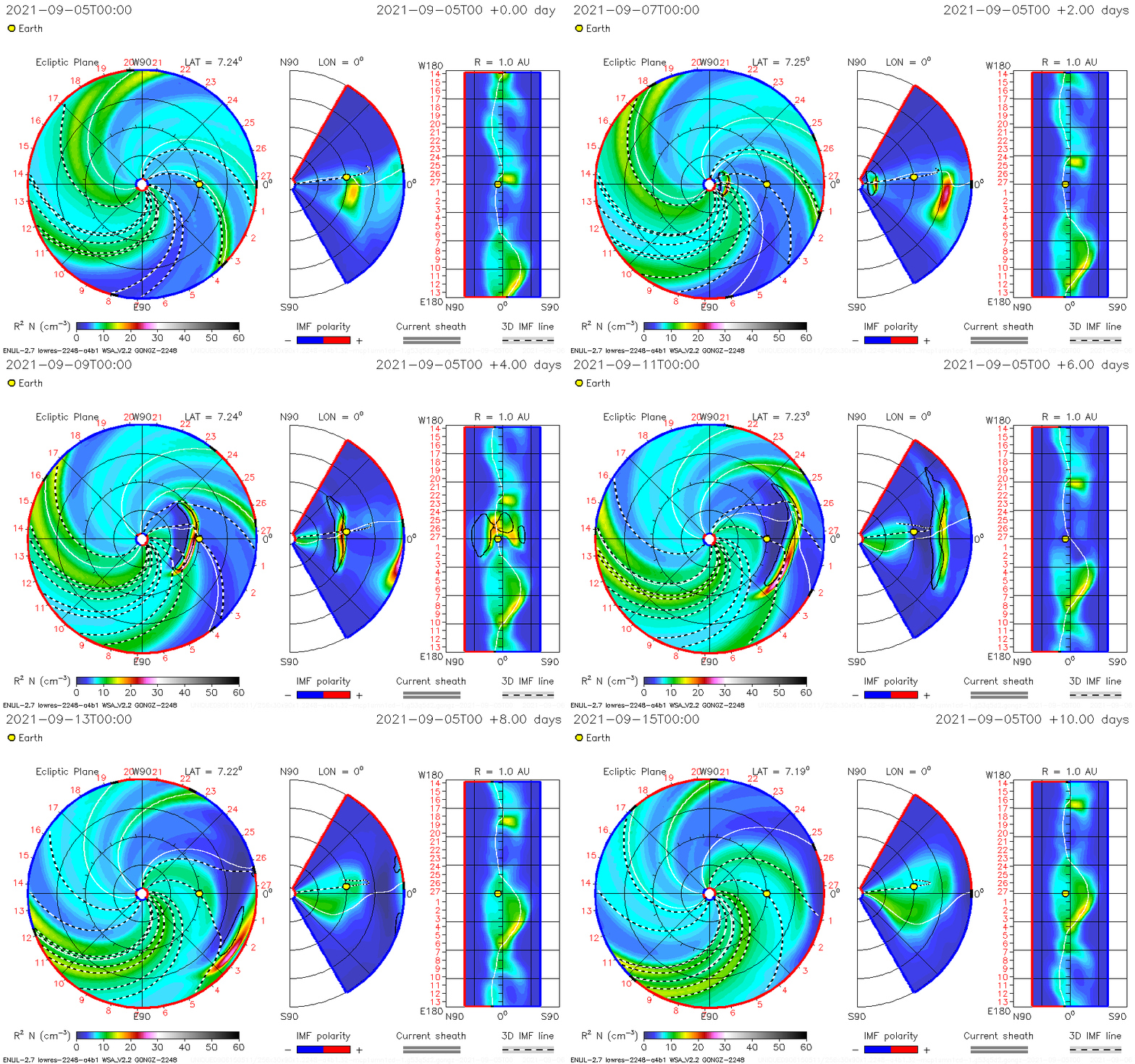
MINOR CME HEADING OUR WAY, MAYBE: On Sept. 5th, decaying sunspot AR2865 produced a B7-class solar flare. The explosion sent a shadowy shock wave rippling through the sun's lower atmosphere and hurled a very faint CME into space. Forecast models suggest the CME could reach Earth on Sept. 9th, bringing a chance of minor geomagnetic storms and polar auroras. Solar flare alerts: SMS Text.
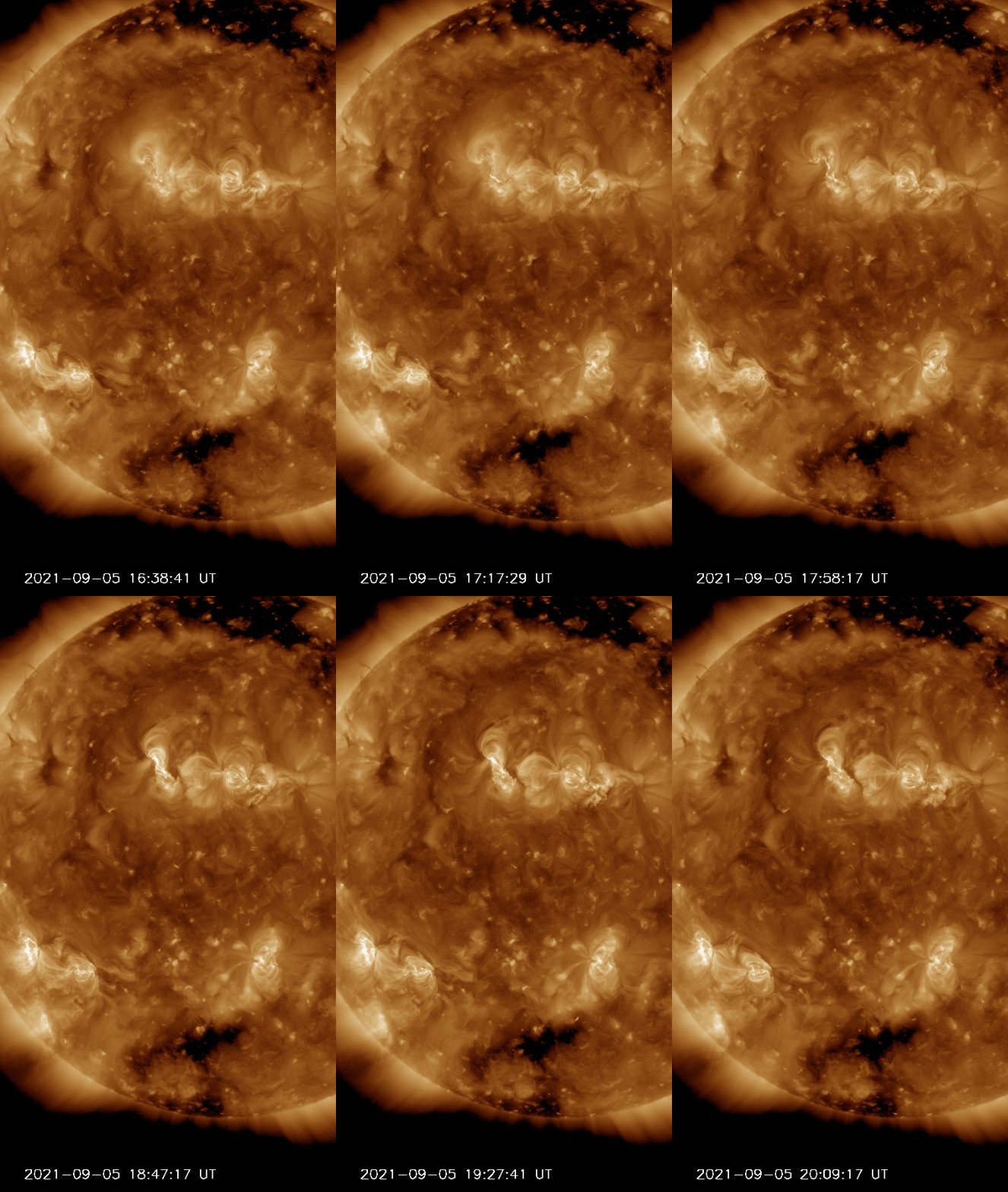
THESE SUNSPOTS COULD SWALLOW PLANETS: Sunspots AR2866 and AR2868 are growing rapidly and turning to face Earth. This movie from NASA's Solar Dynamics Observatory shows their development during the past 24 hours:

How big are they? The entire planet Jupiter could fit comfortably between the primary cores of AR2868 (on the right). AR2866 (on the left) might soon be even bigger. The active region has almost doubled in size since yesterday.
Big sunspots can produce big flares. For the rest of this week, the two will be squarely inside the Earth strike-zone. Any flare or CME will be a direct hit.
This is also a photo-op. As large as gas-giant planets, the two sunspots are easy targets for amateur astronomers with safely-filtered telescopes. (Read "Anatomy of a Sunspot," below, to see what a 14-inch Celestron can accomplish.) And if you don't have a solar filter, try this instead.
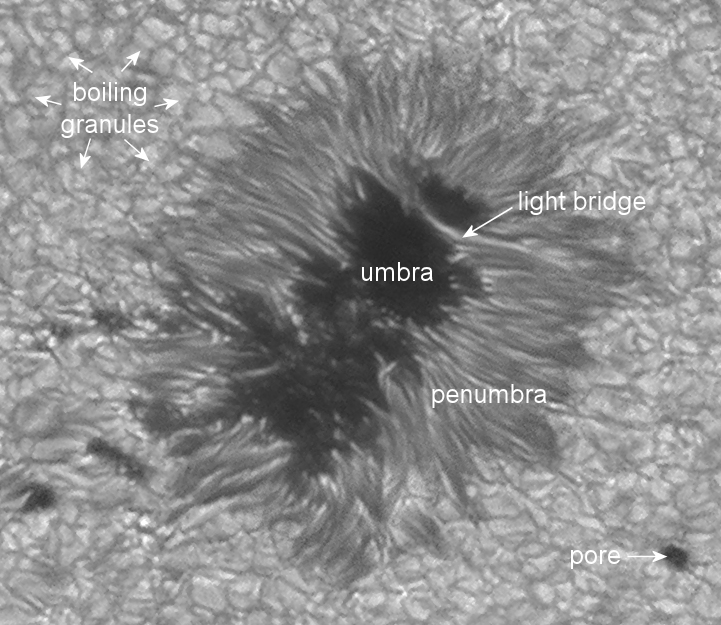
ANATOMY OF A SUNSPOT: For the first time in years, there are multiple large spots on the sun. Yesterday in Austria, astronomer Michael Karrer zoomed in on one of them, and this is what he saw:
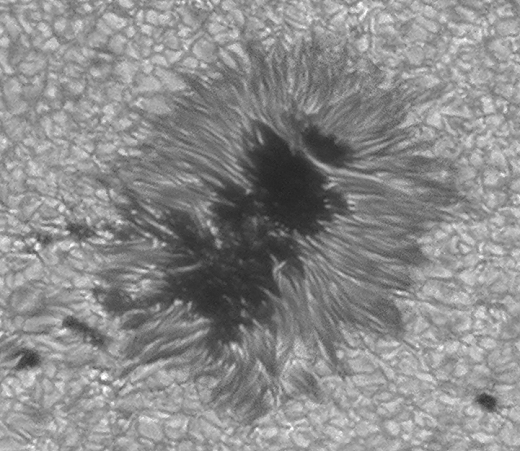
"It took some patience," he says. "I waited until the air was perfectly still and free of turbulence, then took a high-resolution picture of sunspot AR2868." He used a 14-inch Celestron telescope, safely filtered.
In fact, the image above is only a fraction of the total. The whole sunspot is enormous. AR2868 sprawls more than 110,000 km from end to end.
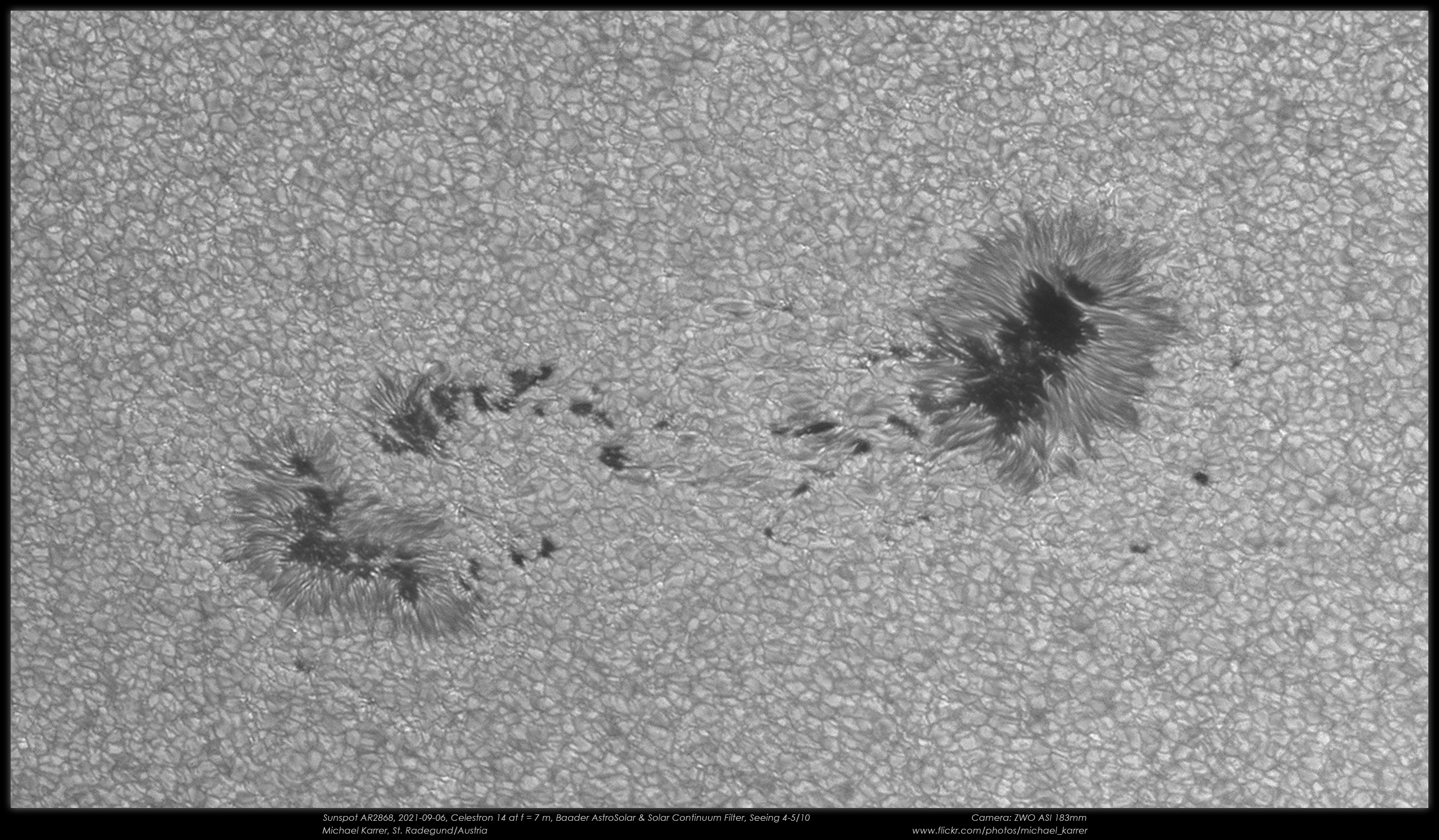
Austria's moment of atmospheric clarity combined with the sheer scale of the sunspot allowed Karrer to capture details rarely seen in amateur photos. There's the dark umbra, the filamentary penumbra, a crack in the sunspot known as a "light bridge," dark pores, and boiling granules the size of North America. Click here for labels.
Realtime Space Weather Photo Gallery
Free: Spaceweather.com Newsletter
POINTY-EARED COFFEE CUP: It's the logical way to wake up in the morning: Coffee in a Mr. Spock Cup. It has pointy ears, holds 20 oz. of brew, and comes from the edge of space. The students of Earth to Sky Calculus flew the cup to the stratosphere on Aug. 25th onboard a cosmic ray research balloon:

You can have it for $99.95. The students are selling Spock cups to support their cosmic ray ballooning program. Each one comes with greeting card showing the heavy-duty ceramic cup in flight and telling the story of its journey to the stratosphere and back again.
Far Out Gifts: Earth to Sky Store
All sales support hands-on STEM education
Realtime Aurora Photo Gallery
Free: Spaceweather.com Newsletter