A LOPSIDED CME IS COMING: Last week, 3 CMEs missed Earth. Will this weekend be different? Another CME is on the way following an explosion in the magnetic canopy of sunspot AR2864 on Sept. 8th. NOAA analysts believe Earth could experience a glancing blow or near miss late on Sept. 11th. Aurora alerts: SMS Text.
GEOMAGNETIC UNREST SPARKS AURORAS: Last night, the digital pen on Stuart Green's UK magnetometer unexpectedly started swinging. Soon thereafter, "beautiful auroras were reported over northern Europe," he says. Here's how it looked in Kuusamo, Finland:
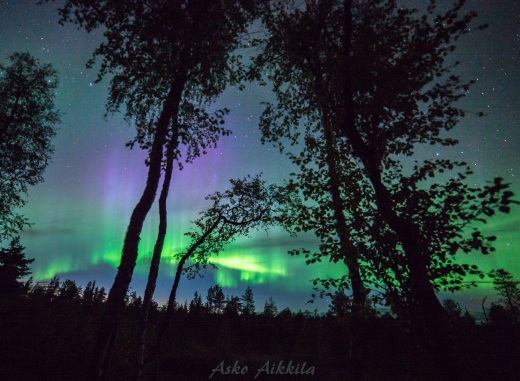
"The evening of Sept. 10th was very quiet until 10 p.m. when the auroras appeared and started their dance," says photographer Asko Aikkila. "The show lasted for more than an hour."
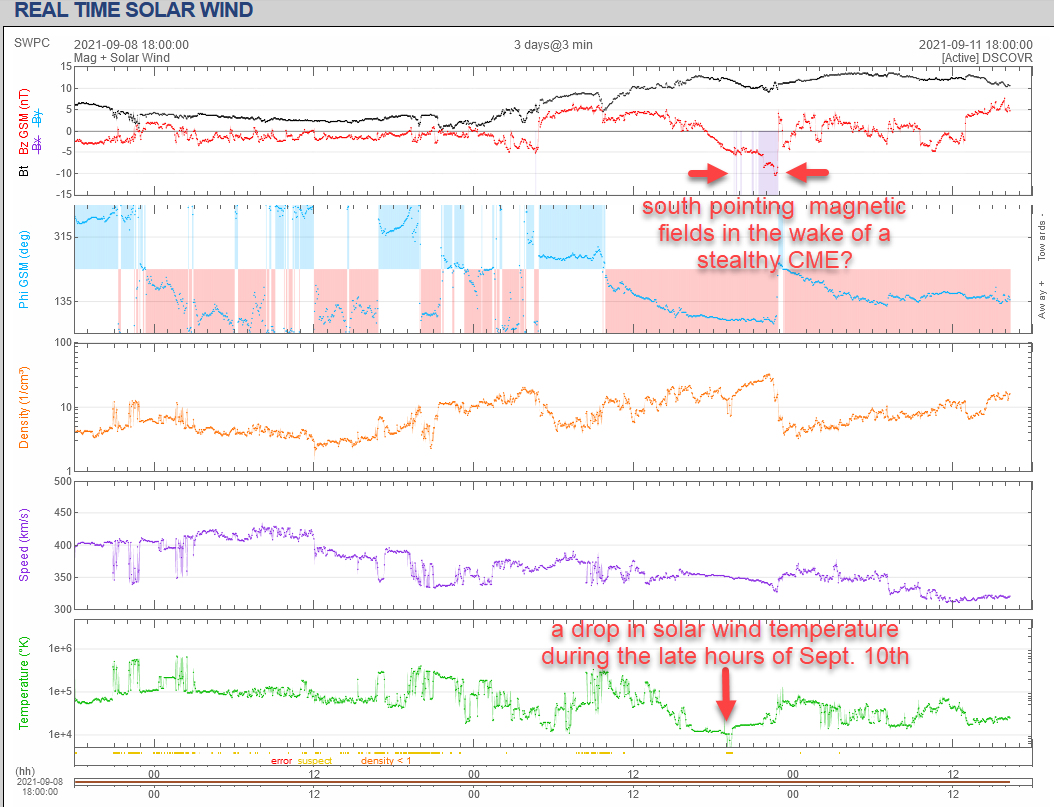
What caused the disturbance? Solar wind data suggest that a stealthy CME might have passed by Earth. There was no sudden uptick in solar wind speed signaling a direct hit. Instead, the temperature of the solar wind dropped. Studies of CME thermodynamics find that CME can have a lower temperature than ambient solar wind. This "chill in the night" may have been one of the recent missing CMEs making itself known en route to the outer solar system.
Realtime Aurora Photo Gallery
Free: Spaceweather.com Newsletter
HUGE SOLAR PROMINENCE: One of the largest prominences in years is coiling over the northeastern limb of the sun. Alan Friedman sends this picture from Buffalo, New York:
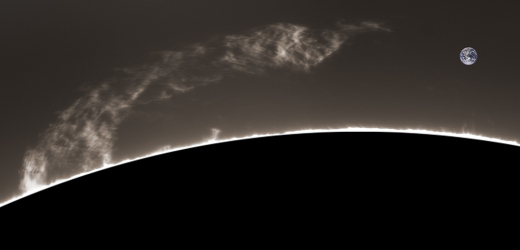
"I added an image of Earth for scale," says Friedman. "It was really stunning."
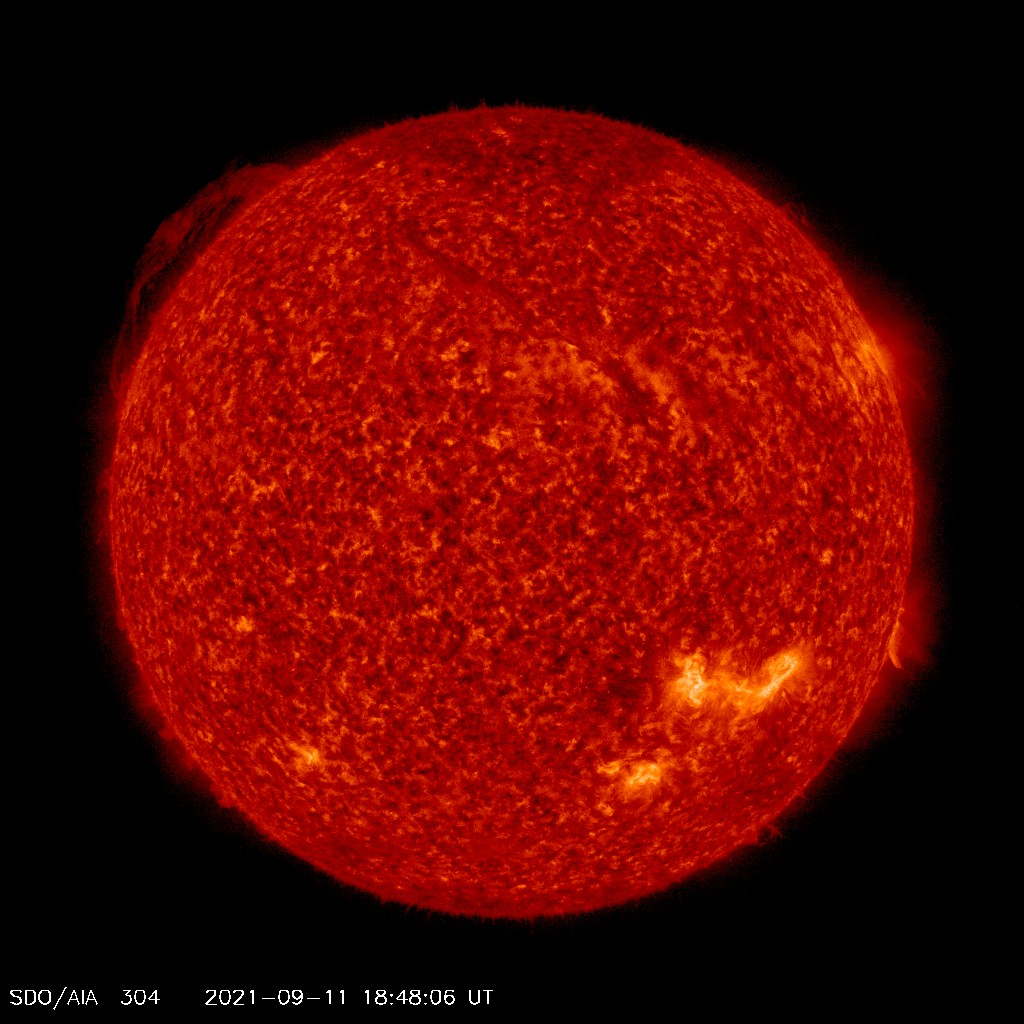
This full-disk image from NASA's Solar Dynamics Observatory shows how amazingly large it is. If you have a solar telescope, take a look! More images: from Günter Kleinschuster of Feldbach, Austria; from Apollo Lasky of Naperville, Illinois; from James Roger Samworth of Nailstone, UK; from Ivar Hamberg of Nice, France; from Ted Adachi of Montreal, Canada
Realtime Space Weather Photo Gallery
Free: Spaceweather.com Newsletter
THE PINK AURORA PEARL: Inspired by the color of rare pink auroras, Spaceweather.com and the students of Earth to Sky Calculus launched a pink pearl to the stratosphere. It hitched a ride onboard a cosmic ray research balloon, flying 112,205 feet above the Sierra Nevada mountains of central California:
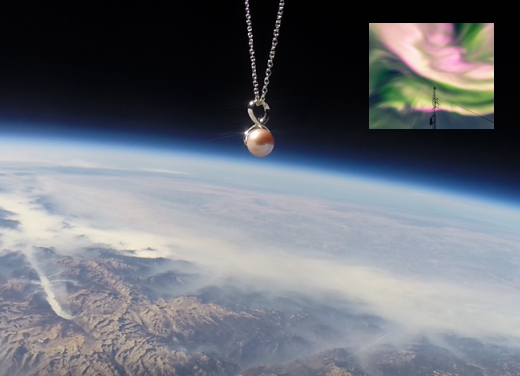
You can have it for $249.95. The students are selling space pearls to support their cosmic ray monitoring program. Measuring 9 mm in diameter, the Aurora Pearl is mounted on a sterling silver infinity twist and suspended on a matching 17 inch long sterling silver chain. Each pearl comes with a greeting card showing the pendant in flight and telling the story of its journey to the edge of space.
Far Out Gifts: Earth to Sky Store
All sales support hands-on STEM education