GEOMAGNETIC STORM IN PROGRESS: Minor G1-class geomagnetic storms are underway on Sept. 17th as Earth passes through the wake of a CME (described below) that struck earlier in the day. High-latitude sky watchers should be alert for auroras after local nightfall. Aurora alerts: SMS Text.

THE AFTERGLOW OF A 'WEAK' CME: A CME hit Earth's magnetic field on Sept. 17th at ~0200 UT. The impact was very weak, lifting the solar wind speed by a measly 40 km/s. Despite such a feeble blow, the CME managed to stir geomagnetic activity hours later when Earth encountered magnetic fields in the CME's wake. Marketa Murray sends this picture from Fairbanks, Alaska:
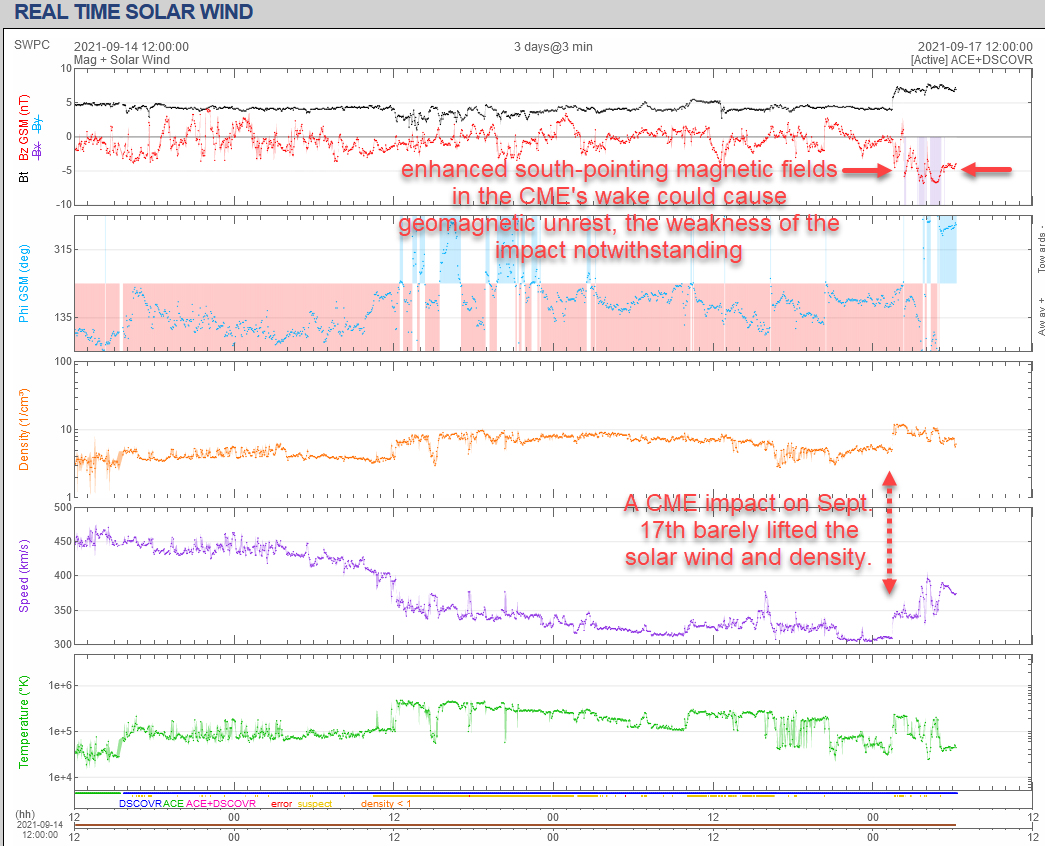
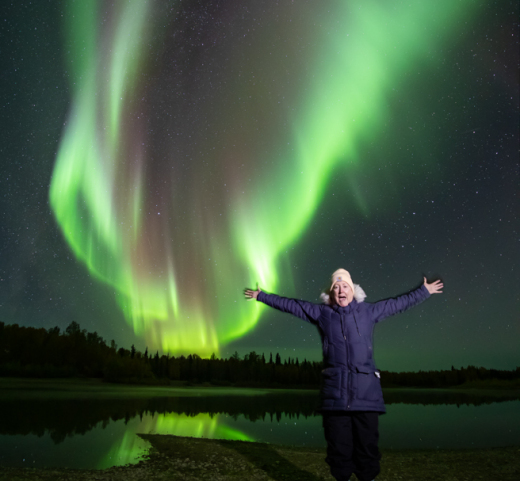
"After waiting all night long for a storm, the skies filed up with reds, purples, pinks, greens and were dancing 'til sunrise," says Murray. "Absolutely amazing!"
Her picture shows why even weak CMEs are eagerly anticipated by aurora photographers. The magnetized storm clouds have a knack for opening cracks in Earth's magnetic field, allowing solar wind to enter the magnetosphere. Just imagine what a strong CME could do. Aurora alerts: SMS Text.
Realtime Aurora Photo Gallery
Free: Spaceweather.com Newsletter
HISTORIC SPACE MISSION BLASTS OFF: SpaceX just made history again. On Sept. 15th, a Falcon 9 rocket blasted off from Cape Canaveral carrying the first all-civilian crew to Earth orbit. "It was spectacular," reports Bill Williams of Titusville, Florida. "Shooting from the west side of the Indian River, I recorded exhaust plumes and a dramatic 'rocket nebula' in the moonlit dusk skies."
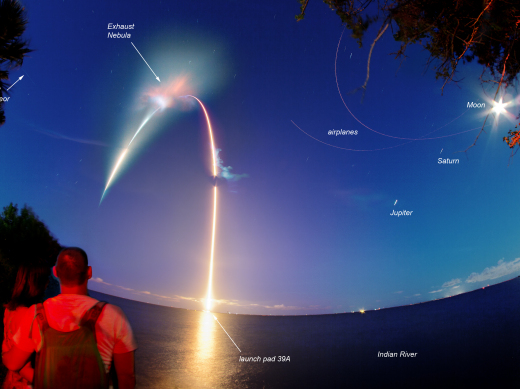
"I would rather have been on the rocket," says Williams, "but the view from Earth wasn't bad either!"
This mission, named "Inspiration4," is setting a number of milestones. First of all, there are no astronauts onboard. It's the first orbital spaceflight crewed entirely by private citizens. One of them, Hayley Arceneaux, age 29, is the youngest American ever to go to space. All 4 citizens received astronaut training from SpaceX, including orbital mechanics, microgravity exercises and mission simulations.
Arceneaux is also a pediatric cancer surviver, and the flight is raising money for childhood cancer research. The seat next to her on the spacecraft was raffled off, raising $200 million for the St. Jude Children's Research Hospital, where Arceneaux's life was saved years ago.
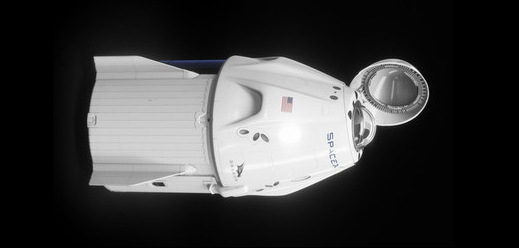
Above: The crew capsule with its bubble-shaped window
To top it all off, the crew are orbiting higher than any astronauts since STS-125 in 2009. They're actually above the International Space Station.
If all goes as planned, the capsule will be in Earth orbit until Sept. 19th. One end of the spacecraft has a bubble-shaped window, giving the space travelers an unparalled view of Earth. Here on the ground, we can look up and see them, too. The capsule is about as bright as a 3rd magnitude star, easy to spot from rural areas. For local flyby predictions, check Heavens Above.
Realtime Space Weather Photo Gallery
Free: Spaceweather.com Newsletter
STAR TREK WINE STOPPER: It's the most far-out wine stopper ever! On Sept. 9, 2021, the students of Earth to Sky Calculus launched the USS Enterprise to the stratosphere onboard a cosmic ray research balloon. Here is the starship-shaped stopper floating 105,563 feet above the rugged Sierra Nevada mountains of central California:
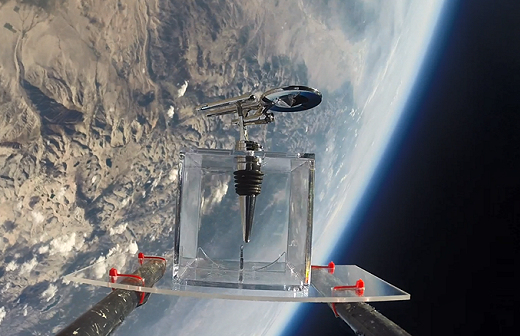
You can have it for $99.95. The students are selling these must-have bar accessories to support their cosmic ray research program. Each one comes with a greeting card showing the stopper in flight, telling the story of its trip to the edge of space and back again.
Far Out Gifts: Earth to Sky Store
All sales support hands-on STEM education