SUBSIDING GEOMAGNETIC ACTIVITY: The storm is over. Earth's magnetic field is quieting on Sept. 18th following a day of unrest sparked by the CME impact of Sept. 17th. Arctic skywatchers might still see auroras tonight in response to isolated substorms, but the main event has passed. Aurora alerts: SMS Text.
LEAPING PLASMA FOUNTAIN: Earlier today, Sept. 18th, a plume of plasma leaped over the southeastern edge of the sun and fell back to the surface. NASA's Solar Dynamics Observatory recorded the splash:
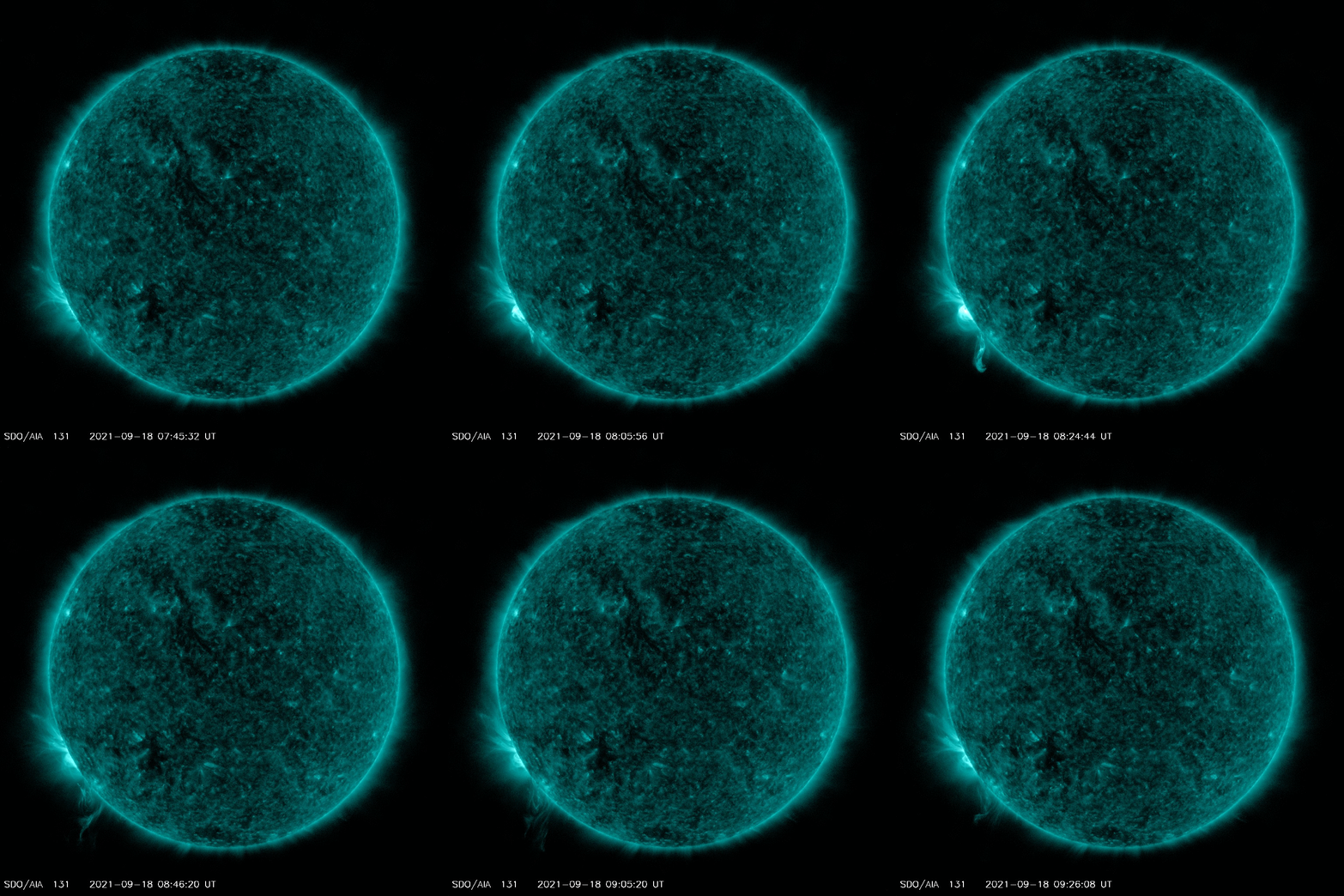
Consider this a "hello" from an old friend. The source of the eruption is almost certainly returning sunspot AR2860, which is coming back after a two-week trip around the farside of the sun. During its previous appearance in late August, the sunspot produced 1 M-class flare and 21 C-class flares. We shall soon see if AR2860 has lost any of its potency as it rotates into view this weekend. Instant solar flare alerts: SMS Text.
Realtime Space Weather Photo Gallery
Free: Spaceweather.com Newsletter
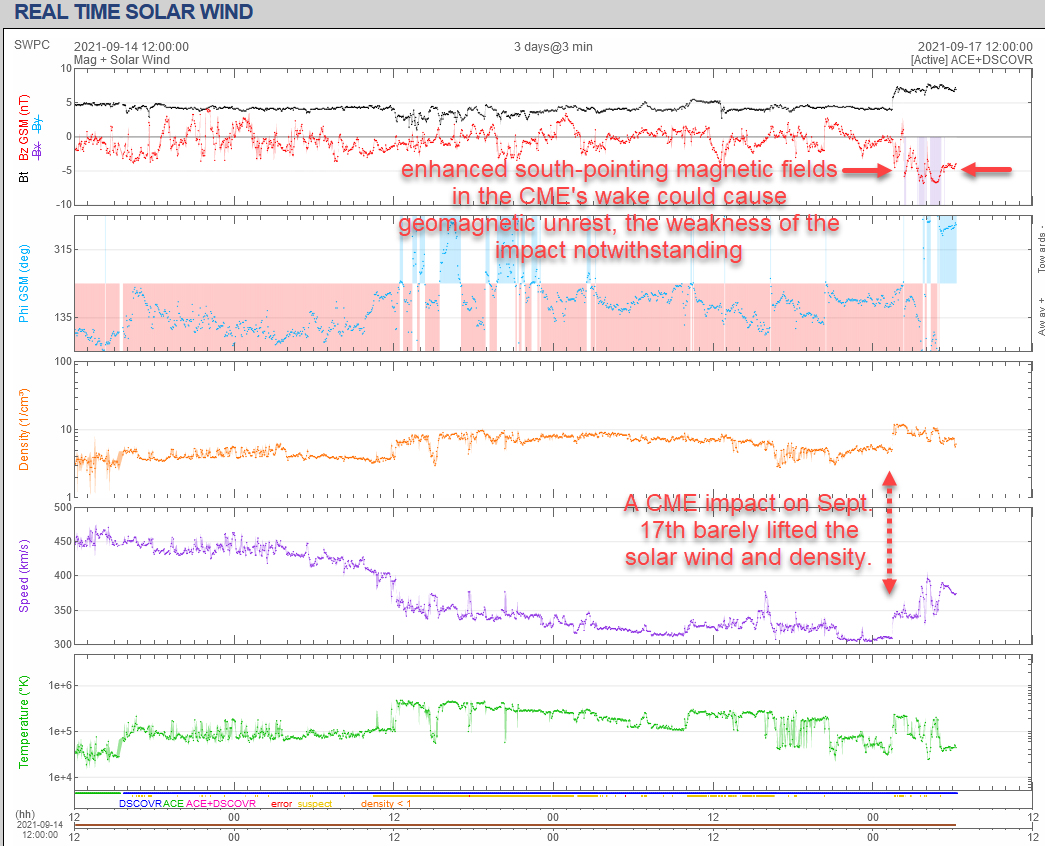
THE AFTERGLOW OF A 'WEAK' CME: Yesterday, Sept. 17th (0200 UT), a long-awaited CME hit Earth's magnetic field. The impact was weak, lifting the solar wind speed by a measly 40 km/s. Despite such a feeble blow, the CME managed to stir geomagnetic activity hours later when Earth encountered magnetic fields in the CME's wake. Evan Zucker filmed the display from High Level, Alberta:
"At first we saw little more than a dim green glow in the northern sky," says Zucker, who watched the show with his wife. "At around 4:00 AM MDT, however, the aurora became increasingly active, culminating in by far the brightest display we have ever seen. Auroras stretched from horizon to horizon. It was exhilarating! "
Zucker's story shows why even weak CMEs are eagerly anticipated by aurora photographers. CMEs of all sizes drag solar magnetic fields behind them. These fields can link up with Earth's own magnetic field, opening cracks for incoming solar wind. The resulting afterglow can be very beautiful, indeed. Now imagine what a strong CME could do. Aurora alerts: SMS Text.
Realtime Aurora Photo Gallery
Free: Spaceweather.com Newsletter
STERLING SILVER OPAL PENDANT: It may be our most beautiful space pendant ever: The Sterling Silver Opal. Earth to Sky Calculus just launched one to the stratosphere onboard a cosmic ray research balloon. Here it is floating 103,018 ft above Earth's surface on Sept. 5th:
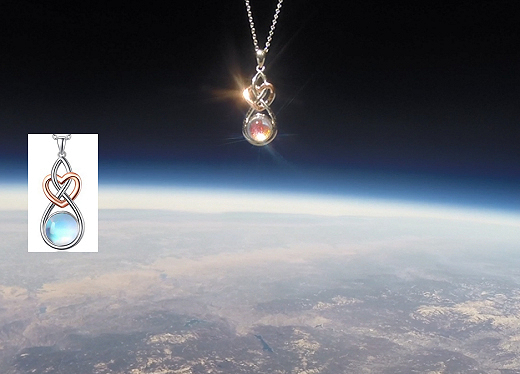
You can have it for $179.95. The opal is wrapped in a sterling silver Celtic love knot and suspended from a matching chain. Anyone who receives this far-out gift will be impressed by the accompanying greeting card, which shows the opal in flight and tells the story of its trip to the edge of space.
Opals are cousins of blue moonstones; in fact, they look much the same in low light. But when bright sunlight strikes an opal, something special happens. A spray of color emerges from the stone. This happened while the opal was in the stratosphere (see above) and it remains capable of this beautiful trick back on Earth.
Far Out Gifts: Earth to Sky Store
All sales support hands-on STEM education