THE HARVEST MOON: Tomorrow's full Moon has a special name: The Harvest Moon. It's the full Moon closest to the northern autumnal equinox. Long ago, farmers depended on the light of the Harvest Moon to gather ripening crops after dark. Post-Edison, we appreciate it mainly for its beauty. Maximum illumination occurs on Monday, Sept. 20th, at 7:55 p.m. Eastern Daylight Time. Browse: Harvest Moon Gallery.
A SOLAR STORM SYSTEM: Emerging sunspot AR2871 is more than just a sunspot. It's the eye of a whole solar storm system. Yesterday in the French Alps, Philippe Tosi photographed the sunspot emerging over the sun's southeastern limb, flanked by two mantis-like appendages of magnetism:
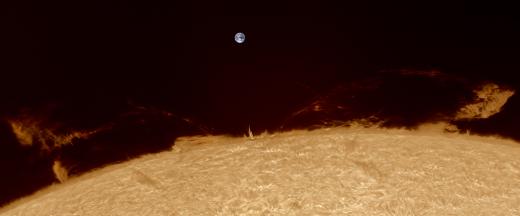
If that were a mantis, it would be a big one. The glowing, raptorial legs are more than 500,000 km long.
Today, as the sunspot rotated more fully toward Earth, another aspect of the system came into view: a swirling storm cloud overhead. Maximilian Teodorescu sends this short movie from Magurele, Romania:

"This is 30 minutes of solar activity compressed into just a few seconds," he says. "I recorded it using a 150 mm refractor and a Quark Chromosphere filter."
We've seen this sunspot before. AR2871 is actually old sunspot AR2860, returning after a two-week trip around the farside of the sun. During its previous appearance in late August, the sunspot produced 1 M-class flare and 21 C-class flares. Since then, the sunspot's dark cores have diminished, but the surrounding storm system still has an air of menace. Instant solar flare alerts: SMS Text.
Realtime Space Weather Photo Gallery
Free: Spaceweather.com Newsletter
STERLING SILVER OPAL PENDANT: It may be our most beautiful space pendant ever: The Sterling Silver Opal. Earth to Sky Calculus just launched one to the stratosphere onboard a cosmic ray research balloon. Here it is floating 103,018 ft above Earth's surface on Sept. 5th:
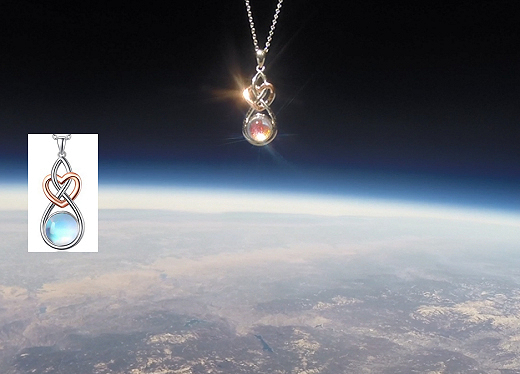
You can have it for $179.95. The opal is wrapped in a sterling silver Celtic love knot and suspended from a matching chain. Anyone who receives this far-out gift will be impressed by the accompanying greeting card, which shows the opal in flight and tells the story of its trip to the edge of space.
Opals are cousins of blue moonstones; in fact, they look much the same in low light. But when bright sunlight strikes an opal, something special happens. A spray of color emerges from the stone. This happened while the opal was in the stratosphere (see above) and it remains capable of this beautiful trick back on Earth.
Far Out Gifts: Earth to Sky Store
All sales support hands-on STEM education
Realtime Aurora Photo Gallery
Free: Spaceweather.com Newsletter