GLANCING BLOW CME, INCOMING: A dark filament of magnetism exploded away from the sun's southern hemisphere on Sept. 19th. Watch the movie. NOAA analysts say the debris could reach Earth on Sept. 23rd in the form of a weak CME. A likely glancing blow could spark minor G1-class geomagnetic storms. Aurora alerts: SMS Text.


WHAT A GLANCING BLOW CME CAN DO: It's weak, and it won't even deliver a direct hit. What kind of auroras could such a CME produce? Here is the answer:
Swedish photographer Göran Strand recorded this movie on Sept. 17th in the aftermath of a weak, glancing blow CME.
"We experienced 360° of amazing Northern Lights," says Strand. "It was one of the best displays I've seen for quite some time, so I'm really happy."
The CME of Sept 17th was much like the one en route to Earth now: faint and mostly off-target. When the CME hit during the early hours of Sept. 17th, it barely registered on NASA's solar wind sensors. Our automated CME alarms didn't even go off. For hours after the weak impact, Earth's magnetic field remained quiet.
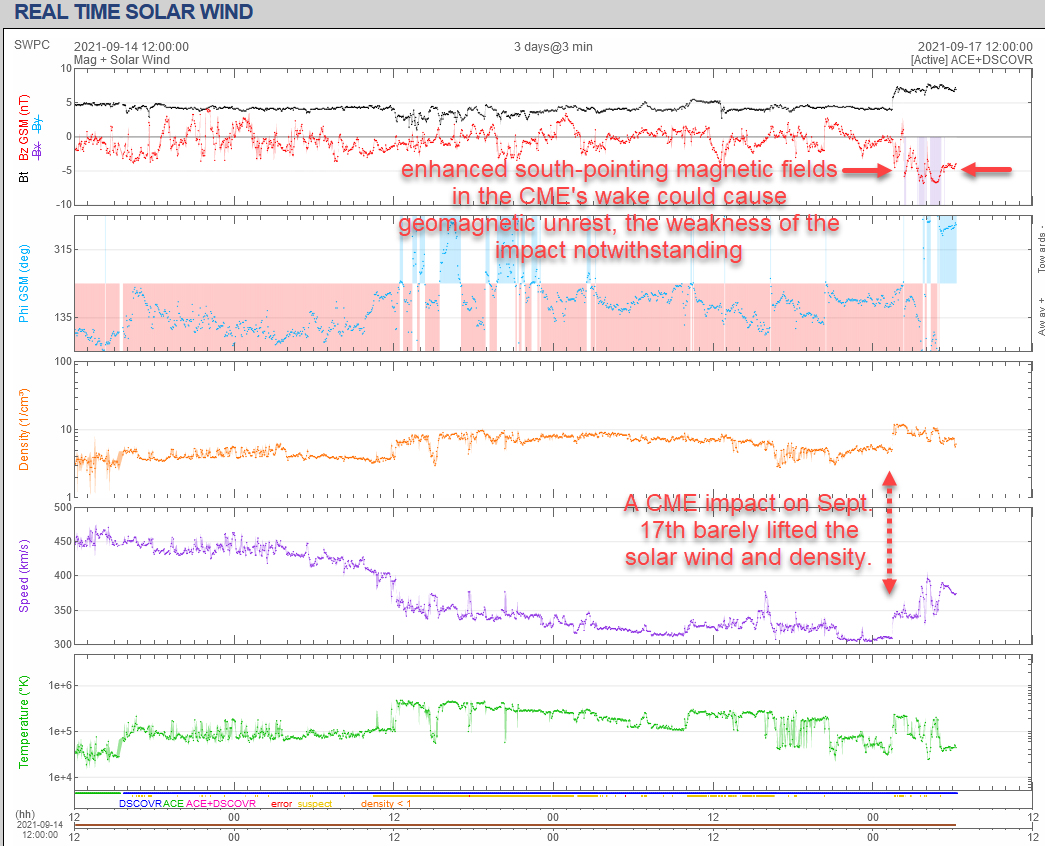
Then the storm began. Magnetic fields in the wake of the CME opened a crack in Earth's magnetosphere. Solar wind poured in to fuel a G1-class geomagnetic storm with 360° polar auroras. All CMEs can perform this trick, even weak ones that land off target. High-latitude sky watchers should therefore be alert on Sept. 23rd, just in case. Instant solar flare alerts: SMS Text.
Realtime Aurora Photo Gallery
Free: Spaceweather.com Newsletter
THE HARVEST MOON: Last night's full Moon occurred less than 48 hours before the northern autumnal equinox. This makes it the "Harvest Moon." Marek Nikodem photographed the pumpkin-colored orb rising near Koronowo, Poland:

Long ago, farmers relied on the light of the Harvest Moon to gather autumn crops after dark. "But, here, the crops are already harvested," says Nikodem. "So instead I scheduled a session with the Moon and a model." Good choice! For more moonshots, browse the photo gallery:
Realtime Space Weather Photo Gallery
Free: Spaceweather.com Newsletter
TO BOLDLY GO WHERE NO MUG HAS GONE BEFORE: There's nothing like morning coffee in a cup from space. See for yourself. The students of Earth to Sky Calculus flew this rare ceramic Capt. Kirk mug to the stratosphere onboard a cosmic ray research balloon. Here it is floating 97,438 feet high, above more than 98% of Earth's atmosphere:
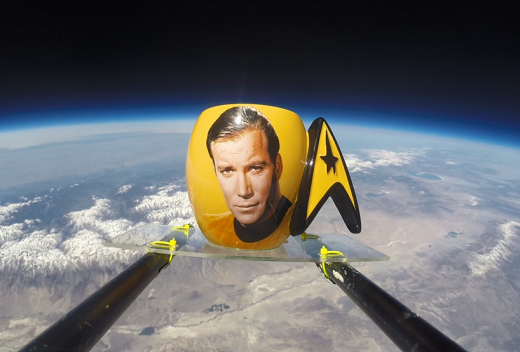
You can have it for $170.10. That's the serial number of the Enterprise divided by 10. The students are selling Star Trek mugs to support their cosmic ray ballooning program. Each one holds 16 oz. of steaming hot Raktajino (Klingon coffee) and comes with a greeting card showing the collector's item in flight.
Far Out Gifts: Earth to Sky Store
All sales support hands-on STEM education