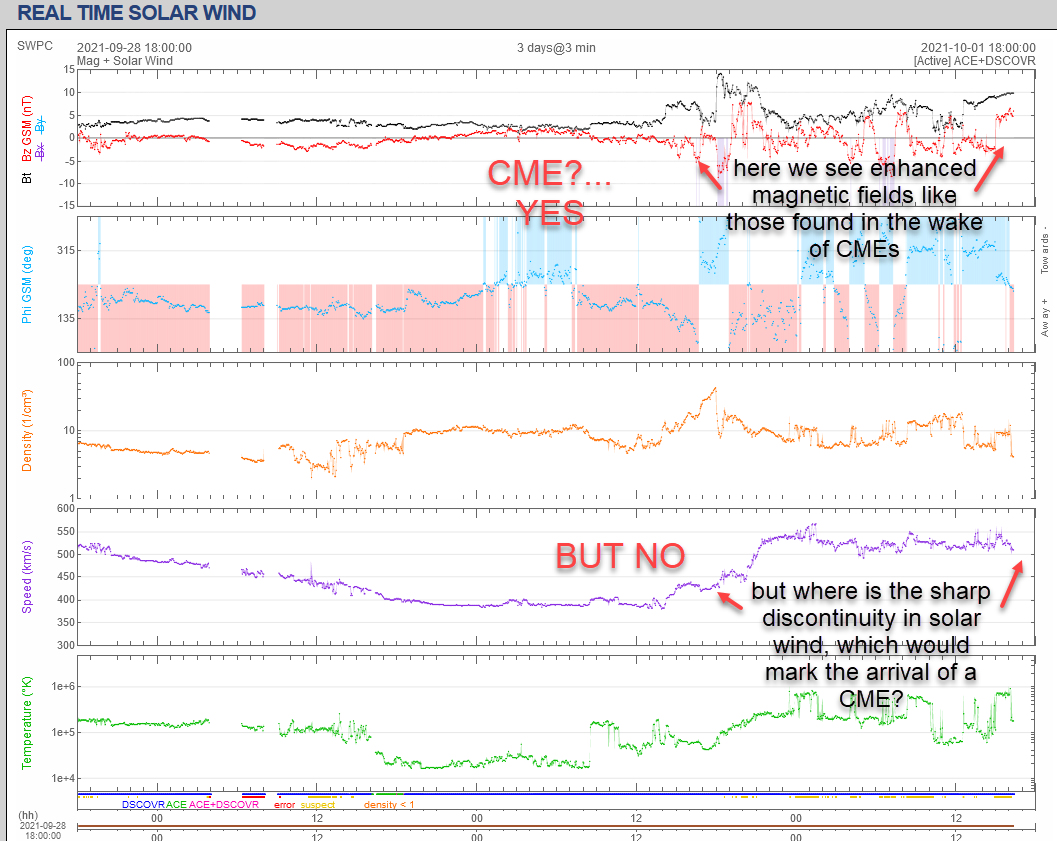
SCHRODINGER'S CME HIT EARTH (NO, IT DIDN'T): Did a CME hit Earth's magnetic field today? An examination of solar wind data reveals evidence for both possibilities: Yes and no. There is no sharp discontinuity in solar wind speed typical of CME strikes. But, yes, there are enhanced magnetic fields like those often found in the wake of CMEs. Whatever happened, it successfully disturbed Earth's magnetic field just enough for some Arctic auroras on Sept. 30th/Oct. 1st. Aurora alerts: SMS Text.
MARTIAN COMMUNICATIONS BLACKOUT: Starting tomorrow, Oct. 2nd, NASA mission controllers will lose contact with spacecraft and rovers at Mars. The two-week blackout is due to the sun. Click on the image, below, to see what's going on:
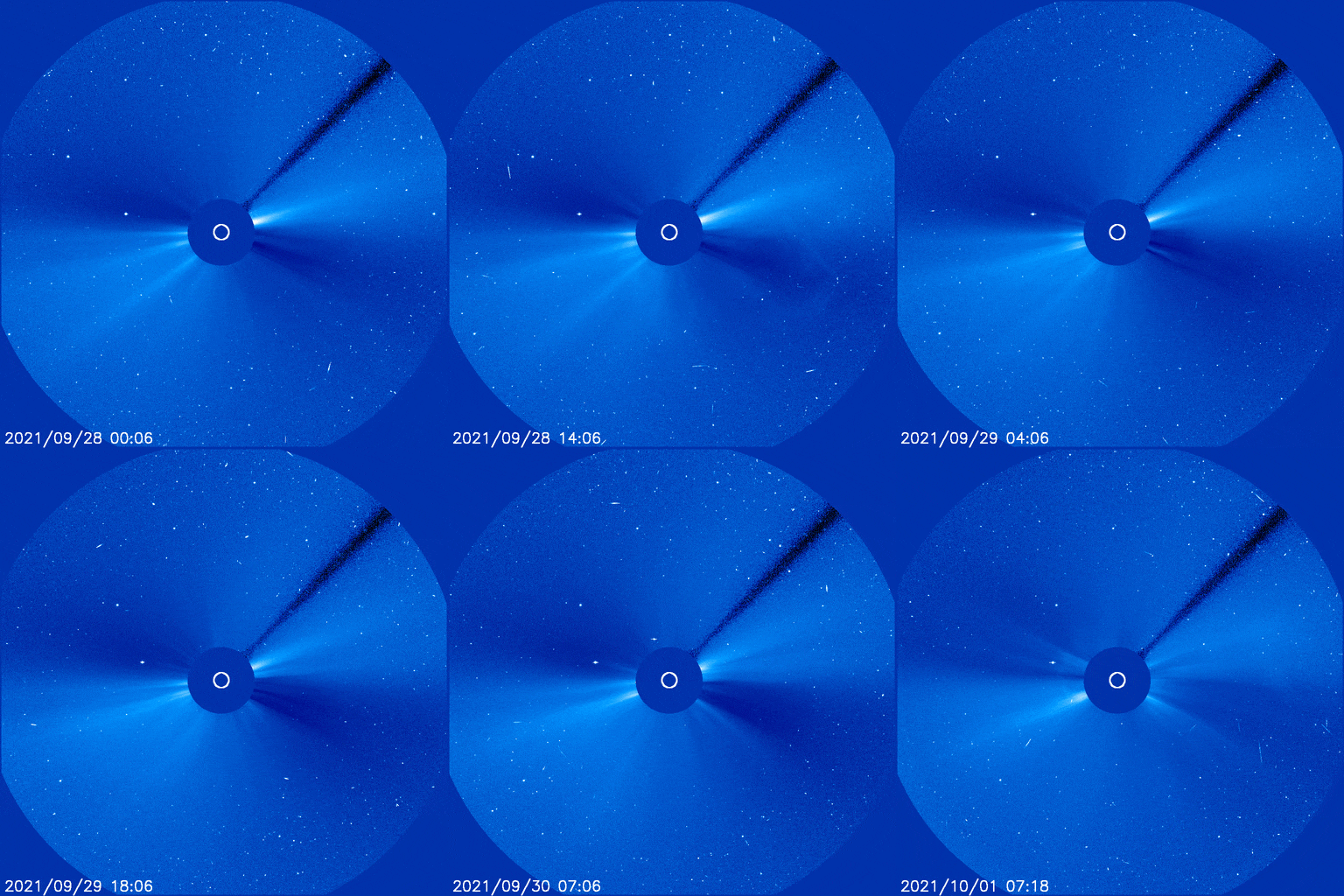
As this 3-day movie from SOHO shows, Mars is approaching the sun for a close encounter. Astronomers call it "solar conjunction." From Oct. 2nd through Oct. 14th, Mars will be within 2 degrees of the sun. Thus, NASA has placed a moratorium on communications.
No one attempts to send new instructions to Mars during solar conjunction. It's impossible to predict what information might be lost due to interference from solar radio bursts or distorted by refraction in the sun's atmosphere. Garbled commands could potentially endanger the spacecraft. Instead, prior to solar conjunction, engineers send two weeks' worth of instructions and wait. See you on the other side, Mars!
Realtime Space Weather Photo Gallery
Free: Spaceweather.com Newsletter
EARTH CAN MAKE ITS OWN AURORAS: No solar storms? No problem. Earth has learned to make its own auroras. New results from NASA's THEMIS-ARTEMIS spacecraft show that a type of Northern Lights called "diffuse auroras" comes from our own planet--no solar storms required.
Diffuse auroras look a bit like pea soup. They spread across the sky in a dim green haze, sometimes rippling as if stirred by a spoon. They're not as flamboyant as auroras caused by solar storms. Nevertheless, they are important because they represent a whopping 75% of the energy input into Earth's upper atmosphere at night. Researchers have been struggling to understand them for decades.
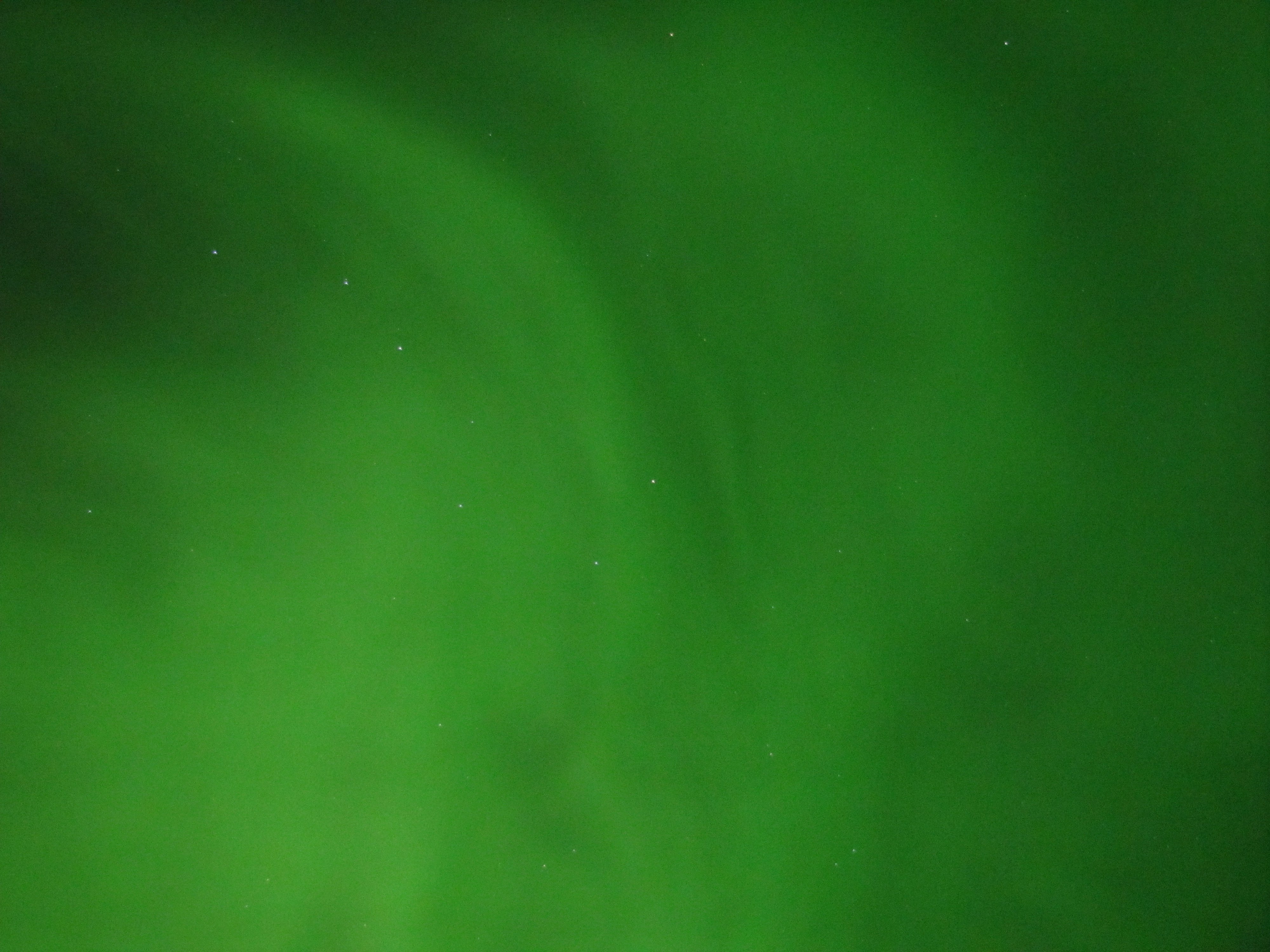
Above: Diffuse auroras and the Big Dipper, photographed by Emmanuel Masongsong in Fairbanks, AK
"We believe we have found the source of these auroras," says UCLA space physicist Xu Zhang, lead author of two papers reporting the results in the Journal of Geophysical Research and Physics of Plasmas.
It is Earth itself. Earth performs the trick using electron beams. High above our planet's poles, beams of negatively-charged particles shoot upward into space, accelerated by electric fields in Earth's magnetosphere. Sounding rockets and satellites discovered the beams decades ago. It turns out, they can power the diffuse auroras.
The video, below, shows how it works. The beams travel in great arcs through the space near Earth. As they go, they excite ripples in the magnetosphere called Electron Cyclotron Harmonic (ECH) waves. Turn up the volume and listen to the waves recorded by THEMIS-ARTEMIS:
Above: The electrical circuit in space, which powers diffuse auroras. ECH waves were sonified by NASA's HARP (Heliophysics Audified: Resonances in Plasmas) software.
ECH waves, in turn, knock other electrons out of their orbits, forcing them to fall back down onto the atmosphere. This rain of secondary electrons powers the diffuse auroras.
"This is exciting," says UCLA professor Vassilis Angelopoulos, a co-author of the papers and lead of the THEMIS-ARTEMIS mission. "We have found a totally new way that particle energy can be transferred from Earth's own atmosphere out to the magnetosphere and back again, creating a giant feedback loop in space."
According to Angelopoulos, Earth's polar electron beams sometimes weaken but they never completely go away, not even during periods of low solar activity. This means Earth can make auroras without solar storms.
The sun is currently experiencing periods of quiet as young Solar Cycle 25 sputters to life. Pea soup, anyone?
An expanded and sharable version of this story may be found here.
Realtime Aurora Photo Gallery
Free: Spaceweather.com Newsletter
STERLING SILVER OPAL PENDANT: It might be the most beautiful space pendant ever: The Sterling Silver Opal. Earth to Sky Calculus just launched one to the stratosphere onboard a cosmic ray research balloon. Here it is floating 103,018 ft above Earth's surface on Sept. 5th:
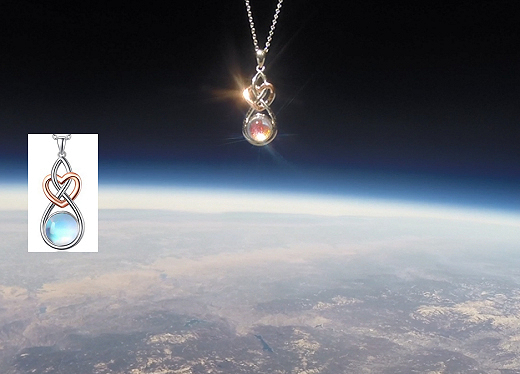
You can have it for $179.95. The opal is wrapped in a sterling silver Celtic love knot and suspended from a matching chain. Anyone who receives this far-out gift will be impressed by the accompanying greeting card, which shows the opal in flight and tells the story of its trip to the edge of space.
Opals are cousins of blue moonstones; in fact, they look much the same in low light. But when bright sunlight strikes an opal, something special happens. A spray of color emerges from the stone. This happened while the opal was in the stratosphere (see above) and it remains capable of this beautiful trick back on Earth.
Far Out Gifts: Earth to Sky Store
All sales support hands-on STEM education