OUT OF THE OFFICE: Narrative updates to Spaceweather.com may be more terse than usual from now until Monday evening, Oct. 4th. Dr. Tony Phillips and the rest of our cosmic ray team are out of the office, making their 3rd attempt to recover a high-altitude balloon payload that landed in a canyon behind Keynot Peak in the Inyo Mountains. Solar flare alerts: SMS Text.
SOLAR CYCLE UPDATE: Solar Cycle 25 continues to overperform. Sunspot counts for Sept. 2021 were the highest in more than 5 years. And, for the 11th month in a row, the sunspot number has significantly exceeded the official forecast.
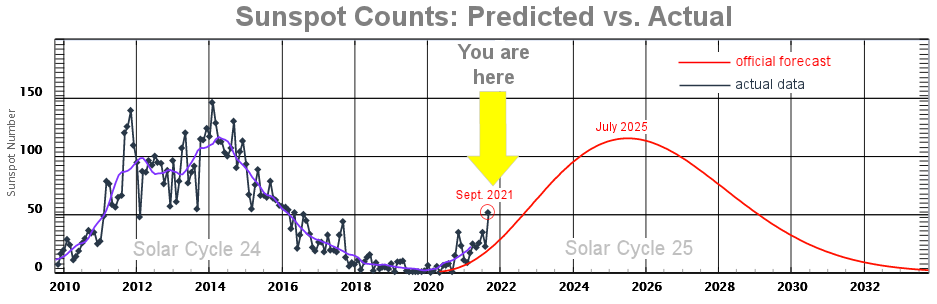
The plot above shows sunspot counts vs. time. The red curve traces the forecast issued by the NOAA/NASA Solar Cycle 25 Prediction Panel in 2019. It calls for a relatively weak solar cycle peaking in July 2025.
The sun has a mind of its own, though. Higher-than-expected sunspot counts suggest a stronger cycle, with a peak occuring in late 2024 instead of mid-2025. This is good news for aurora watchers, but maybe not so good for the Internet.
Realtime Space Weather Photo Gallery
Free: Spaceweather.com Newsletter
GOTCHA! AMATEUR PHOTOGRAPHS MILITARY SPACE PLANE: Did you know there's a space plane orbiting Earth? It's the US Space Force's Boeing X-37B mini-shuttle. Last night Philip Smith trained his 14-inch telescope on the elusive spacecraft as it soared over in Manorville, NY:
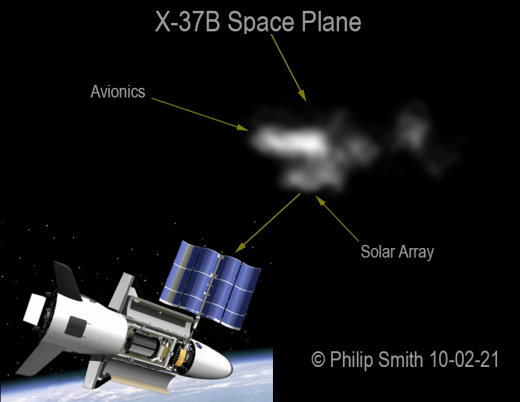
"I let out a loud audible 'GOTCHA' followed by a huge smile," says Smith. "I've been hunting this space plane for a long time."
The X-37B is a semi-secret robotic spacecraft which resembles NASA's old space shuttle. In fact, it started as a NASA project in 1999 before being transferred to the United States Department of Defense in 2004. The X-37B has been orbiting Earth off and on since April 2010, with some flights lasting as long as 780 days in orbit.
"I only wish the seeing had been better so I could get more details," says Smith. Maybe next time. Thanks in part to the efforts of amateur satellite observers, we usually know where the X-37B is. Local flyby predictions may be found at Heaven's Above.
RARE MR. SPOCK MUG (COLLECTOR'S ITEM): It's the logical way to wake up in the morning: Coffee in a rare Mr. Spock mug. The students of Earth to Sky Calculus flew this ceramic collector's item to the stratosphere onboard a cosmic ray research balloon:

You cannot buy these mugs anywhere on the internet--not even Amazon. But you can have one from Earth to Sky Calculus for $170.10. That's the serial number of the Enterprise divided by 10. The mug comes with a greeting card showing the item in flight and telling the story of its journey to the edge of space and back again. It's a great gift for any Trekkie!
Far Out Gifts: Earth to Sky Store
All sales support hands-on STEM education
Realtime Aurora Photo Gallery
Free: Spaceweather.com Newsletter