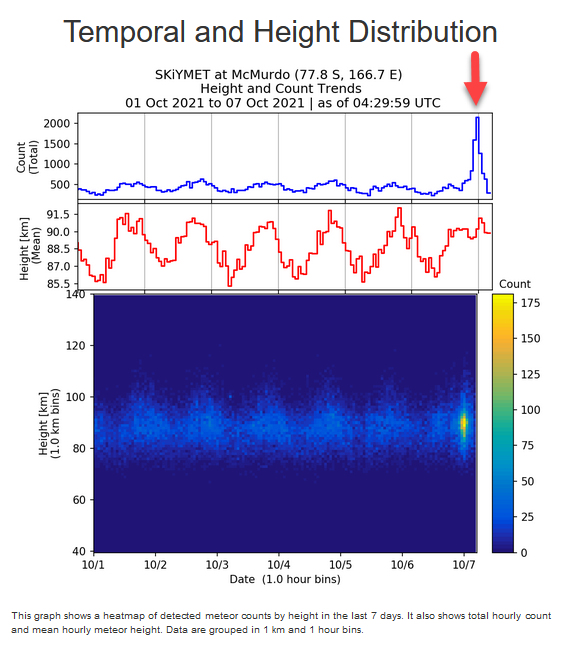
POSSIBLE ANTARCTIC METEOR OUTBURST: The newly-discovered Arid meteor shower (described below) may have just produced an outburst over Antarctica. The University of Colorado Boulder operates a shortwave meteor radar at McMurdo Sound, and it detected a significant peak in meteor activity around 2300 UT on Oct. 6th. That matches the time Earth was expected to encounter a stream of debris from parent comet 15P/Finlay.
A NEW METEOR SHOWER: For thousands of years, Comet 15P/Finlay has been dive-bombing Earth's orbit, leaving trails of dust on our planet's doorstep, yet, strangely, there has never been a meteor shower. Until now. On Sept. 27th, Earth hit a stream of debris from Comet Finlay, and a meteor shower was born.
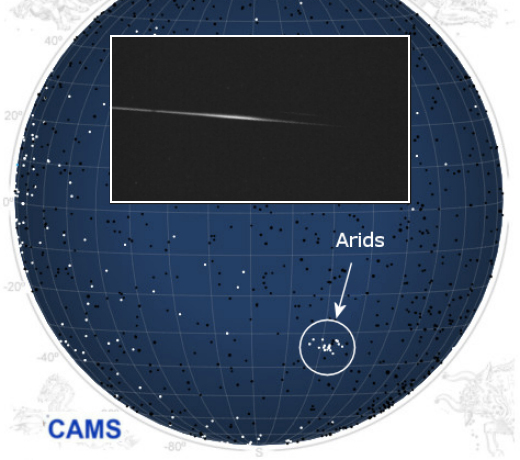
Above: An Arid meteor (inset) detected by the Cerro Tololo station of the CAMS Chile network on Sept. 29. [video] [more]
"It is called the Arid meteor shower, because the meteors radiate from the far-southern constellation Ara, the Altar," explains Peter Jenniskens of the SETI Institute, whose meteor cameras in New Zealand and Chile detected the mini-outburst of 13 Arids.
It's long overdue. Every 6 years, Finlay passes only 0.01 au from Earth's orbit. Somehow, we've dodged the debris. "This is the first time we've ever seen meteors from the comet," says Jenniskens.
The shower might not be over. Earth is poised to hit another of Finlay's debris streams, and this one could trigger a storm.
"We predict an encounter sometime between Oct. 6th at 2200 UT and Oct. 7th at 0100 UT," says astronomer Quanzhi Ye of the University of Maryland. "Forecasts range from ~50 to as many as 1100 meteors per hour."
The debris was ejected by the comet in 2014 and 2015. In those years, something unexpected happened. Astronomers watching Finlay dive through the inner Solar System were surprised when the comet erupted--twice--more than quadrupling in brightness and producing massive jets of gas and dust.
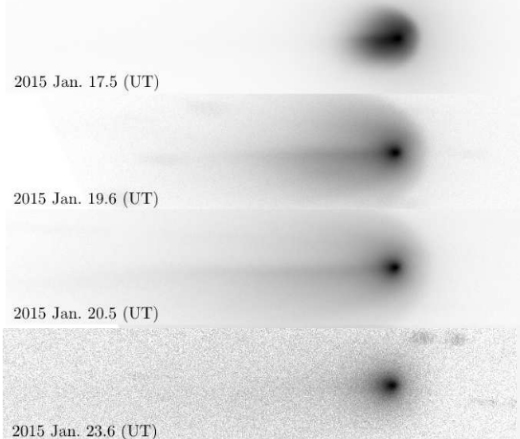
Above: Finlay's outburst in 2015 from "Bangs and Meteors from the Quiet Comet 15P/Finlay" by Ye et al. (Astrophysical Journal, Oct. 2015)
"Somewhere between 100 million and a billion kilograms of material were ejected--about the mass of a small hill," says Ye, who has spent years studying Finlay and its debris.
If Earth grazes this material, a meteor storm could occur. Unfortunately for sky watchers, the best place to see it is in Antarctica. However, the timing also favors observers in parts of South America. "Our cameras are well-positioned to record anything that happens," says Jenniskens. So stay tuned.
Realtime Space Weather Photo Gallery
Free: Spaceweather.com Newsletter
STERLING SILVER MOONSTONE PENDANT: Nothing says "I love you" like a moonstone from space. Here's one floating 112,201 feet above Earth's surface onboard an Earth to Sky Calculus cosmic ray research balloon:
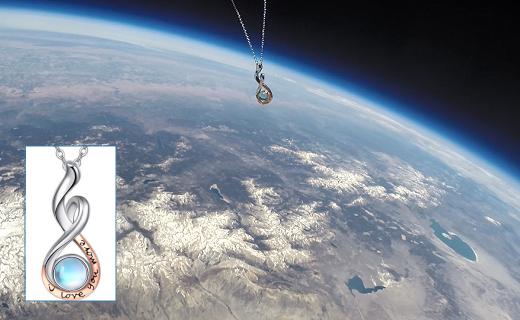
You can have it for $142.95. The students are selling these Sterling silver pendants to support their cosmic ray ballooning program. Engraved with "I Love You More," it makes a great anniversary, birthday or (never too early!) Christmas gift. Each one comes with a greeting card showing the moonstone in flight.
Far Out Gifts: Earth to Sky Store
All sales support hands-on STEM education
Realtime Aurora Photo Gallery
Free: Spaceweather.com Newsletter