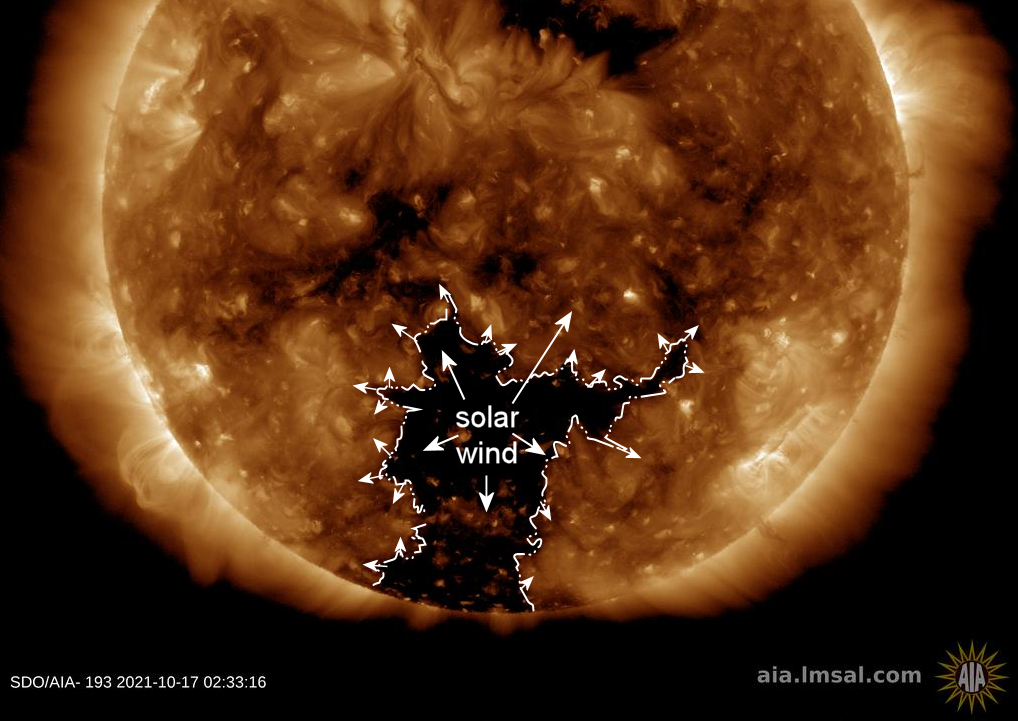
SOLAR WIND, INCOMING: A large southern hole in the sun's atmosphere is spewing solar wind toward Earth. ETA: Oct. 19-20. Solar wind speeds could top 500 km/s, sparking auroras around the Arctic Circle. Aurora alerts: SMS Text.
CHASING THE ELUSIVE 'SAR': Pro tip for aurora photographers: Double-check your images. You might have caught an elusive SAR. Jun Wang photographed this specimen over Lake Louise, Alberta, during last week's G2-class geomagnetic storm:

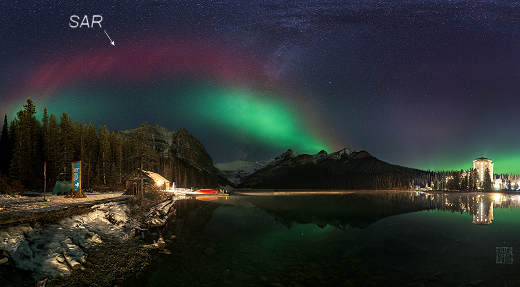
"At the time, I didn't notice the red arc," says Wang. "I found it later, at home, while I was processing the photos."
SARs are related to auroras, but they are not the same. Regular auroras appear when charged particles rain down from space, hitting the atmosphere (100-200 km high) and causing it to glow like the picture tube of an old color TV. SARs form differently. They are a sign of heat energy leaking into the upper atmosphere (~400 km high) from Earth's ring current system.
The vivid red arcs were discovered in 1956 at the beginning of the Space Age and have been recorded by cameras on satellites hundreds of times since. Most aurora watchers have never seen one, though, because SARs are usually faint.
Wang's experience is typical. He couldn't see the SAR, but it was there, easy to capture in a long exposure. During stronger storms, G3 and above, SARs can become naked-eye objects. Widespread sightings may be just a matter of time as young Solar Cycle 25 intensifies. Meanwhile, double-check your photos.
Realtime Space Weather Photo Gallery
Free: Spaceweather.com Newsletter
STERLING SILVER OPAL PENDANT: It's our most beautiful space pendant ever: The Sterling Silver Opal. The students of Earth to Sky Calculus just launched one to the stratosphere onboard a cosmic ray research balloon. Here it is floating 103,018 ft above Earth's surface on Sept. 5th:
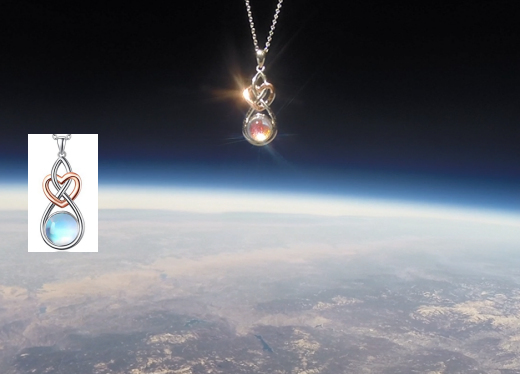
You can have it for $179.95. Wrapped in a sterling silver Celtic love knot, the opal is suspended from a matching 18-inch chain. Each pendant comes with a greeting card showing the opal in flight, telling the story of its trip to the edge of space and back again.
Opals are cousins of moonstones; in fact they look the same in low light. But when bright sunlight strikes an opal, something special happens. A spray of color emerges from the stone. This happened while the stone was in the stratosphere (see above) and it remains capable of this beautiful trick back on Earth.
Far Out Gifts: Earth to Sky Store
All sales support hands-on STEM education
Realtime Aurora Photo Gallery
Free: Spaceweather.com Newsletter