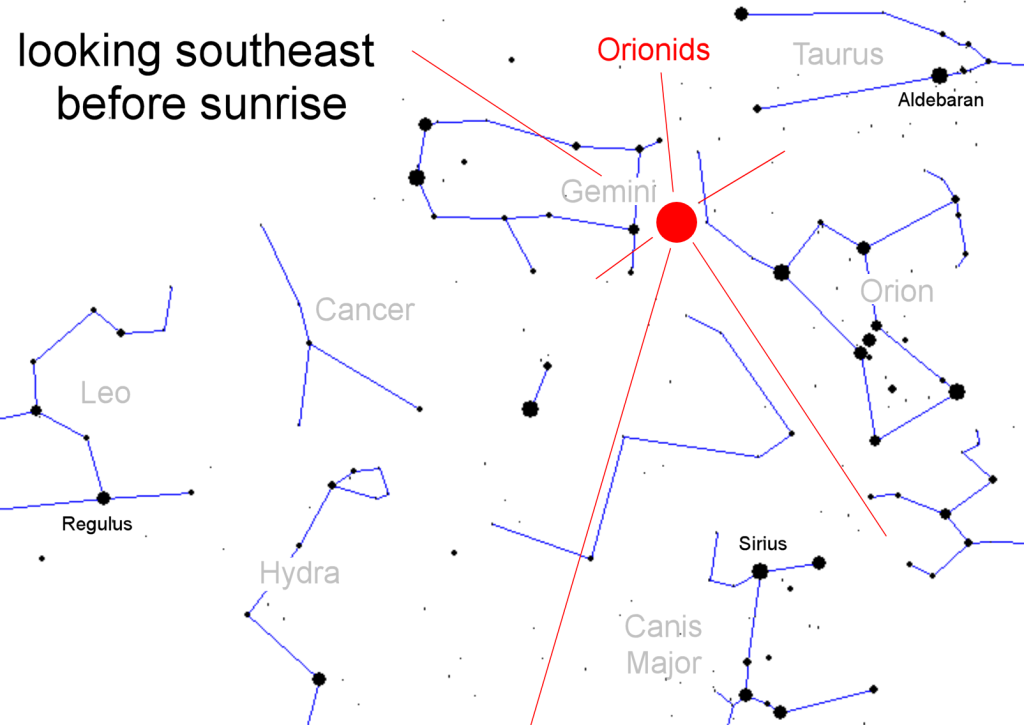
THE ORIONID METEOR SHOWER: Earth is entering a stream of debris from Halley's comet, source of the annual Orionid meteor shower. Forecasters expect the shower to peak on Thursday morning, Oct. 21st. Interference from the Hunter's Moon will reduce visible meteor rates from the usual 20 to only 5 Orionids per hour. Browse: photo gallery, sky map.
SPRITES AT THE FEET OF ORION: Oklahoma storm chaser Paul Smith has photographed a lot of sprites, hundreds since he began targeting the elusive bolts 4 years ago. This month, for the first time, he caught them dancing at the feet of Orion:
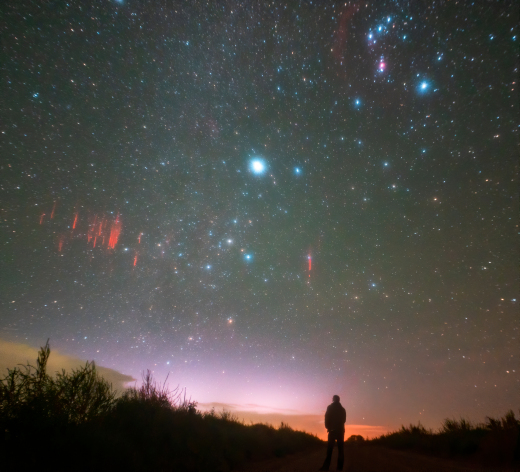
"This is something I've wanted to photograph for a long time," says Smith. "It's tricky, because the severe storms which create sprites tend to occur in spring and summer, but this shot is really only available in the fall."
On Oct. 13th, a system of autumnal thunderstorms began to form over Oklahoma. Smith seized the opportunity: "I drove a little further than normal and stayed out until the early hours of the morning, hoping that the storms would strengthen under Orion. Just before sunrise, they did!"
"I could actually see the sprites with my unaided eyes, so I knew the composition had worked," he says. "Haze in the image caused by a bit of dew on the lens makes it look dream-like, which is in fact how the moment felt to me."
Readers, would you like to take a shot like this? Smith will teach you in one of his unique Sprite Workshops.
Realtime Space Weather Photo Gallery
Free: Spaceweather.com Newsletter
SHADES OF THE RED (GIANT): Everyone knows Betelgeuse is a red giant. It's also yellow, blue, green and violet. The other colors appear, oh so briefly, when the star twinkles. Soumyadeep Mukherjee captured the full spectrum on Oct. 14th when he took 1300 rapid-fire images of Betelgeuse and assembled them as follows:
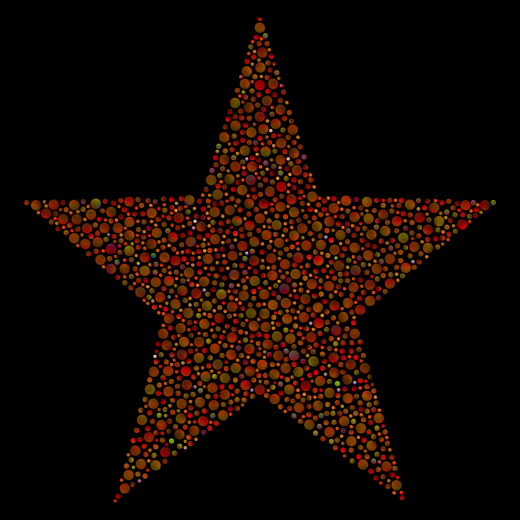
Take a look at the full-resolution image. Each dot is an individual image of Betelgeuse. "They are different sizes," explains Mukherjee, "because they were recorded with different amounts of defocusing. The defocusing was done intentionally to make the colors prominent. I shot a total of 1500 images and randomly selected 1300 images to compose the final 'star.'"

Twinkling is strongest when a star is near the horizon, receiving the full prismatic distortion of the low atmosphere. Mukherjee took advantage of this fact to improve his composition. "Betelgeuse was around 12-18 degrees above the horizon when I sampled its colors," he says..
STERLING SILVER OPAL PENDANT: It's our most beautiful space pendant ever: The Sterling Silver Opal. The students of Earth to Sky Calculus just launched one to the stratosphere onboard a cosmic ray research balloon. Here it is floating 103,018 ft above Earth's surface on Sept. 5th:
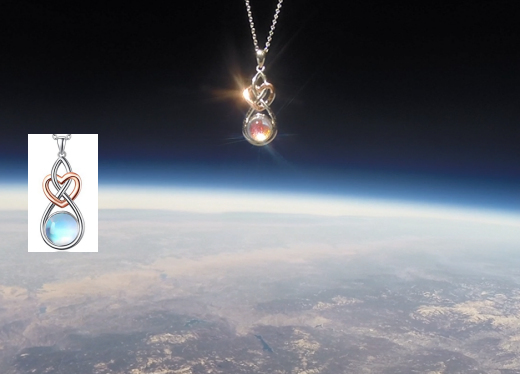
You can have it for $179.95. Wrapped in a sterling silver Celtic love knot, the opal is suspended from a matching 18-inch chain. Each pendant comes with a greeting card showing the opal in flight, telling the story of its trip to the edge of space and back again.
Opals are cousins of moonstones; in fact they look the same in low light. But when bright sunlight strikes an opal, something special happens. A spray of color emerges from the stone. This happened while the stone was in the stratosphere (see above) and it remains capable of this beautiful trick back on Earth.
Far Out Gifts: Earth to Sky Store
All sales support hands-on STEM education
Realtime Aurora Photo Gallery
Free: Spaceweather.com Newsletter