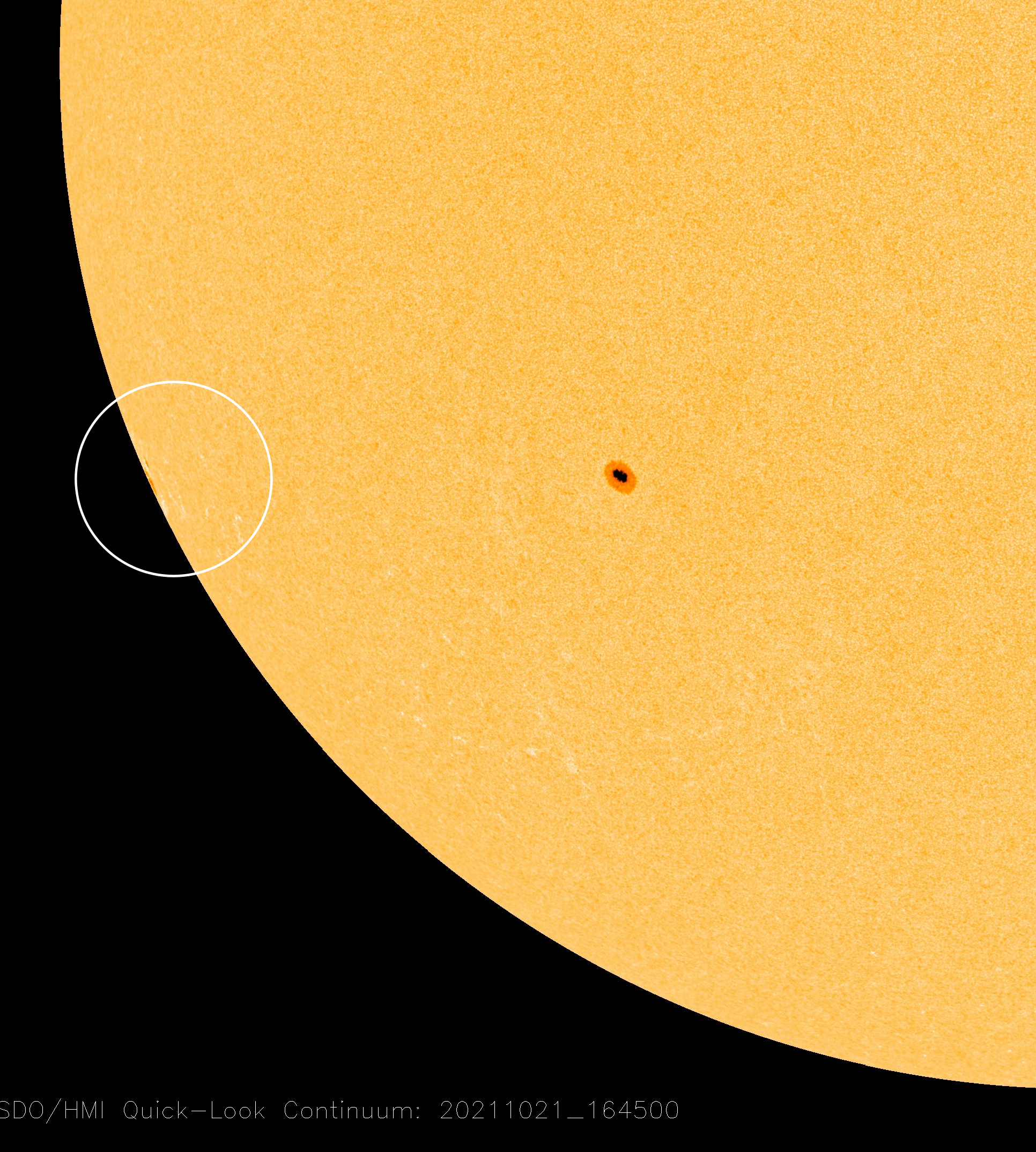
ACTIVITY ON THE SUN'S EASTERN LIMB: A new sunspot group is emerging over the sun's southeastern limb, right here. It is crackling with activity. An intensifying series of minor B-class solar flares is probably stronger than it looks because each explosion has been partially eclipsed by the edge of the sun. Solar flare alerts: SMS Text.

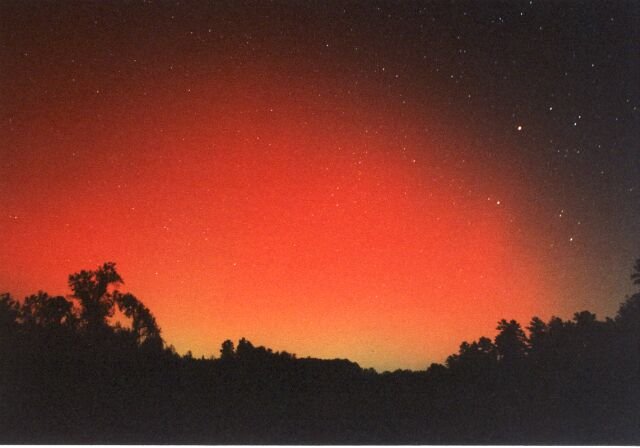
20 YEARS AGO, A SEVERE GEOMAGNETIC STORM: Paolo Bardelli will never forget Oct. 21, 2001. "The sky over my hometown in Italy suddenly filled with intense red auroras," he recalls. "This happened exactly 20 years ago today."
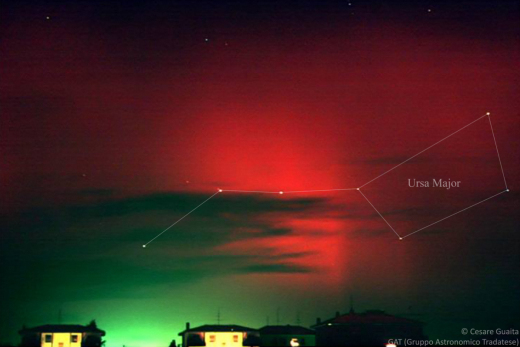
Above: Red auroras over Tradate, Italy (latitude +45N), on Oct. 21, 2001. Photo credit: Cesare Guaita
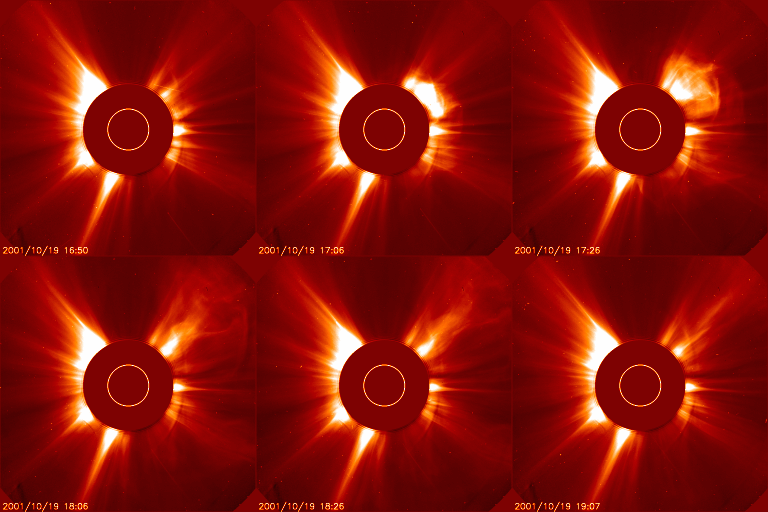
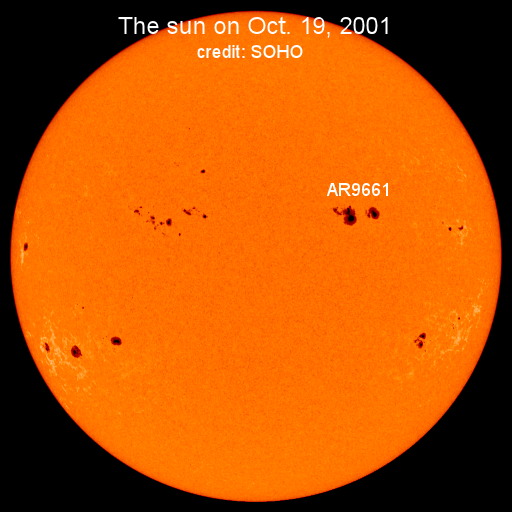
A trip down memory lane: In 2001, Solar Cycle 23 was peaking and solar activity was very high. Strong flares were a daily occurance. On Oct. 19th, giant sunspot AR9661 erupted twice in quick succession, producing almost identical X1.6-class solar flares. The double blast hurled two bright CMEs toward Earth: CME #1, CME #2.
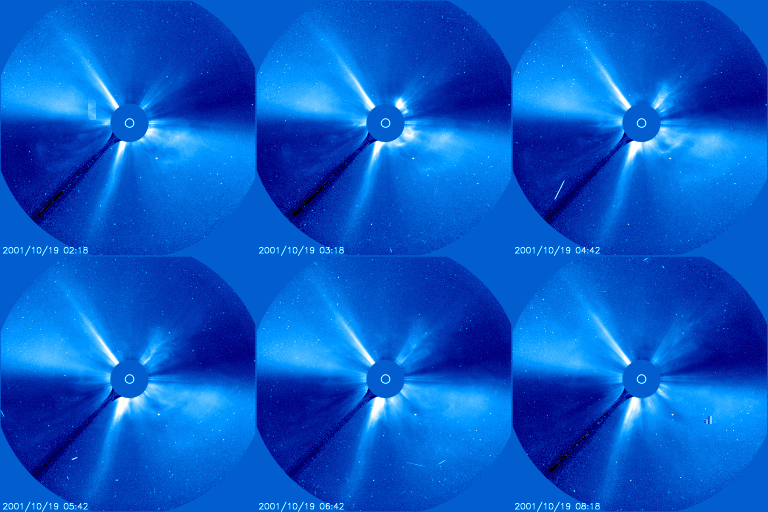
This is what the sun looked like that day:
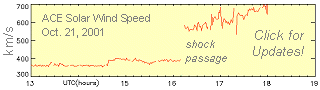
The first CME took only two days to reach Earth. It was fast and potent. The storm cloud's arrival on Oct. 21, 2001, ignited a severe geomagnetic storm (Kp=8). Solar wind speeds in the CME's wake topped 700 km/s, keeping the storm going for more than 15 hours.
In Troutman, North Carolina, Ronnie Sherril witnessed the CME's impact. "Auroras were visible in twilight even before the evening sky faded to black," says Sherril, who took this picture at 7:30 pm local time:
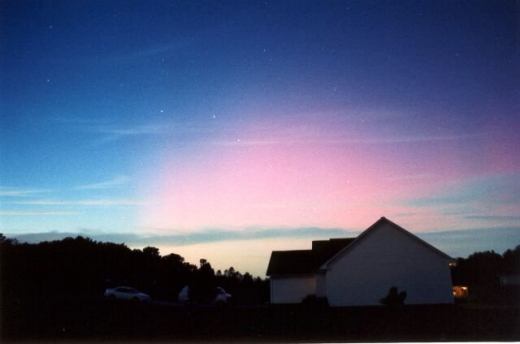
"By 10:30 pm the sky had exploded into bright red with yellowish beams," says Sherril. "What an awesome display!"
Less than a day later the second CME arrived, and it happened all over again. Another 15 hours of strong-to-severe storming ensued. Using data from a global network of magnetometers, NOAA made this record of planetary K-indices during the two-day event:
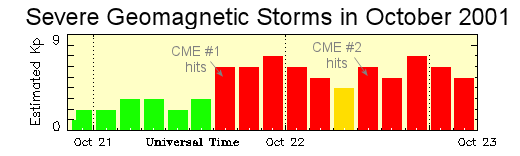
Red auroras were sighted in Germany, France, Italy, Spain, Australia, Japan, and in the United States as far south as latitude 35N. Remarkably, there were no widespread power outages or satellite disruptions. The Internet functioned normally throughout. It was mainly an aurora show.
Some observers are ready for more. "We are hoping for something similar for Solar Cycle 25, as the sun has recently had a good increase in its activity," says Bardelli. Indeed, young Solar Cycle 25 is intensifying, but Solar Max isn't expected for another 3 to 4 years. Until then, browse the Oct. 2001 photo gallery:
October 2001 Aurora Photo Gallery
Free: Spaceweather.com Newsletter
VOYAGER GOLDEN RECORD ORNAMENT: This is a must-have Christmas ornament for space fans: The Voyager Golden Record. On Oct. 15th, the students of Earth to Sky Calculus launched it to the stratosphere onboard an cosmic ray research balloon:
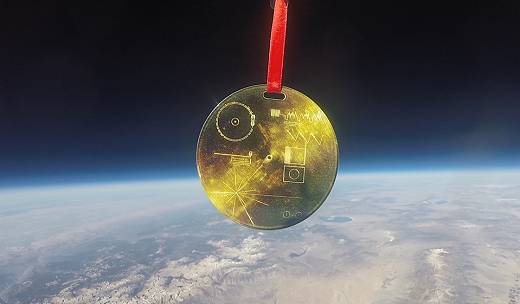
You can have it for $129.95. The 4-inch aluminum disk is imprinted with instructions intended for extraterrestrials, telling them how to play the phonographs now sailing through interstellar space onboard NASA's Voyager probes. Having touched the edge of space, it's the closest thing on Earth to an actual Golden Record.
The students are selling these unique ornaments to support their cosmic ray ballooning program. Each one comes with a greeting card showing the ornament in flight and extra materials decoding the markings on the disk.
Far Out Gifts: Earth to Sky Store
All sales support hands-on STEM education
Realtime Aurora Photo Gallery
Free: Spaceweather.com Newsletter
Realtime Space Weather Photo Gallery
Free: Spaceweather.com Newsletter