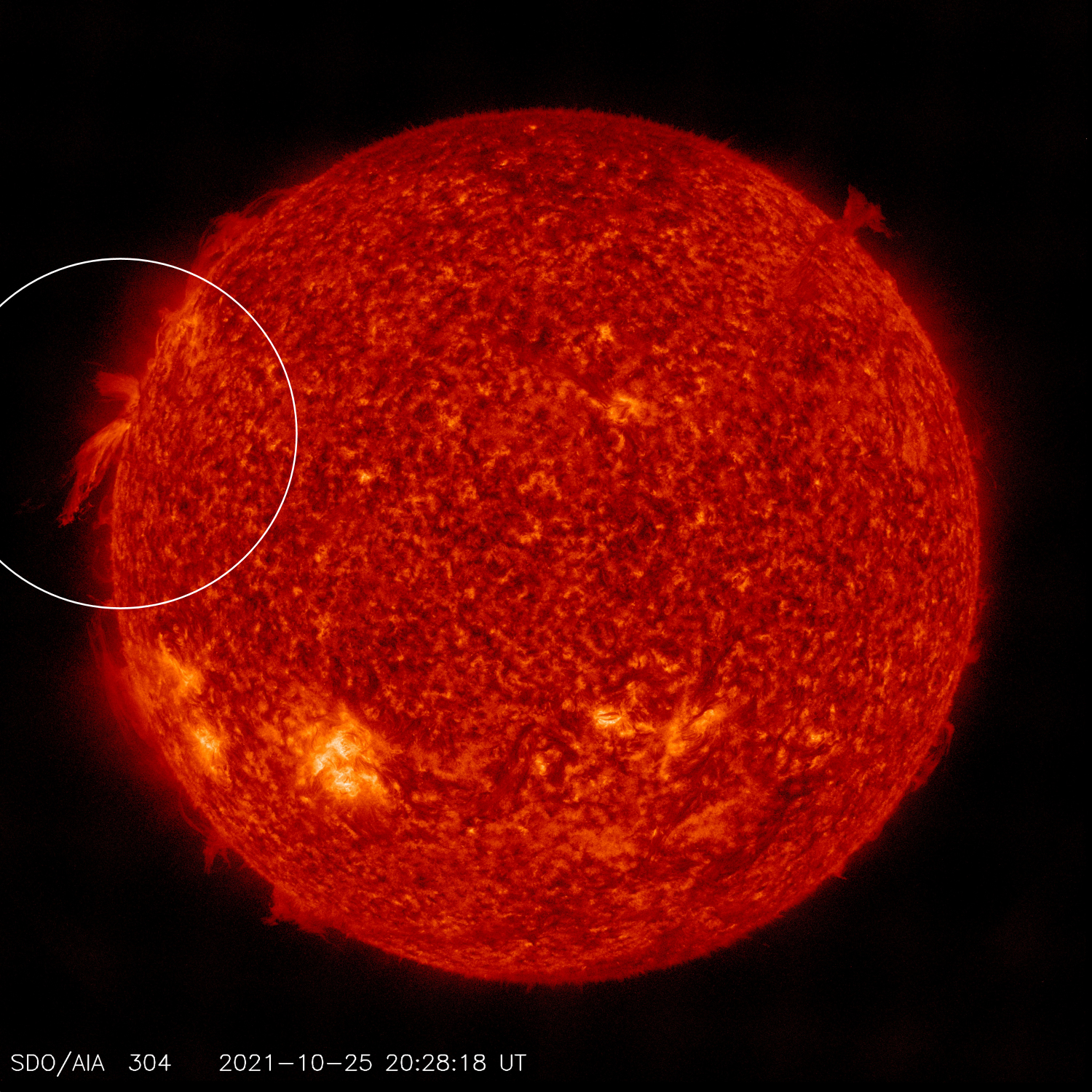
FARSIDE SOLAR FLARE: A farside sunspot erupted on Oct. 25th (1958 UT), producing a C8-class solar flare. Located just behind the sun's northeastern limb, the active region will soon turn to face Earth. Solar flare alerts: SMS Text.
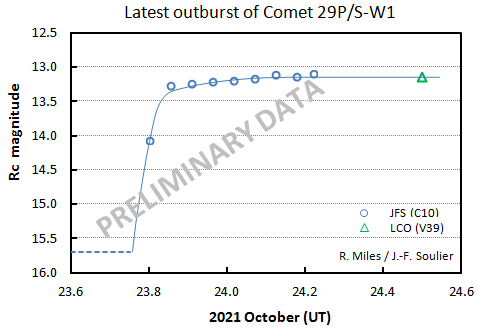
COMET 29P ERUPTS AGAIN: The British Astronomical Association (BAA) is reporting another strong outburst of Comet 29P/Schwassmann-Wachmann. The volcanic comet suddenly brightened 10-fold on Oct. 23.75 UT when a sunlit vent opened, spewing 'cryomagma' into space. Dr. Richard Miles of the BAA provided this light curve:
Comet 29P is one of the strangest objects in the solar system. In fact, it strains the definition of "comet." 29P is a ball of ice 60 km wide (much larger than a typical comet) trapped in a planet-like orbit between Jupiter and Saturn. It appears to be festooned with ice volcanoes which erupt ~20 times a year.
A rapidfire "super-eruption" of 4 volcanoes in late September created an expanding shell of vaporized cryomagma, which astronomers have been monitoring. Yesterday's eruption propelled a new compact shell into the old larger one:
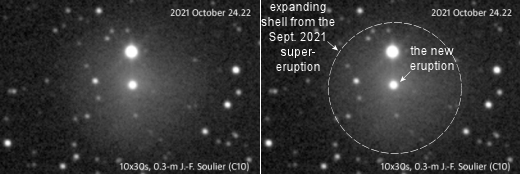
Above: Comet 29P photographed less than 12 hours after the Oct. 23rd eruption. Credit: Jean-Francois Soulier of France.
29P rotates once every ~58 days. As sunlight sweeps across its frozen surface, cryovolcanoes erupt under the high sun. "The latest eruption has taken place some 59 days after a similar event on August 25th, and may be an example of an outburst from the same cryovolcano erupting a second time on the next rotation of the nucleus," says Miles.
Amateur astronomers with mid-sized telescopes and astrophotography experience are encouraged to monitor 29P. It changes every night. The comet is located in the constellation Auriga, high in the northern sky at midnight. Point your optics here and check the BAA's Mission 29P website for updates.
more images: from Andrea Aletti of Campo dei Fiori Mount, Varese , Italy
Realtime Space Weather Photo Gallery
Free: Spaceweather.com Newsletter
VOYAGER GOLDEN RECORD ORNAMENT: This is a must-have Christmas ornament for space fans: The Voyager Golden Record. On Oct. 15th, the students of Earth to Sky Calculus launched it to the stratosphere onboard a cosmic ray research balloon:
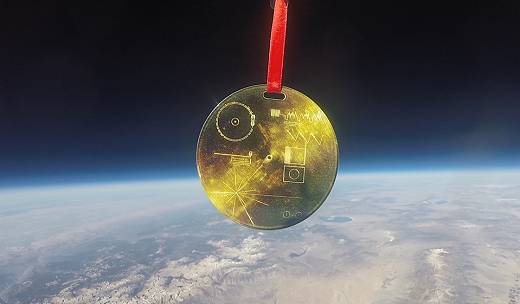
You can have it for $129.95. The 4-inch aluminum disk is imprinted with instructions intended for extraterrestrials, telling them how to play the phonographs now sailing through interstellar space onboard NASA's Voyager probes. Having touched the edge of space, it's the closest thing on Earth to an actual Golden Record.
The students are selling these unique ornaments to support their cosmic ray ballooning program. Each one comes with a greeting card showing the ornament in flight and extra materials decoding the markings on the disk.
Far Out Gifts: Earth to Sky Store
All sales support hands-on STEM education
Realtime Aurora Photo Gallery
Free: Spaceweather.com Newsletter