THE STORM IS OVER: Earth's magnetic field is calming as our planet exits the wake of a Cannibal CME, which struck on Nov. 3rd. Almost 20 hours of strong geomagnetic storms followed the CME's impact. During the apex of the category G3 event, auroras were sighted as far south as California, New Mexico and Colorado. The storm is over now. Aurora alerts: SMS Text.
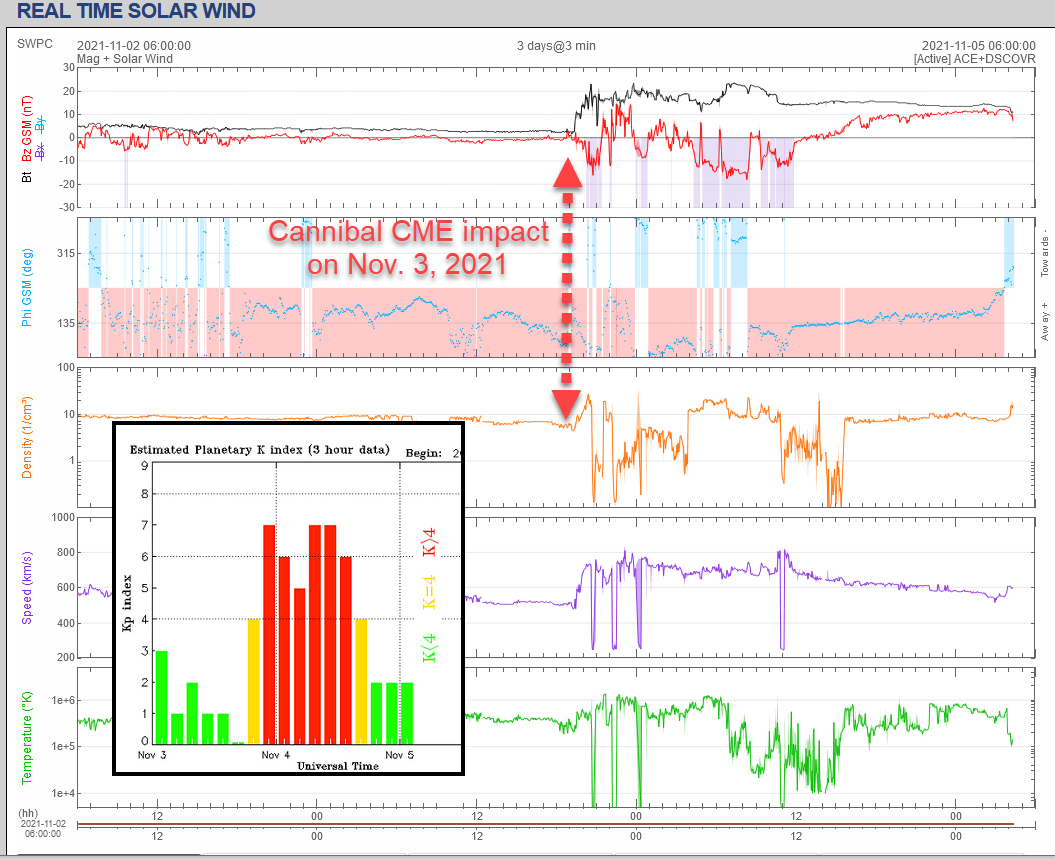

AURORA SOUNDS RECORDED DURING STRONG GEOMAGNETIC STORM: For centuries, Arctic sky watchers have occasionally reported strange sounds filling the air as Northern Lights danced overhead. Hisses, crackles, and even loud "claps" have been heard and recorded. Are they real? Evan Ludes of South Dakota is believer. On Nov. 4th, he heard strange sounds after a Cannibal CME hit Earth's magnetic field, sparking a strong geomagnetic storm:
"After pulling off the highway to observe the pulsing green aurora, I shut off my car engine and heard buzzing and chirping," says Ludes. "At first I thought the noise was being created by birds, which would have been very unusual for the middle of the night. Upon further investigation the sound seemed to be emanating from nearby power lines or barbed wire fencing. "
"In one instance," he says, "the noise seemed to be synced with quick pulses of auroral light. The auroras were flickering, something I had never seen before. It was bizarre."
Aurora sounds are controversial. Despite innumerable reports over the years, researchers have struggled to explain the phenomenon and sometimes suggested that they might be imaginary. Recently, however, Prof. Emeritus Unto K. Laine of Finland's Aalto University has shown that at least some of the sounds are real. Using arrays of microphones in Finland, he has recorded instances of "geomagnetic thunder." The chirps Ludes recorded seem to be a different type of noise, but perhaps no less authentic.
Advice to observers: The next time a geomagnetic storm erupts, don't just look. Try listening as well.
Realtime Aurora Photo Gallery
Free: Spaceweather.com Newsletter
THE CITRINE X-PENDANT: It's the color of a sunburst: The Citrine X-Pendant. On Oct. 15, 2021, the students of Earth to Sky Calculus launched one to the stratosphere onboard an cosmic ray research balloon. At the apex of the flight it floated 120,892 feet above Earth's surface--a record high for our 10-year ballooning program:
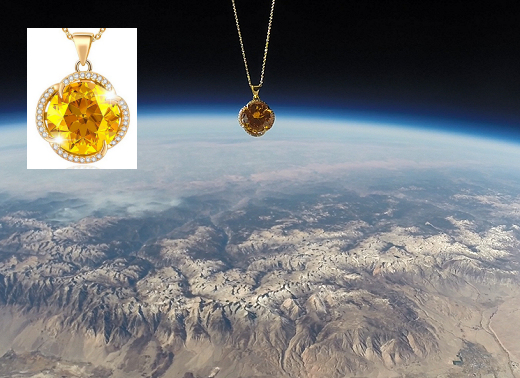
You can have it for $169.95. The citrine gemstone is framed in an 18K gold-plated swirl with a matching 16-inch chain. The students are selling these pendants to support their cosmic ray ballooning program. Each one comes with a greeting card showing the necklace in flight and telling the story of its journey to the edge of space.
Far Out Gifts: Earth to Sky Store
All sales support hands-on STEM education
Realtime Space Weather Photo Gallery
Free: Spaceweather.com Newsletter