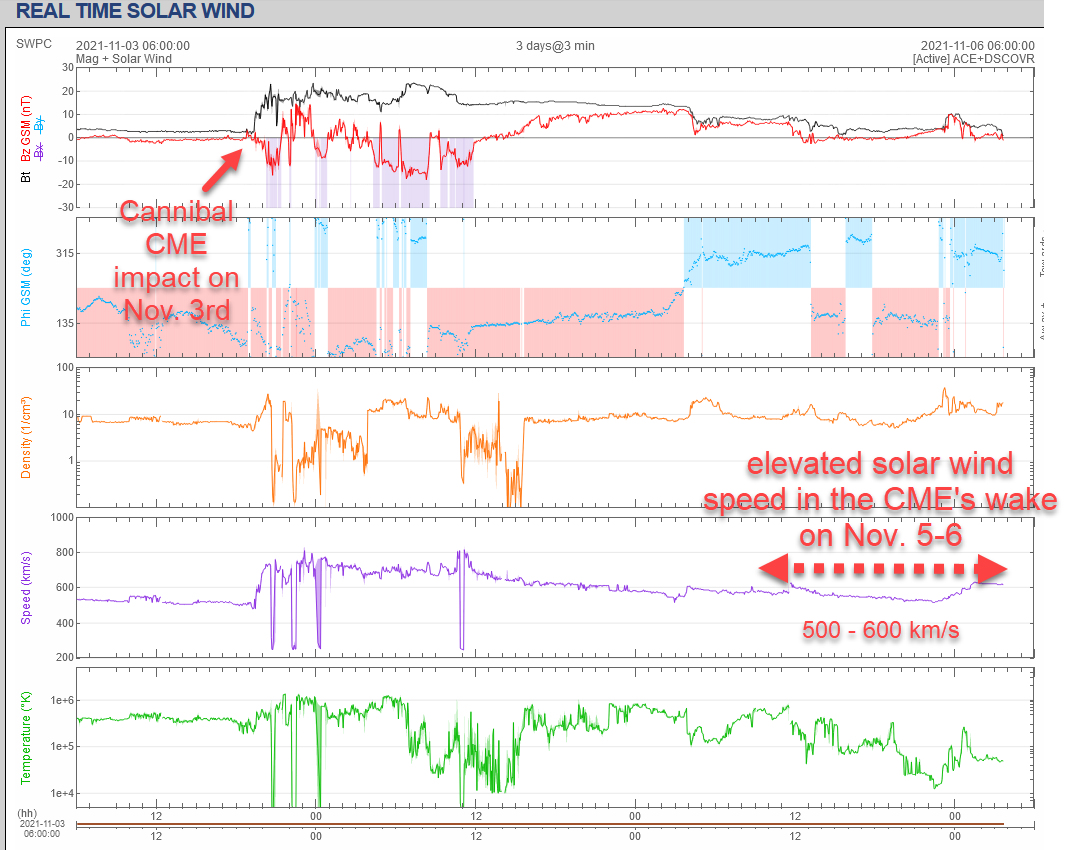
MOSTLY QUIET: This weekend, the sun is taking a break from big explosions. Quiet conditions have returned to most of Earth's magnetosphere. The exception: Inside the Arctic Circle where elevated solar winds could spark auroras without a geomagnetic storm. Aurora alerts: SMS Text.
BACK IN THE DAYS WHEN AURORAS WERE BLACK AND WHITE: This past week's big geomagnetic storm brought back some old memories for Canadian photographer Brian Martin. "Here is a picture I took 53 years ago on November 1, 1968."
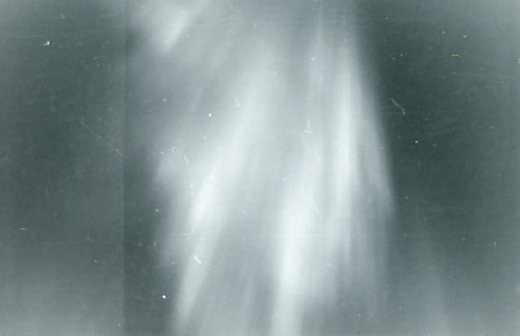
"How technology has changed!" says Martin. "The image was taken with a 50 mm lens, 15s exposure using a Tri-X emulsion. This was one of the brightest displays I have ever seen and had this been colour film, the auroras would have been violet and red."
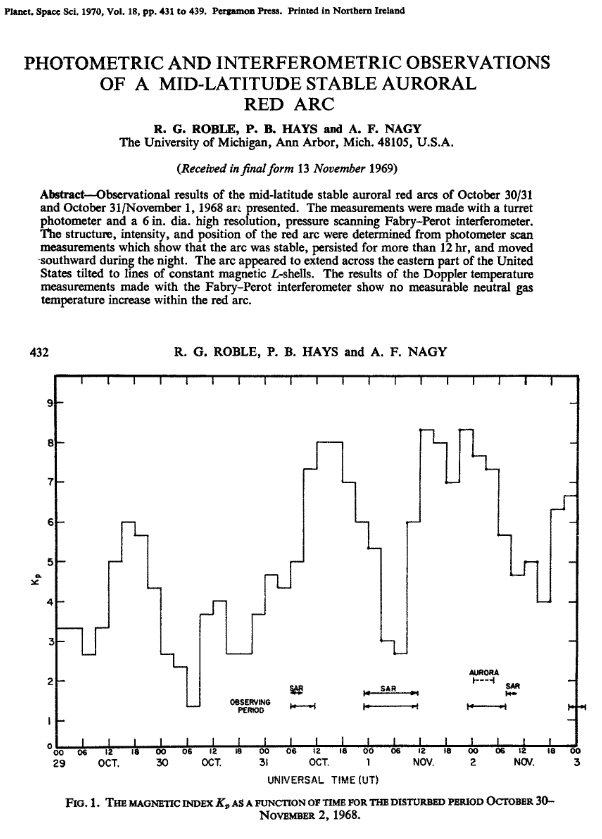
Most people have forgotten the Great Storm of Oct. 31-Nov 2, 1968. Researchers believe that a powerful CME struck Earth's magnetic field. No one is certain, though, because in those days CMEs had not yet been discovered. During the 3-day event, storm levels reached category G4 (Kp=8). It was almost three times longer and (on average) two times stronger than last week's G3 storm.


"I was a callow youth of 14 at the time," recalls Martin. "The event came as a complete surprise. My future wife also saw it and was convinced it was 'the end of times!' Luckily it wasn't! The storm was visible right after sunset and the Moon was nearing full. I have not again seen such an all-sky red aurora that lasted as long or was as bright."
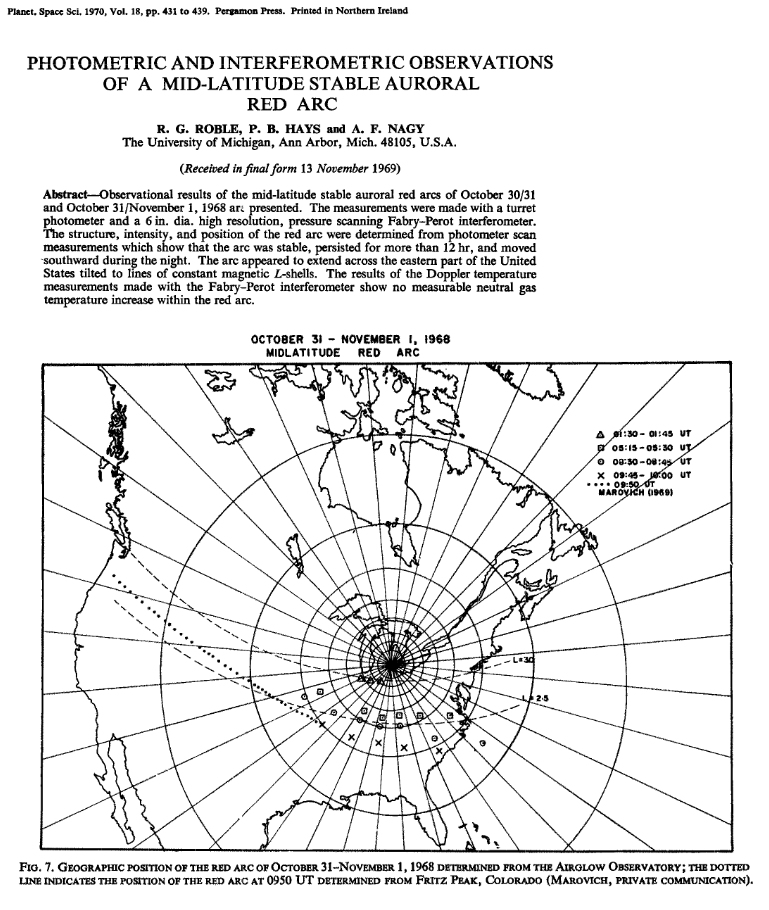
Above: Curved lines in this map show how far south the SARs spread. Regular auroras were sighted even farther south. [more] [ref]
The storm resulted in a flurry of research papers. Many were focused on SARs, strange red arcs of light that descended into the United States. SARs are not auroras. Auroras appear when particles rain down from space, lighting up the atmosphere like the picture tube of an old TV. SARs form differently. They are a sign of heat energy leaking into the upper atmosphere (~400 km high) from Earth's ring current system. Usually confined to polar regions, the SARs of Nov. 1, 1968, were photographed as far south as Colorado.
All this happened during the peak of Solar Cycle 20, a middle-of-the-road cycle, neither remarkably weak nor remarkably strong. Current Solar Cycle 25 is shaping up to be about the same. Deja vu, anyone?
Realtime Aurora Photo Gallery
Free: Spaceweather.com Newsletter
THE CITRINE X-PENDANT: It's the color of a sunburst: The Citrine X-Pendant. On Oct. 15, 2021, the students of Earth to Sky Calculus launched one to the stratosphere onboard an cosmic ray research balloon. At the apex of the flight it floated 120,892 feet above Earth's surface--a record high for our 10-year ballooning program:
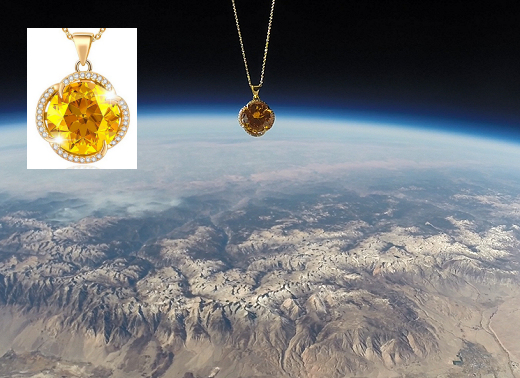
You can have it for $169.95. The citrine gemstone is framed in an 18K gold-plated swirl with a matching 16-inch chain. The students are selling these pendants to support their cosmic ray ballooning program. Each one comes with a greeting card showing the necklace in flight and telling the story of its journey to the edge of space.
Far Out Gifts: Earth to Sky Store
All sales support hands-on STEM education
Realtime Space Weather Photo Gallery
Free: Spaceweather.com Newsletter