FARSIDE SOLAR FLARE: AN active region located just behind the sun's northeastern limb unleashed a strong M2-class solar flare today, Nov 9th @ 17:01 UT: movie. X-rays from the flare caused a minor shortwave radio blackout over the Americas: map. The explosion almost certainly produced a CME, but it won't be Earth-directed because of the blast site's farside location. Solar flare alerts: SMS Text.


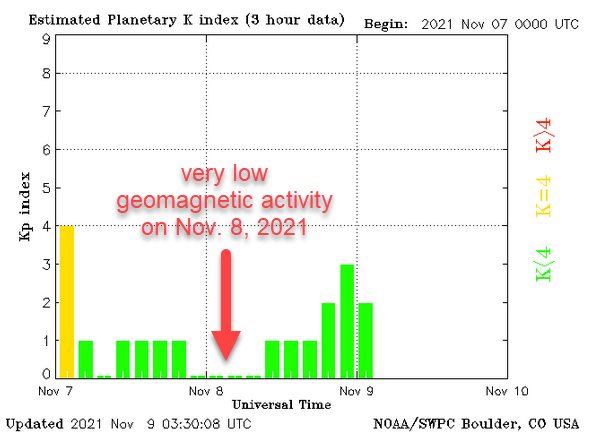
A SYMPHONY OF MAGNETIC WAVES: On Nov. 8th, for only a few hours, Earth's magnetic field became very quiet. In the silence, a symphony ensued. Citizen scientist Rob Stammes recorded the performance using his magnetometer in Lofoten, Norway. "At first, the line on the digital chart recorder seemed flat," he says, "but when I zoomed in I saw an almost musical superposition of sine waves."
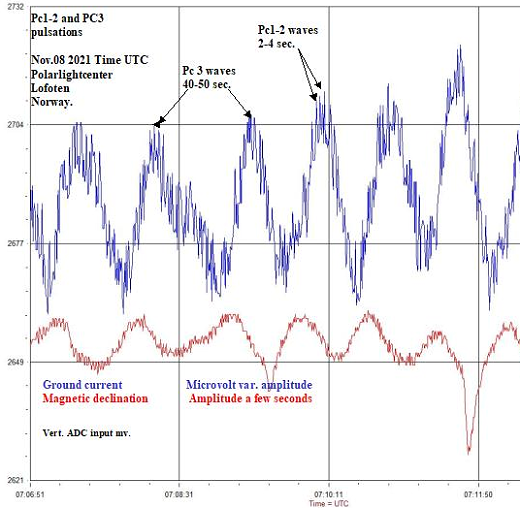
"This is very striking," says Stammes, who has spent years observing and cataloging magnetic disturbances inside the Arctic Circle. "Note how the high-frequency Pc1 and Pc2 waves are superimposed on the slower Pc3. In musical terms, it's a form of vibrato modulation."
"Pc" stands for "pulsation continuous." This is research jargon meaning, essentially, sine waves in the magnetosphere. They are present at all times, usually as a noisy cacophany of competing frequencies. Only during moments of extreme quiet can a few individual frequencies pop out and make music together.
Over the years, researchers have identified 5 types of Pc waves; Stammes recorded 3 of them. Fast Pc1 and Pc2 waves are associated with protons spiralling around Earth's magnetic field. These waves scatter so-called "killer electrons" out of the Van Allen radiation belts, making space safer for satellites. Slower Pc3 waves are a gentle flutter caused by solar wind blowing down the flanks of the magnetosphere. (Imagine blowing across a piece of paper, making it flutter with your breath. Same idea.)
"Magnetic storms are great," says Stammes, "but sometimes the 'quiet' can be just as interesting."
Realtime Aurora Photo Gallery
Free: Spaceweather.com Newsletter
DRAGON FIRE OVER THE GULF OF MEXICO: Last night, Nov. 8th, four astronauts in a SpaceX Crew Dragon capsule splashed down off the coast of Florida, returning home from a six-month mission to the ISS. "It was a show to savor for a lifetime," says astronomy professor Wayne Wooten, who photographed the re-entry from Pensacola:
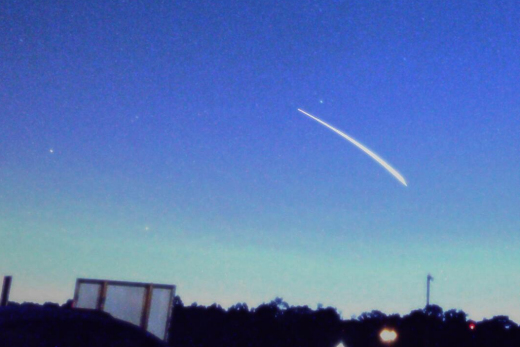
"It appeared at 9:25 PM as an orange dot rising just under Jupiter," says Wooten. "Then it arced back downward to safe landing in the Gulf of Mexico. At its brightest, the Dragon rivalled Jupiter and looked fiery bright orange in binoculars."
more images: from David Kriegler of Gulf Shores, Alabama;
Realtime Space Weather Photo Gallery
Free: Spaceweather.com Newsletter
VOYAGER GOLDEN RECORD ORNAMENT: This is a must-have Christmas ornament for space fans: The Voyager Golden Record. On Oct. 15th, the students of Earth to Sky Calculus launched it to the stratosphere onboard a cosmic ray research balloon:
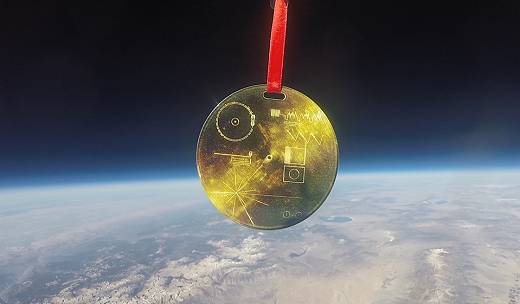
You can have it for $129.95. The 4-inch aluminum disk is imprinted with instructions intended for extraterrestrials, telling them how to play the phonographs now sailing through interstellar space onboard NASA's Voyager probes. Having touched the edge of space, it's the closest thing on Earth to an actual Golden Record.
The students are selling these unique ornaments to support their cosmic ray ballooning program. Each one comes with a greeting card showing the ornament in flight and extra materials decoding the markings on the disk.
Far Out Gifts: Earth to Sky Store
All sales support hands-on STEM education