LEONID METEOR SHOWER: Earth is entering a stream of debris from Comet Tempel-Tuttle, source of the annual Leonid meteor shower. In some years, dense ribbons of comet dust produce Leonid meteor storms. 2021 is not a storm year. Forecasters expect no more than 10 to 15 meteors per hour when the shower peaks on Nov. 17th.
SPACE WEATHER AND THE RUSSIAN ASAT STRIKE: Russia just destroyed one of its own satellites. On Nov. 15, 2021, a missile launched from the Plesetsk Cosmodrome struck Kosmos 1408, shattering the old satellite into thousands of pieces. Debris came so close to the ISS that astronauts took shelter in their crew capsules, just in case they had to abandon ship.
Littering Earth orbit with debris is never a good idea. Space weather could make it much worse. To understand why, turn back the clock 18 years to the Halloween Storms of October 2003, when our planet "lost" half its satellites.
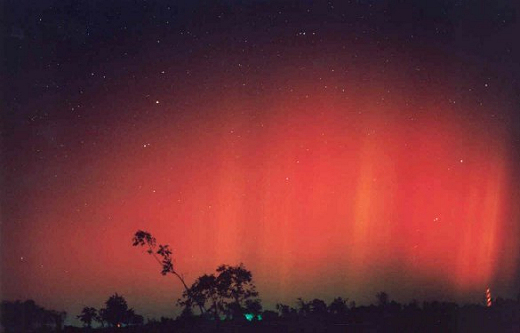
Above: Northern Lights over Houston, Texas, on Oct. 29, 2003. Credit: Christie Ponder [photo gallery]
Solar Cycle 23 was winding down. Space weather forecasters were talking about how quiet things would soon become when, suddenly, the sun unleashed two of the strongest solar flares of the Space Age: An X17 flare on Oct. 28th followed by an X10 flare on Oct. 29th. Powerful CMEs struck Earth's magnetic field only 19 hours later, sparking 3 days of severe to extreme geomagnetic storms.
An "after action report" from NOAA lists some of the storm's side effects: Commercial airlines scrambled to redirect flights from the poles, where radiation levels were suddenly high. Each detour cost as much as $100,000. Many Earth-orbiting satellites experienced reboots and even unwanted thruster firings. Some operators simply gave up and turned their instruments off. Goddard's Space Science Mission Operations Team estimates that 59% of NASA's Earth and space science satellites were affected.
There's a dawning awareness that something else important happened, too. Many of Earth's satellites were misplaced.
In a 2020 paper entitled "Flying Through Uncertainty," a team of researchers led by Thomas Berger at the University of Colorado's Space Weather Technology, Research, and Education Center report a little-known anecdote from USAF satellite operators. During the Halloween storms, they recalled, "the majority of [low Earth orbiting] satellites were temporarily lost, requiring several days of around-the-clock work to reestablish [their positions]."
"The Halloween storms pumped an extra 3 Terrawatts of power into Earth's upper atmosphere," explains Martin Mlynczak, principal investigator of NASA's SABER spacecraft, which measured the energy dump. "We didn't feel it down on the planet's surface, but it was a big event for Earth orbiting satellites. The extra power puffed up the atmosphere, sharply increasing aerodynamic drag."
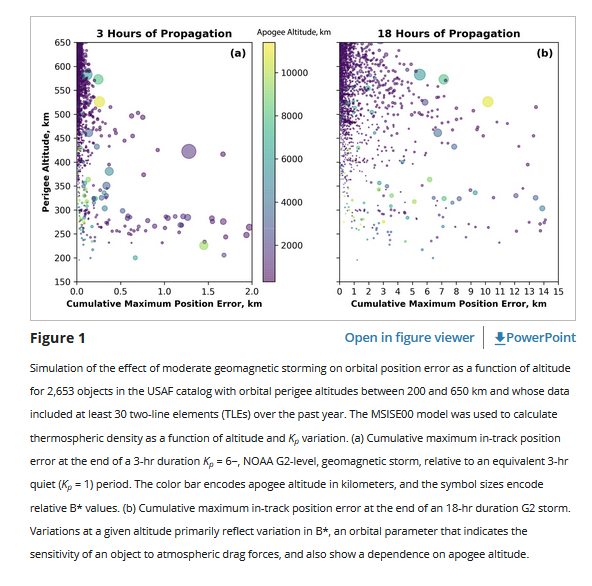
Above: A simulation of orbital position errors caused by a moderate geomagnetic storm for 2,653 objects in the USAF catalog. From "Flying Through Uncertainty." [full caption]
Simulations show that even moderate geomagnetic storms can shift the position of a satellite by 10 km or more. The Halloween Storms created far larger uncertainties. This is a problem because, when you're in a shooting gallery, you can't dodge the bullets unless you know where they are.
"Fortunately, the Halloween storm did not cause any major collisions that we know of," write Berger and his co-authors. "But if a geomagnetic storm on the level of the 2003 event were to occur today, the situation could be very different. Most satellite operators today have never experienced anything like the Halloween 2003 storm."
Right now radars and telescopes in the United States Space Surveillance Network are surely working to pinpoint the debris of Kosmos 1408. Orbital solutions will allow collision warnings to be issued; satellites can dodge. However, a strong geomagnetic storm could wipe out their findings in an instant.
Intensifying geomagnetic activity is almost certain as young Solar Cycle 25 gains steam in the years ahead. It's something to think about the next time you launch an ASAT weapon...
Realtime Space Weather Photo Gallery
Free: Spaceweather.com Newsletter
CO-ROTATING INTERACTION REGION SPARKS AURORAS: A co-rotating interaction region (CIR) hit Earth's magnetic field during the late hours of Nov. 15th: data. "Suddenly, the whole sky exploded with colorful auroras," reports Markus Varik from Tromsø, Norway:

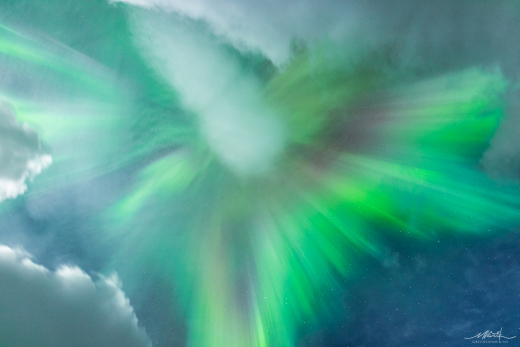
"We were surprised by this display because the forecast called for low geomagnetic activity," he says.
Indeed, forecasters were surprised. CIRs are notoriously hard to predict, and this one was not expected to arrive for another 24 hours--if it existed at all.
CIRs are transition zones between slow- and fast-moving streams of solar wind. Inside a CIR, solar wind plasma is compressed, sometimes even forming magnetized shock-like structures. They strike with the effect of a mini-CME.
Earth is now inside a fast-moving stream of solar wind following behind the CIR. With wind speeds topping 600 km/s, the Arctic aurora show could continue through Nov. 16th. Stay tuned! Aurora alerts: SMS Text.
Realtime Aurora Photo Gallery
Free: Spaceweather.com Newsletter
A TARDIS AT THE EDGE OF SPACE: By popular demand, we present Dr. Who's Tardis at the Edge of Space. The famous time traveling police box hitched a ride on a cosmic ray balloon during the strongest geomagnetic storm of new Solar Cycle 25. Here it is floating above 99% of Earth's atmosphere on Nov. 3, 2021:

You can have it for $134.95. It makes a great gift for Dr. Who fans and comes with a bonus figurine of the fifth Dr. Who (Peter Davison), who flew inside the police box. The Tardis comes with a greeting card showing the police box in flight and telling the story of its journey to the edge of space and back again.

Far Out Gifts: Earth to Sky Store
All sales support hands-on STEM education