SOLAR ORBITER TO BUZZ EARTH: The European Space Agency's Solar Orbiter spacecraft is about to fly by Earth for a gravity assist, bending its orbit toward the sun. At closest approach (Nov. 27th @ 4:30 UT), the probe will speed just 460 kilometers above the Atlantic Ocean. It's the riskiest maneuver of the entire mission as Solar Orbiter dips into the debris zone of Russia's recent ASAT test. Heaven's Above has local flyby times for potential observers; the spacecraft will glow like a 9th magnitude star.
GEOMAGNETIC STORM WATCH: Minor G1-class geomagnetic storms are possible on Nov. 27th when a CME is expected to sideswipe Earth's magnetic field. Click to watch the storm cloud leaving the sun yesterday:

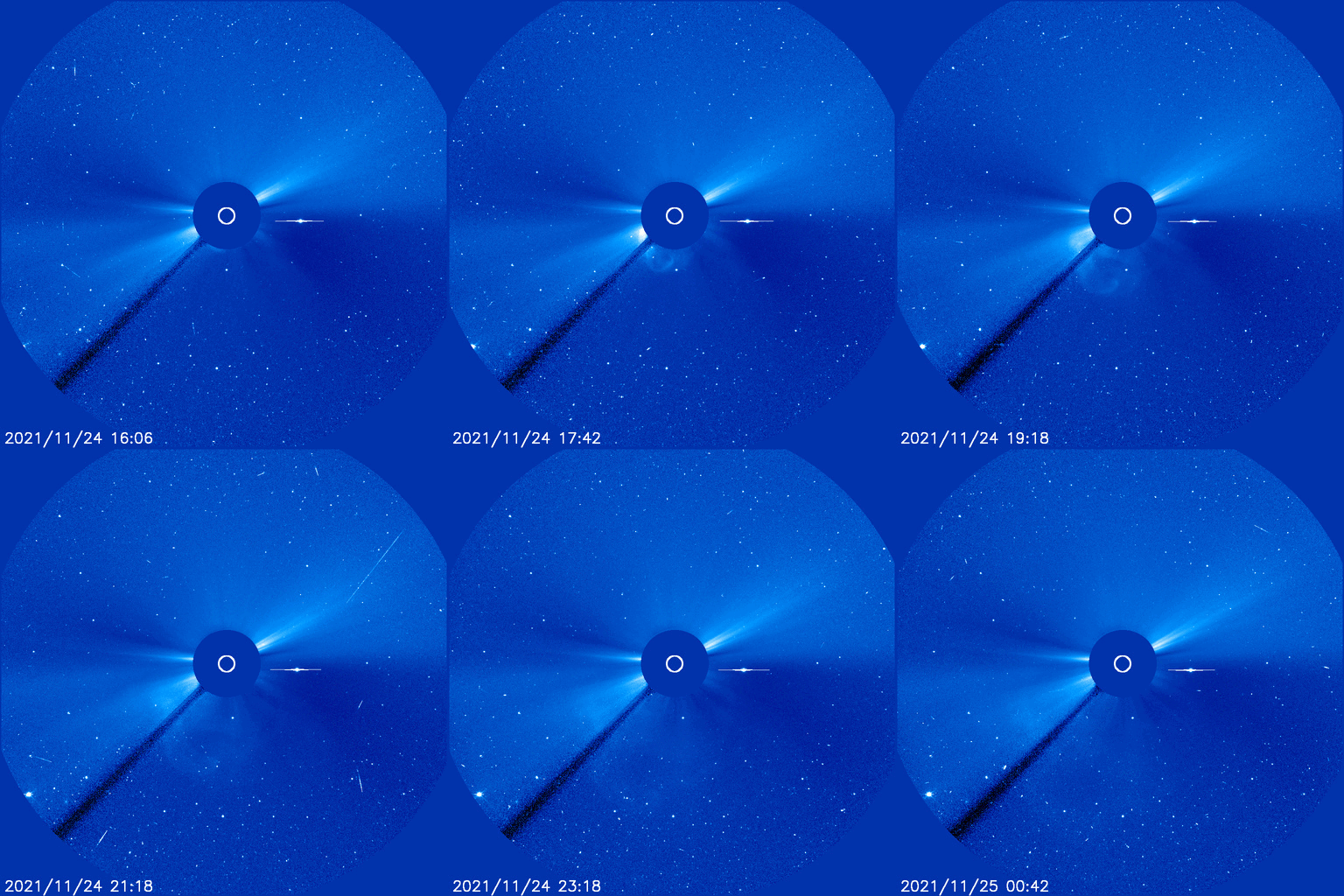
The CME was hurled into space by an erupting filament of magnetism in the sun's southern hemisphere. Flying upward, the filament split the sun's atmosphere, carving out a "canyon of fire" as it ascended. The glowing walls remained intact for more than 6 hours after the blast.

NOAA models of the CME suggest a glancing blow during the late hours of Nov. 27th. Much of the CME will miss, sailing south of our planet. But the fraction that hits should be enough to spark bright Arctic auroras. Aurora alerts: SMS Text
Realtime Aurora Photo Gallery
Free: Spaceweather.com Newsletter
BLACK FRIDAY AT THE EDGE OF SPACE: Christmas is coming. Are you looking for a far-out gift? Check out the Earth to Sky Store. It's filled with unique items that have flown to the edge of space onboard cosmic ray research balloons.

Carried aloft by giant helium balloons, these unique gifts have flown above 99.7% of Earth's atmosphere, experiencing space-like blasts of cosmic rays, extreme cold, and a wild ride parachuting back to Earth after the balloon explodes. Even Amazon doesn't carry items this far out.
Don't forget to enter coupon code "BLACKPEARL" at checkout for a 15% Black Friday discount.
Far Out Gifts: Earth to Sky Store
All sales support hands-on STEM education
COMET LEONARD AND THE WHALE: The brightest comet of 2021 just had a close encounter with a whale. On Nov. 24th, Comet Leonard (C/2021 A1) passed a tails'-width from NGC 4631, also known as the "Whale Galaxy." Amateur astronomer Tapio Lahtinen photographed the pair using a remote-controlled telescope in Spain:
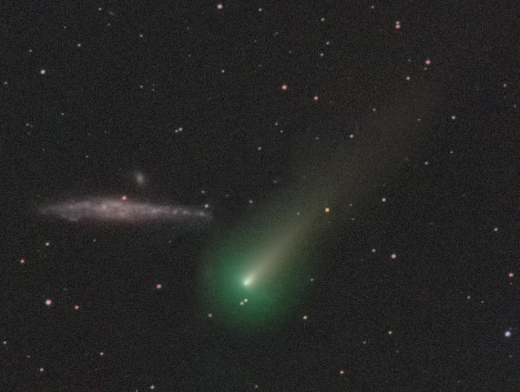
"It was so nice to see this cosmic rendezvous," says Lahtinen. "The comet was shining like a 9th magnitude star, making it a good match for the Whale Galaxy."
Next stop: Earth. Comet Leonard will pass near both Earth and Venus in December before it swoops around the Sun in early January 2022. If current trends continue, Comet Leonard will brighten to magnitude +4, an easy target for small telescopes and potentially visible to the naked eye from dark-sky sites. Stay tuned for updates as Comet Leonard draws near.
Realtime Comet Photo Gallery
Free: Spaceweather.com Newsletter
Realtime Space Weather Photo Gallery
Free: Spaceweather.com Newsletter