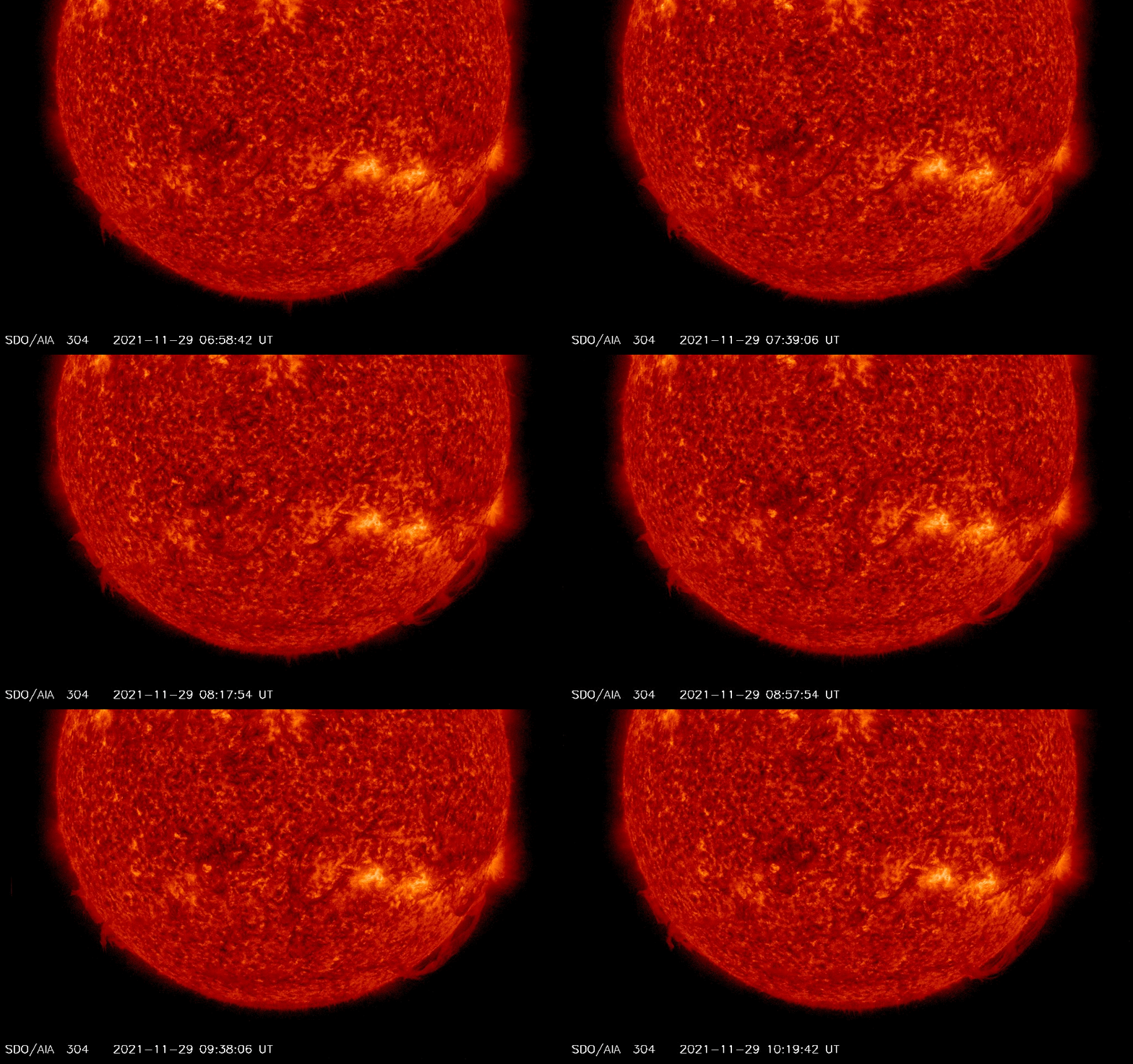
GEOMAGNETIC STORM WATCH: Minor geomagnetic storms are possible on Dec. 3rd when a CME might sideswipe Earth's magnetic field. The storm cloud was hurled into space on Nov. 29th by an erupting filament of magnetism in the sun's southern hemisphere (movie). According to NOAA computer models, the bulk of the CME should sail south of our planet with a near miss just as likely as a glancing blow. Aurora alerts: SMS Text.
A SUDDEN DROP IN ATMOSPHERIC RADIATION: Last month, a "Cannibal CME" hit Earth, sparking a strong G3-class geomagnetic storm and auroras as far south as California and New Mexico. You might think such a storm would boost radiation in Earth's atmosphere. Think again. High-altitude balloons hurriedly launched by Earth to Sky Calculus during the storm on Nov. 3rd and 4th found just the opposite. Radiation in the stratosphere plummeted:
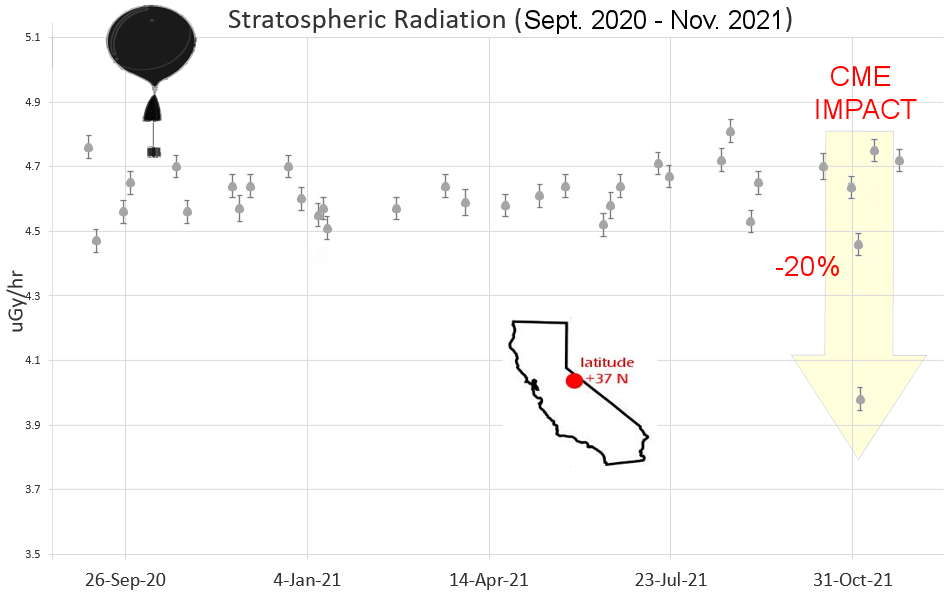
This is called a "Forbush decrease," named after American physicist Scott Forbush who studied cosmic rays in the early 20th century. It happens when a coronal mass ejection (CME) sweeps past Earth and pushes galactic cosmic rays away from our planet. Radiation from deep space that would normally pepper Earth's upper atmosphere is briefly wiped out.
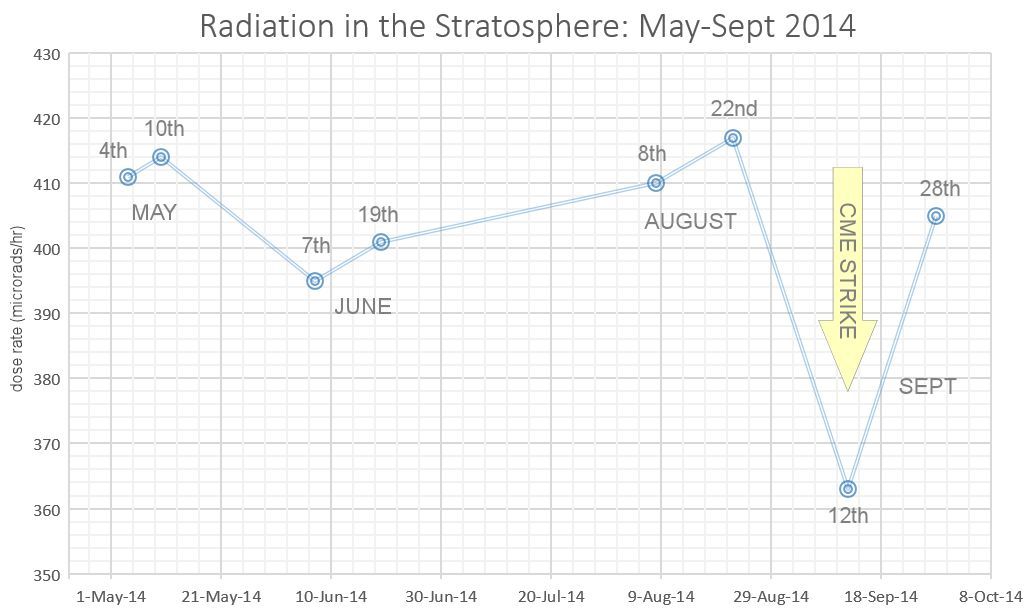
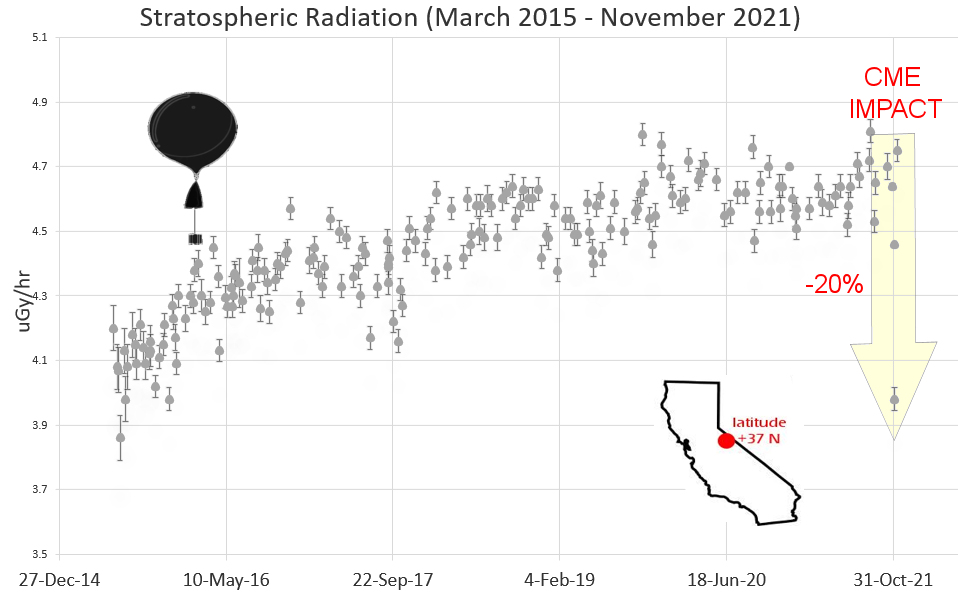
We have measured Forbush decreases before. For example, here's one from Sept. 2014. The Forbush decrease of Nov. 3-4, 2021, was the deepest in the history of our 7-year atmospheric monitoring program. Radiation levels in the stratosphere over California dropped nearly 20%, more than doubling the previous record from our entire dataset.
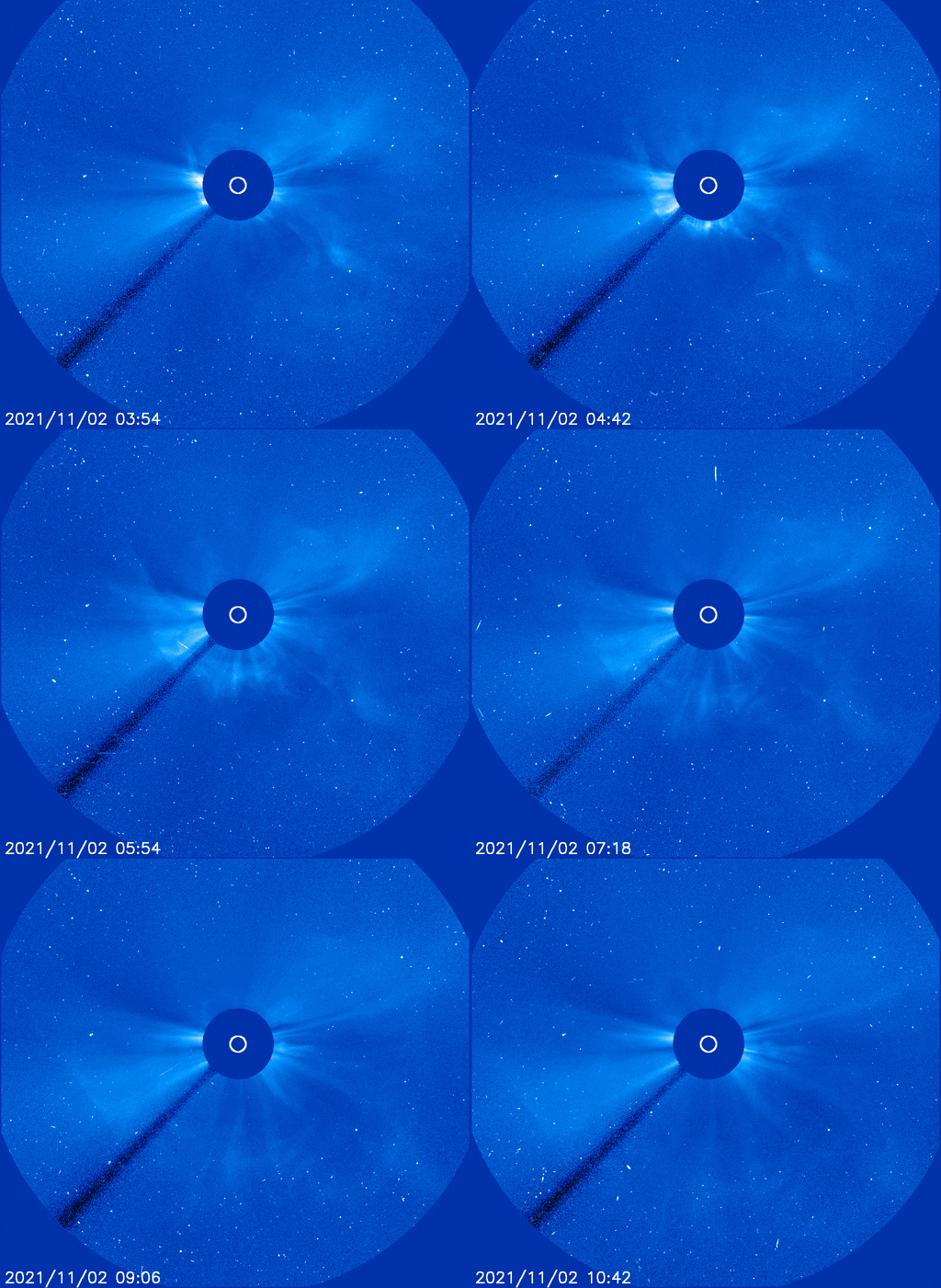
Above: This is the CME that caused the Forbush decrease
This event illustrates the yin-yang relationship between solar activity and cosmic rays. As solar activity increases, more and more CMEs billow away from the sun, pushing cosmic rays out of the inner solar system. This is one reason we expect cosmic radiation to subside in the years ahead as young Solar Cycle 25 intensifies. Click here to learn more.
Realtime Space Weather Photo Gallery
Free: Spaceweather.com Newsletter
GIFTS FROM THE EDGE OF SPACE: Christmas is coming. Are you looking for a far-out gift? Check out the Earth to Sky Store. It's filled with unique items that have flown to the edge of space onboard cosmic ray research balloons.

These unique gifts have flown above 99.7% of Earth's atmosphere, experiencing space-like blasts of cosmic rays, extreme cold, and a wild ride parachuting back to Earth after the balloon explodes. Even Amazon doesn't carry items this far out.
Don't forget to enter coupon code "BLACKPEARL" at checkout for a 15% Extended Black Friday discount.
Far Out Gifts: Earth to Sky Store
All sales support hands-on STEM education
PHOTO-OP ALERT: Comet Leonard (described below) is about to have a close encounter with globular cluster M3, a super photo-op for astrophotographers. Closest approach: Dec. 3rd. Gregg Ruppel of New Mexico sends this preview.
COMET LEONARD APPROACHES EARTH: The brightest comet of the year is approaching Earth. On Dec. 12, 2021, Comet Leonard (C/2021 A1) will be just 35 million kilometers away and could be visible to the naked eye in the early morning sky. "Below is my first capture of Comet Leonard," reports Darrell Spangler of Estes Park, Colorado. "It was much brighter than I expected."

Spangler photographed the comet on Nov. 30th using a 2.4 inch Raptor Radian telescope and a Canon 5Ds digital camera. "It was an easy target," he says.
Right now, Comet Leonard is in the northern constellation Canes Venatici (the Hunting Dogs) shining like a fuzzy star of magnitude +7. During the 10 days, the comet's brightness will sharply increase. Most forecasters agree that Comet Leonard will reach magnitude +4, easy to see in small telescopes and visible to the naked eye from dark-sky sites during the second week of December.

Above: The blue curve traces the predicted brightness of Comet Leonard. Crosses are recent observations. Credit: Comet Observation Database
As the comet approaches the sun in early January, forward scattering of sunlight through the comet's dusty atmosphere could create an additional surge in brightness to magnitude +1. The same phenomenon worked on Comet McNaught in 2007, making it visible in broad daylight. Stay tuned for updates as Comet Leonard draws near.
Realtime Aurora Photo Gallery
Free: Spaceweather.com Newsletter