ANTARCTIC SOLAR ECLIPSE: On Dec. 4th, the New Moon will pass in front of the sun, producing a total solar eclipse visible from parts of Antarctica and the Southern Ocean. Clouds permitting, at least one photographer in the area plans to send us photos of totality--so stay tuned! Browse: Eclipse Photo Gallery.
THE COMET AND THE STAR CLUSTER: Last night, Comet Leonard (C/2021 A1) had a close encounter with globular cluster M3. Austrian astrophotographer Michael Jaeger caught the comet passing over a ball of nearly a million stars:

Amateur astronomers around the world watched the extraordinary conjunction. The view is about to get even better. On Dec. 12th, Comet Leonard makes its closest approach to Earth only 35 million kilometers away. Most forecasters agree that the comet will reach magnitude +4, easy to see in small telescopes and visible to the naked eye from dark-sky sites. Point your optics here.
Realtime Comet Leonard Photo Gallery
Free: Spaceweather.com Newsletter
A SUDDEN DROP IN ATMOSPHERIC RADIATION: Last month, a "Cannibal CME" hit Earth, sparking a strong G3-class geomagnetic storm and auroras as far south as California and New Mexico. You might think such a storm would boost radiation in Earth's atmosphere. Think again. High-altitude balloons hurriedly launched by Earth to Sky Calculus during the storm on Nov. 3rd and 4th found just the opposite. Radiation in the stratosphere plummeted:
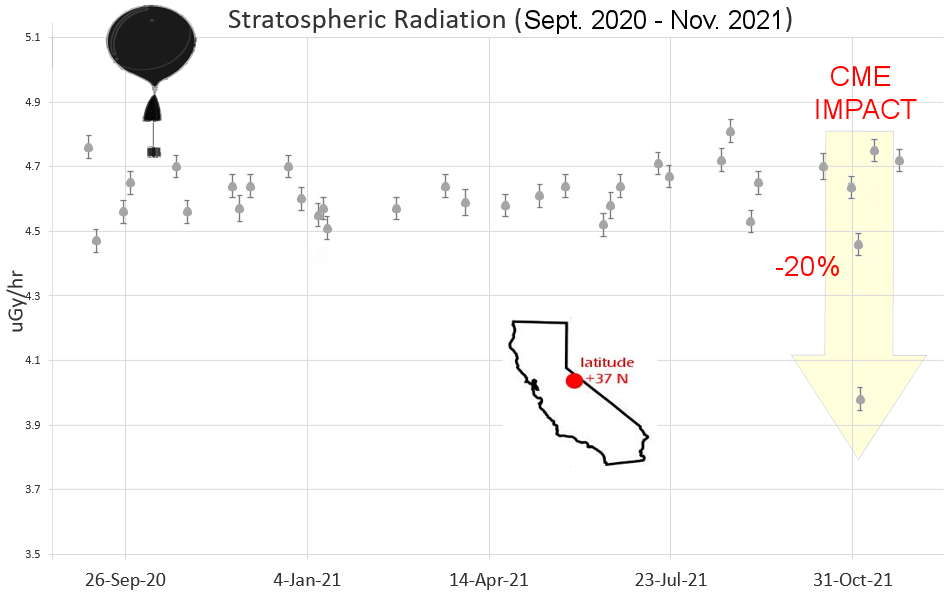
This is called a "Forbush decrease," named after American physicist Scott Forbush who studied cosmic rays in the early 20th century. It happens when a coronal mass ejection (CME) sweeps past Earth and pushes galactic cosmic rays away from our planet. Radiation from deep space that would normally pepper Earth's upper atmosphere is briefly wiped out.
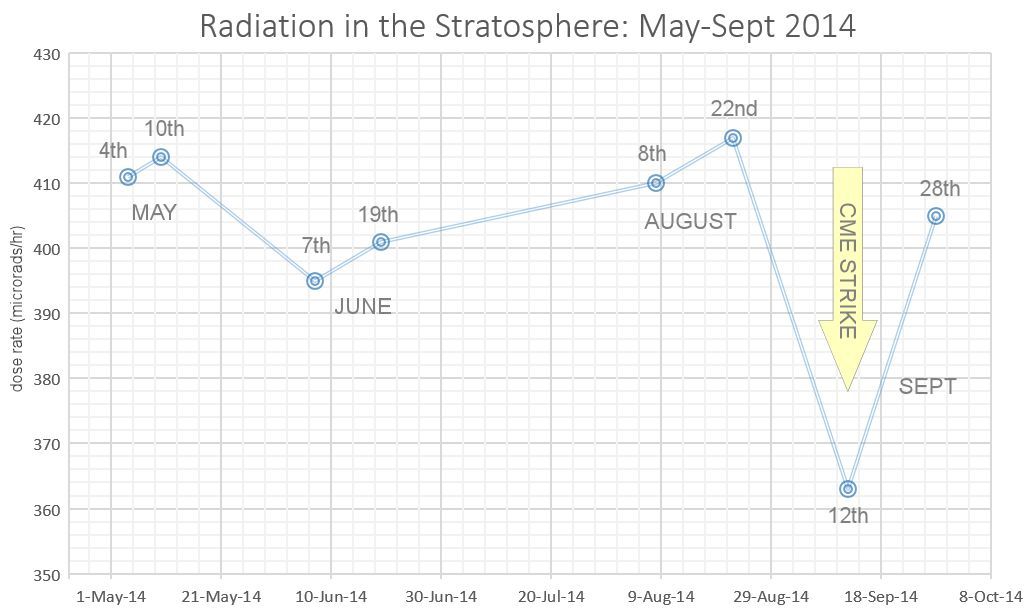
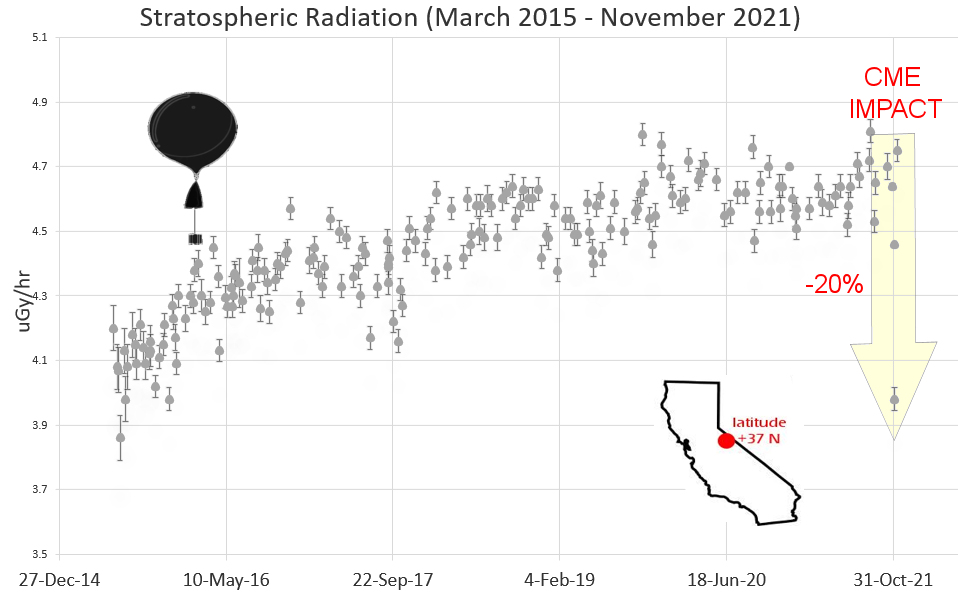
We have measured Forbush decreases before. For example, here's one from Sept. 2014. The Forbush decrease of Nov. 3-4, 2021, was the deepest in the history of our 7-year atmospheric monitoring program. Radiation levels in the stratosphere over California dropped nearly 20%, more than doubling the previous record from our entire dataset.
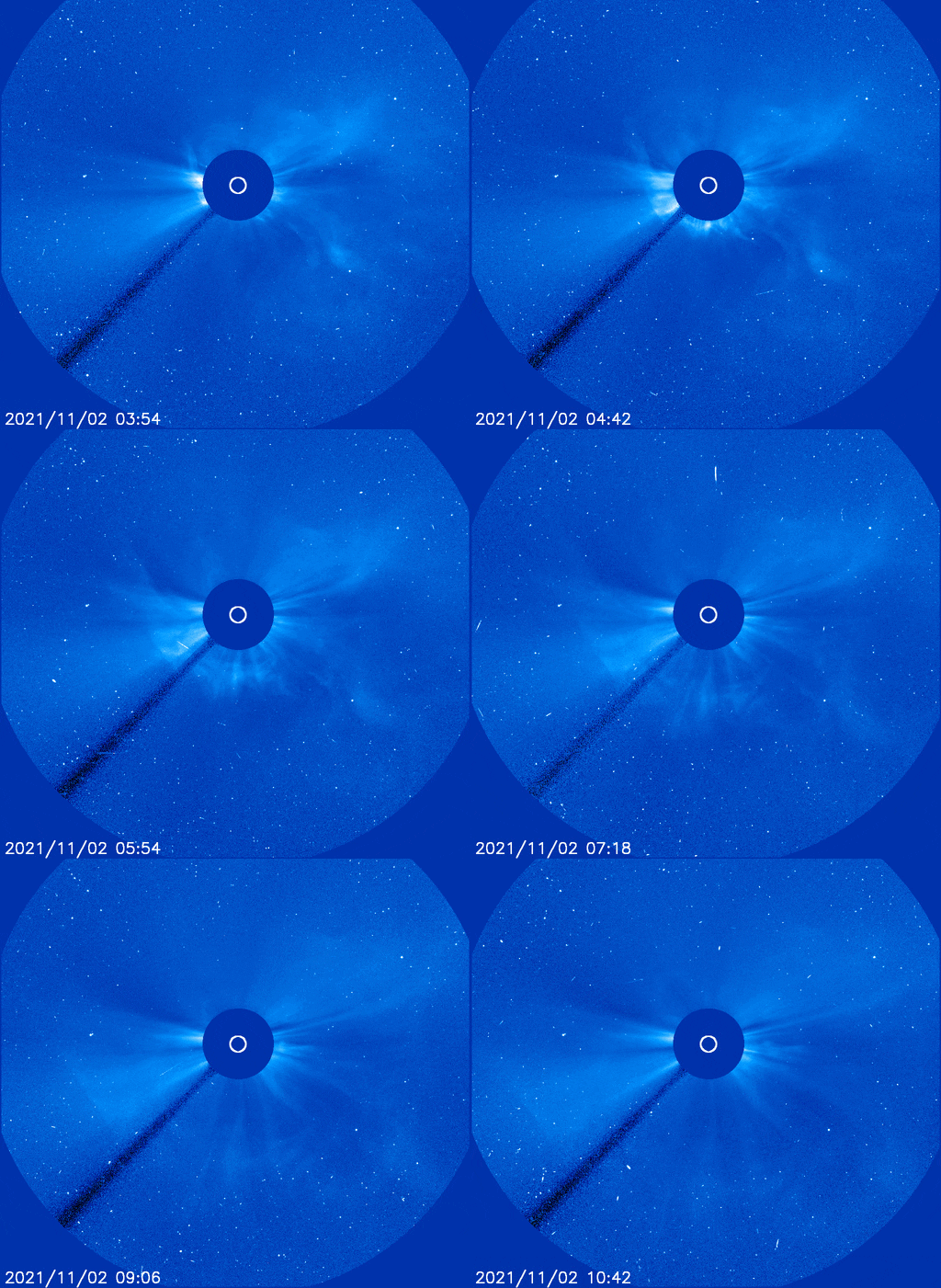
Above: This is the CME that caused the Forbush decrease
This event illustrates the yin-yang relationship between solar activity and cosmic rays. As solar activity increases, more and more CMEs billow away from the sun, pushing cosmic rays out of the inner solar system. This is one reason we expect cosmic radiation to subside in the years ahead as young Solar Cycle 25 intensifies. Click here to learn more.
Realtime Space Weather Photo Gallery
Free: Spaceweather.com Newsletter
GIFTS FROM THE EDGE OF SPACE: Christmas is coming. Are you looking for a far-out gift? Check out the Earth to Sky Store. It's filled with unique items that have flown to the edge of space onboard cosmic ray research balloons.

These unique gifts have flown above 99.7% of Earth's atmosphere, experiencing space-like blasts of cosmic rays, extreme cold, and a wild ride parachuting back to Earth after the balloon explodes. Even Amazon doesn't carry items this far out.
Don't forget to enter coupon code "BLACKPEARL" at checkout for a 15% Extended Black Friday discount.
Far Out Gifts: Earth to Sky Store
All sales support hands-on STEM education
Realtime Aurora Photo Gallery
Free: Spaceweather.com Newsletter