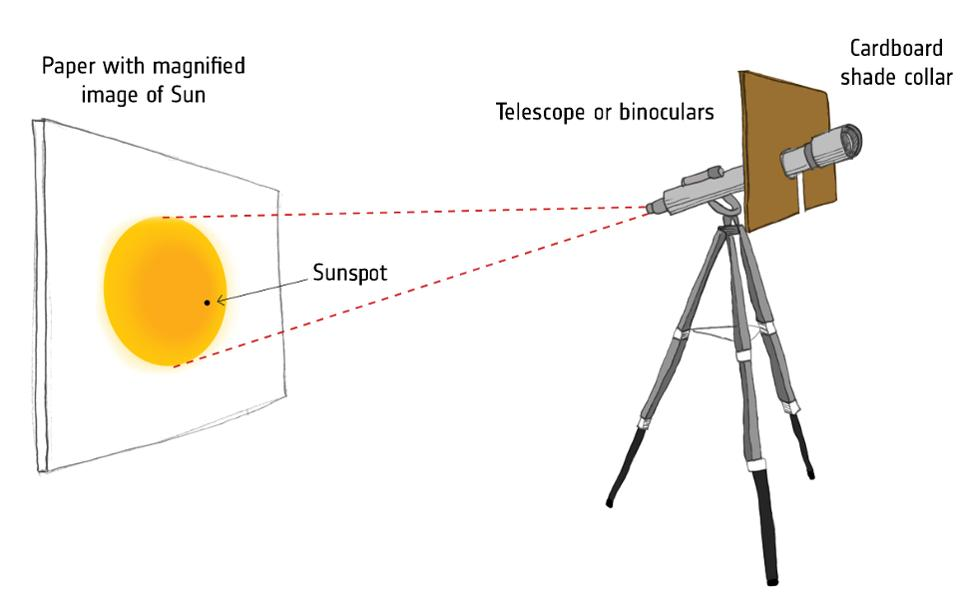
BIG SUNSPOT TURNS TOWARD EARTH: One of the biggest sunspots of Solar Cycle 25 is facing Earth. AR2916 has multiple dark cores larger than Earth and sprawls more than 140,000 km from end to end. These dimensions make it an easy target for backyard solar telescopes. Projection techniques work, too. Solar flare alerts: SMS Text.
A 'DISCONNECTION EVENT' IN COMET LEONARD: Something unusual is happening to the tail of Comet Leonard. It's being disconnected. To see the break, scroll down this picture taken by Gerald Rhemann on Christmas Day:
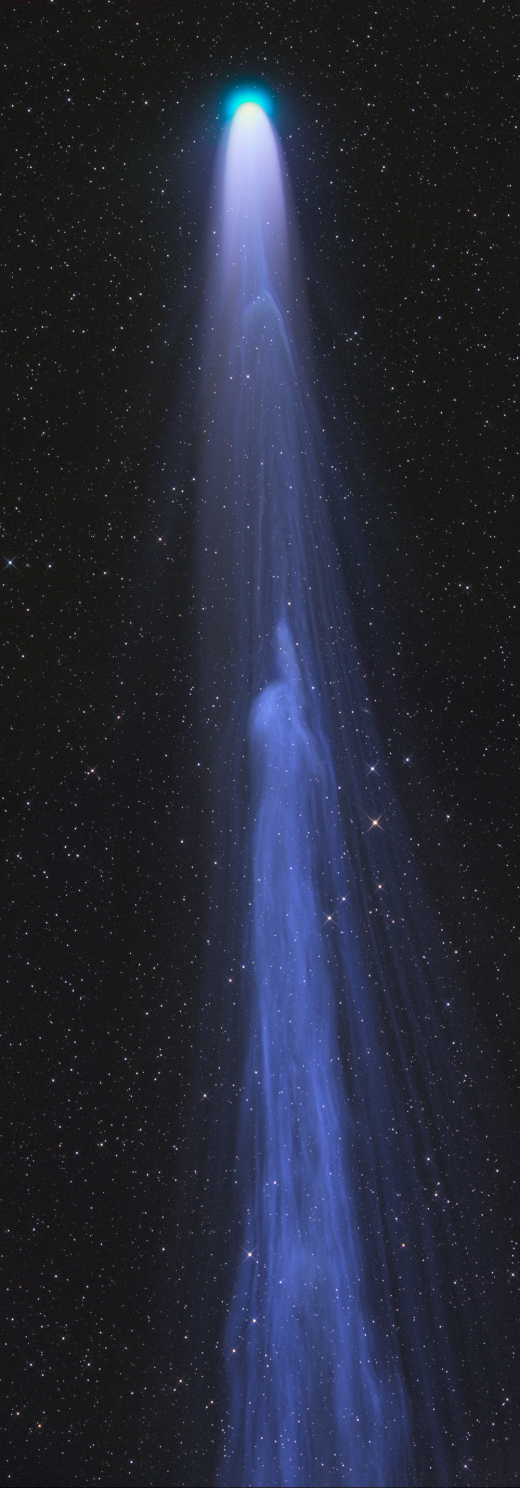
About halfway down the picture, right here, a rupture appears. This is a disconnection event: A piece of Comet Leonard's tail has been pinched off and is being carried away by the solar wind.

Blame space weather. CMEs hitting comets can cause magnetic reconnection in comet tails, sometimes ripping them off entirely. NASA's STEREO-A spacecraft watched this happen to Comet Encke in April 2007: movie. Comet Leonard has not experienced a known CME impact, but solar wind streams can do the same thing. At least two high-speed streams have hit the comet in recent weeks--enough to explain the turmoil.

This photo taken by Jan Hattenbach on Dec. 26th shows Comet Leonard's tail whipsawing across the sky over La Palma in the Canary islands:
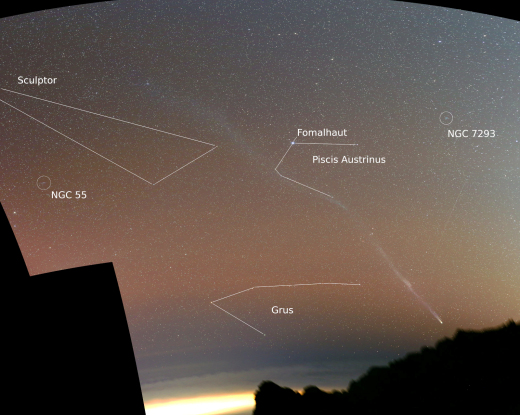
"The tail is at least 36 degrees long!" marvels Hattenbach. "Of those, six degrees could be seen in 10x50 binoculars, including the bright 'knot' associated with the disconnection event. Under the dark skies of La Palma, the comet was easily seen as a 3.9mag elongated cloud with the naked eye."
Not every knot in Leonard's tail is a disconnection event. Comet Leonard has flared in brightness 3 times since Dec. 15th--a sign of possible fragmentation in the comet's core. Much of the tail is doubtless an imprint of Comet Leonard's rapid-fire instabilities.
Whatever is happening, get ready for more. Comet Leonard is approaching the sun for a 0.61 AU close approach on Jan. 3rd. Increasing heat and proximity to solar storms could spark new outbursts and ruptures. Astronomers in the southern hemisphere will have the best view as the comet glides through the constellation Microscopium. Here's where to find it.
Realtime Comet Leonard Photo Gallery
Free: Spaceweather.com Newsletter
MR SPOCK IN THE STRATOSPHERE (COLLECTOR'S ITEM): He's back by popular demand: Mr. Spock Bobblehead. On Dec. 12, 2021, the students of Earth to Sky Calculus flew the green-blooded science officer to the stratosphere onboard a cosmic ray research balloon. At the apex of the flight he was 107,341 ft high:
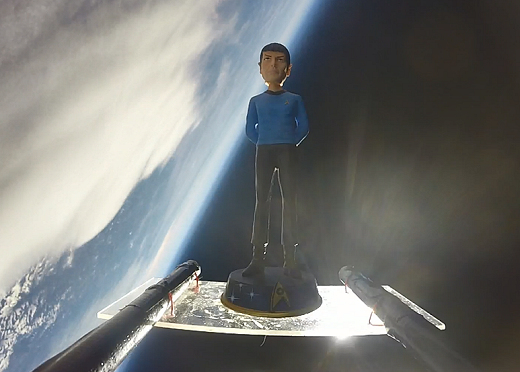
You can have it for $170.10 (the serial number of the Enterprise divided by 10). The bobblehead is made of high-quality resin and hand-painted. It cannot be purchased from Amazon; this rare collector's item is available only from the Earth to Sky Store.
The students are selling Mr. Spock bobbleheads to support their cosmic ray ballooning program. Each one comes with a greeting card showing Spock in flight and telling the story of his journey to the edge of space and back.
Far Out Gifts: Earth to Sky Store
All sales support hands-on STEM education
Realtime Aurora Photo Gallery
Free: Spaceweather.com Newsletter
Realtime Space Weather Photo Gallery
Free: Spaceweather.com Newsletter