NO CMEs THIS TIME: A pair of M1-class solar flares yesterday did *not* hurl CMEs toward Earth. The impulsive flares were too shortlived to lift significant clouds of plasma out of the sun's atmosphere. Maybe next time? The source of the flares, sunspot AR2918, has an unstable 'beta-gamma' magnetic field that is poised to explode again. Solar flare alerts: SMS Text.
TRACKING THE JAMES WEBB SPACE TELESCOPE: NASA's next great space telescope, the James Webb (JWST), is now hurtling toward the L2 Lagrange point where it will park to explore the cosmos. Last night in Puerto Rico, Efrain Morales Rivera photographed the spacecraft en route, 350,000 miles from Earth:
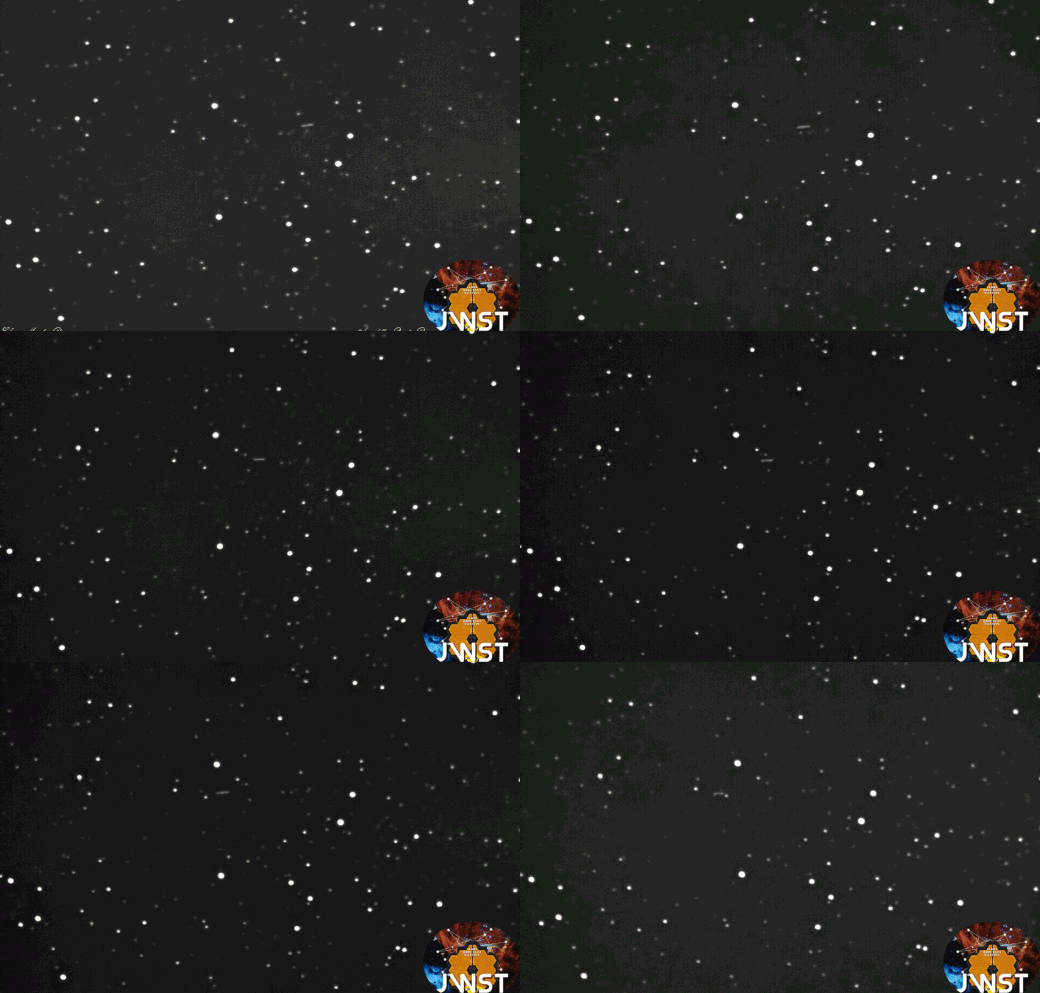
Shining like a 10th magnitude star, JWST was racing through the stars of the constellation Orion. "I photographed it using a 12-inch LX200 telescope," says Morales.
The launch of the JWST on Dec. 25th was a success, but mission planners are still holding their breaths. The 10 billion dollar telescope has to execute a complex sequence of deployments--unfolding pallets, sunshields, and the telescope's mirrors themselves--before the observatory can start work.
Meanwhile, amateur astronomers are tracking the telescope using coordinates provided by JPL Horizons (select the 'App' tab and enter 'JWST' as the target body). Got a picture? Submit it here.
Realtime Space Weather Photo Gallery
Free: Spaceweather.com Newsletter
THE LEONARD NEBULA: There's a new nebula in the night sky. It's a piece of Comet Leonard's tail that was just pinched off by a gust of solar wind. Bill Williams photographed it on Dec. 27th from the Chiefland Astronomy Village in Florida:
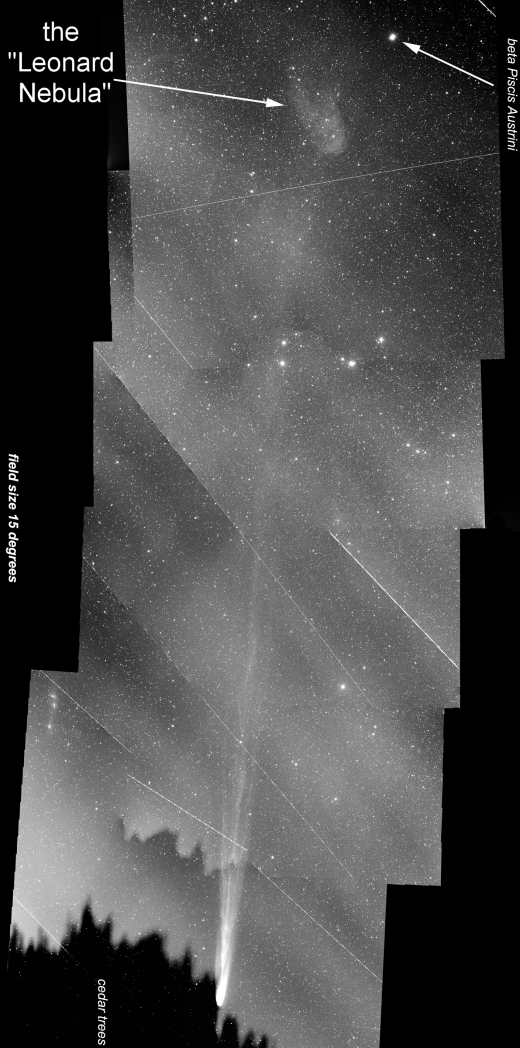
"Last night I took multiple exposures with my 100mm Vixen refractor and SBIG 16803 CCD camera and made a mosaic of the images," explains Williams. "The head of the comet was already setting behind some cedar trees when I photographed the upper reaches of the tail. It is way more than 15 degrees long."
The "Leonard Nebula" is a cloud of gas that became disconnected from the rest of the tail days ago when the comet was hit by a solar wind stream. Interplanetary magnetic fields around the comet's tail crissed-crossed and reconnected, releasing a burst of energy that gave birth to the nebula. A similar process takes place in Earth's magnetosphere during geomagnetic storms powering, among other things, the aurora borealis.
Get ready for more. Comet Leonard is approaching the sun for a 0.61 AU close approach on Jan. 3rd. Increasing heat and proximity to solar storms could spark new outbursts and ruptures. Astronomers in the southern hemisphere will have the best view as the comet glides through the constellation Microscopium--although as Williams' photo shows, northerners can see it, too.
Where is Comet Leonard? Right here.
Realtime Comet Leonard Photo Gallery
Free: Spaceweather.com Newsletter
HUMMINGBIRD-SUNFLOWER PENDANT: This pendant has a secret compartment--and it has touched the edge of space. On Nov. 4, 2021, our Sterling Silver Hummingbird-Sunflower Pendant flew to the stratosphere on board an Earth to Sky Calculus cosmic ray balloon:
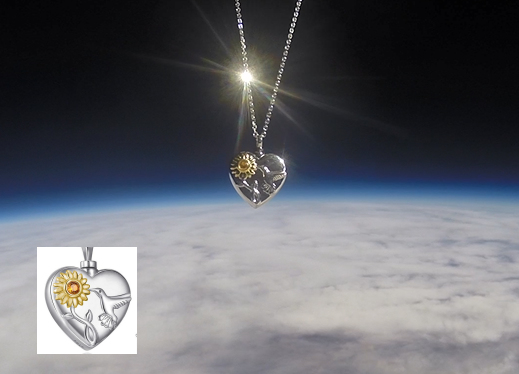
You can have it for $133.95. Inscribed on the back with "Always on my mind, Forever in my heart," each pendant comes with a greeting card showing the item in flight and telling the story of its journey to the edge of space. These make great Christmas gifts.
Bonus: The pendant contains a tiny chamber, which you may fill with the ashes of a loved one or anything else you wish to keep close to your heart.
Far Out Gifts: Earth to Sky Store
All sales support hands-on STEM education
Realtime Aurora Photo Gallery
Free: Spaceweather.com Newsletter