ARCTIC AURORA WATCH: A pair of minor solar wind streams is approaching Earth. ETA: Dec. 31st and Jan 3rd. Arctic sky watchers should be alert for auroras on those dates. Aurora alerts: SMS Text.
AMATEUR PHOTOS OF THE JAMES WEBB SPACE TELESCOPE: NASA's next great space telescope, the James Webb (JWST), is now hurtling toward the L2 Lagrange point where it will park to explore the cosmos. On Dec. 27th, amateur astronomer Zdenek Bardon caught the JWST en route, gliding through Barnard's Loop in the constellation Orion:
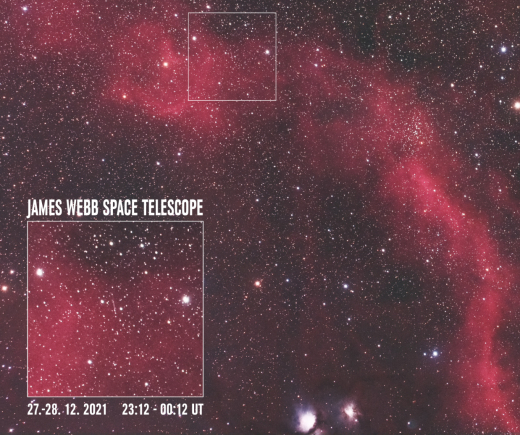
Bardon photographed the distant spacecraft (~350,000 miles away at the time of the exposure) using a 106mm refracting telescope in the Czech Republic. Stitching together a sequence of images, he created a movie of JWST transiting the red cloud of hydrogen ionized by newborn stars in the Orion Nebula. "I was assisted by two other amateur astronomers, Miroslav Grnja and Pavol Rapavy," notes Barton.
The launch of the JWST on Dec. 25th was a success, but mission planners are still holding their breaths. The 10 billion dollar telescope has to execute a complex sequence of deployments--unfolding pallets, sunshields, and the telescope's mirrors themselves--before the observatory can start work.
Meanwhile, amateur astronomers are tracking the telescope using coordinates provided by JPL Horizons (select the 'App' tab and enter 'JWST' as the target body). It is currently glowing like a 15th magnitude star. The brightness could increase, perhaps even abruptly, as the infrastructure of the observatory unfolds. Monitoring is encouraged.
more images: from Malcolm Park using a remote telescope in San Pedro de Atacama, Chile; from Filipp Romanov using a remote observatory in Canada; from Rob Johnson of Liverpool, UK; from Gianluca Masi of Ceccano, Italy; from Efrain Morales Rivera of Aguadilla, Puerto Rico;

Realtime Space Weather Photo Gallery
Free: Spaceweather.com Newsletter
HOW LONG IS THE TAIL OF COMET LEONARD? Astronomers have a problem. The tail of Comet Leonard is so long, it doesn't fit in their cameras. "I finally imaged Comet Leonard with a wide-enough angle lens in order to find out the real length of its tail," reports Daniele Gasparri from Chile's Atacama desert. "It is 60 degrees long."
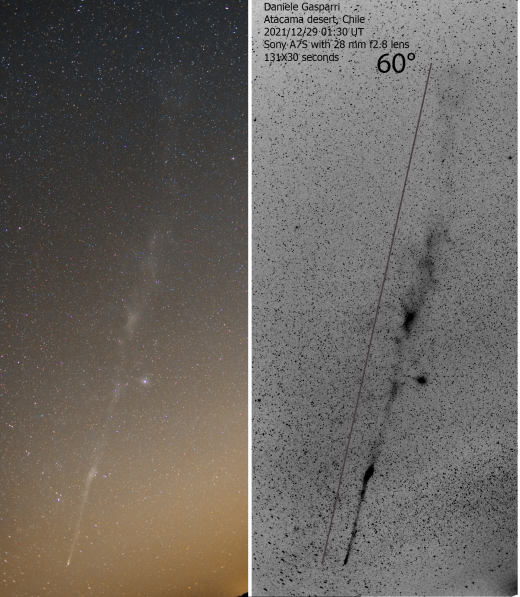
To put this iin perspective, the tail of Comet Leonard is more than twice the size of the Big Dipper and 120 times wider than the full Moon. "It's impressive," says Gasparri.
Comet tails this long are rare. The modern record is held by Great Comet Hyakutake in 1996 with a visible tail 100 degrees long. In reality, all comet tails extend off to infinity along their orbits. Normally, though, the distant parts are invisibly faint. Comet Leonard is a rare exception. It is an unusually active and gassy comet, well-placed for us to see the full extent of its tail from almost point-blank range.
Realtime Comet Leonard Photo Gallery
Free: Spaceweather.com Newsletter
HUMMINGBIRD-SUNFLOWER PENDANT: This pendant has a secret compartment--and it has touched the edge of space. On Nov. 4, 2021, our Sterling Silver Hummingbird-Sunflower Pendant flew to the stratosphere on board an Earth to Sky Calculus cosmic ray balloon:
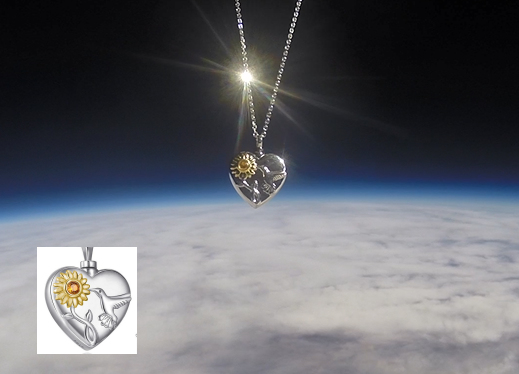
You can have it for $133.95. Inscribed on the back with "Always on my mind, Forever in my heart," each pendant comes with a greeting card showing the item in flight and telling the story of its journey to the edge of space. These make great Christmas gifts.
Bonus: The pendant contains a tiny chamber, which you may fill with the ashes of a loved one or anything else you wish to keep close to your heart.
Far Out Gifts: Earth to Sky Store
All sales support hands-on STEM education
Realtime Aurora Photo Gallery
Free: Spaceweather.com Newsletter