QUADRANTID METEOR SHOWER: Earth is approaching a stream of debris from comet fragment 2003 EH1, source of the annual Quadrantid meteor shower. Forecasters expect the shower to peak at 20:40 UT (3:40 pm EST) on Jan. 3rd, producing more than 60 meteors/hour from a radiant near the North Star. The timing of the peak favors European and Asian observers, although late arriving Quadrantids could sprinkle North America as well. Wherever you live, be alert for meteors on Monday night. [more] [observing tips]
INFERIOR CONJUNCTION OF VENUS: There's a tiny crescent in the sunset sky. It's Venus. Radu Anghel photographed the second planet on Jan. 2nd from Bacau, Romania:

"I caught Venus after sunset shining brightly only 3 degrees over the western horizon," says Anghel. "The crescent shape was not visible to the unaided eye, but my Canon 6D camera recorded it easily."
On Jan. 8th, Venus will pass almost directly between Earth and the sun--an event astronomers call "inferior conjunction." Around this time Venus looks like a crescent because it is turning its night side toward us.
During some inferior conjunctions, Venus transits the face of the sun. Not this year, though. At closest approach on Saturday, Venus and the sun will be separated by almost 5 degrees. This means careful daytime shots of Venus will be possible.
Anthony J. Cook, recently retired from the Griffith Observatory, offers some observing tips: "Find a tall building to shade your telescope at noon. This should make finding and observing Venus relatively easy and safe to do from the northern hemisphere. Just be sure the telescope is entirely inside the building's shadow and observe within 15 minutes of local noon." The photo below was taken yesterday by Argentine astronomer Mariano Ribas using just such a trick:

"To protect myself from sunlight, I placed my Meade LX90 12" telescope and a ZWO ASI 385 camera under the shadow of a wall in my house," explains Ribas. "The image of Venus in the eyepiece at 300x was really awesome: the planet seems a giant and ultrathin C."
When Venus is very close to the sun, the crescent can close upon itself, making a complete circle. That probably won't happen this year. The 5 degree sun-Venus separation is too wide. To see what to expect in 2022, look at this photo of Venus taken during a similar conjunction in 2018.

Realtime Venus Photo Gallery
Free: Spaceweather.com Newsletter
HUMMINGBIRD-SUNFLOWER PENDANT: This pendant has a secret compartment--and it has touched the edge of space. On Nov. 4, 2021, our Sterling Silver Hummingbird-Sunflower Pendant flew to the stratosphere on board an Earth to Sky Calculus cosmic ray balloon:
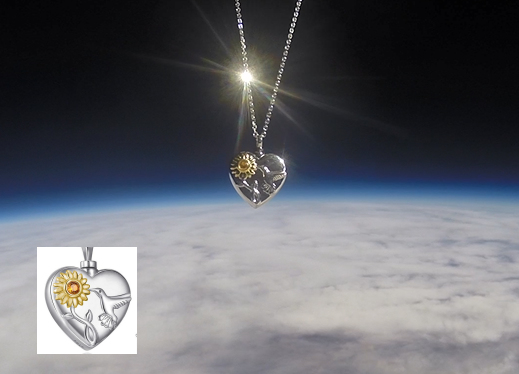
You can have it for $133.95. Inscribed on the back with "Always on my mind, Forever in my heart," each pendant comes with a greeting card showing the item in flight and telling the story of its journey to the edge of space. These make great Christmas gifts.
Bonus: The pendant contains a tiny chamber, which you may fill with the ashes of a loved one or anything else you wish to keep close to your heart.
Far Out Gifts: Earth to Sky Store
All sales support hands-on STEM education
COMET LEONARD AT PERIHELION: Today, Comet Leonard (C/2021 A1) is at perihelion--its closest approach to the sun (0.61 AU). Intense solar heat has given the comet one of the most beautiful tails astronomers have ever seen. Gerald Rhemann took this picture on New Year's Eve using a 12-inch telescope in Farm Tivoli, Namibia:
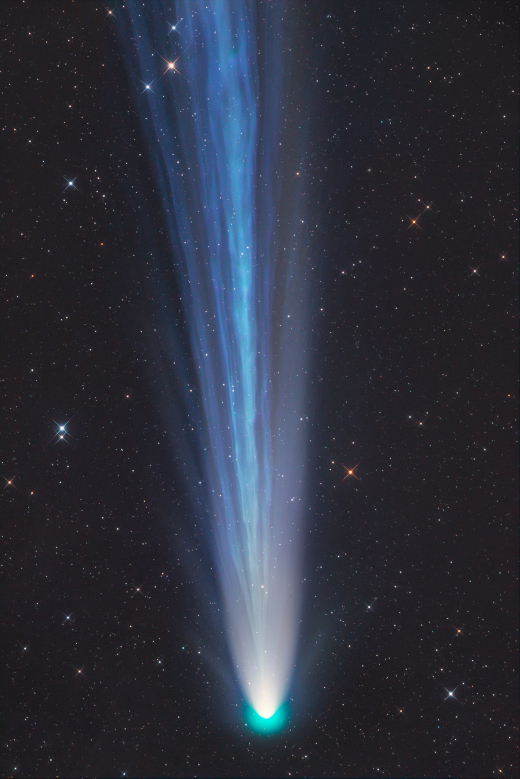
Even more beautiful views may be expected today as sunlight hitting the Leonard's icy core reaches its peak. The comet hasn't been this hot for more than 80,000 years! Southern hemisphere observers are favored as the comet glides through the constellation Pisces Austrinus glowing like a 5th magnitude star. Submit your pictures here.
Realtime Comet Leonard Photo Gallery
Free: Spaceweather.com Newsletter
Realtime Space Weather Photo Gallery
Free: Spaceweather.com Newsletter
Realtime Aurora Photo Gallery
Free: Spaceweather.com Newsletter