SOLAR WIND, INCOMING: A stream of solar wind is approaching Earth. ETA: Jan. 8-9. The gaseous material is flowing from a southern hole in the sun's atmosphere. Arctic auroras are likely when the solar wind arrives. Aurora alerts: SMS Text.

VENUS HAS TURNED INTO A RAINBOW: Like the Moon, Venus has phases, and right now it is a crescent. Moreover, it is a rainbow crescent. Meiying Lee photographed the phenomenon from Hsinchu, Taiwan:
"I video recorded the tiny crescent sinking into the clouds at sunset," says Lee. "The rainbow colors were quite distinct."
What's happening? Earth's atmosphere acts like a prism, splitting the light of Venus into primary colors. A tiny red Venus, blue Venus and green Venus are moving through the sky in tandem--a celestial rainbow.
Eliot Herman photohraphed the colorful arc last night in Tucson, Arizona:

"There was a narrow window of time just after sunset when Venus was visible and the sun was safely behind the mountains south of Tucson," says Herman. "That's when I took the shot."
Soon, the sun and Venus will be too close together for sunset shots. On Saturday, Jan. 8th, Venus is going to pass almost directly between Earth and the sun--an event astronomers call "inferior conjunction." At that time the separation will be no more than 5 degrees, and Venus will be surrounded by daytime blue.
Anthony J. Cook, recently retired from the Griffith Observatory, offers these daytime observing tips: "Find a tall building to shade your telescope at noon. This should make finding and observing Venus relatively easy and safe to do from the northern hemisphere. Just be sure the telescope is entirely inside the building's shadow and observe within 15 minutes of local noon."
Please be careful! Any sunlight straying into unshadowed optics can cause potentially serious eye damage.
Realtime Venus Photo Gallery
Free: Spaceweather.com Newsletter
AN ECSTATIC SOLAR ECLIPSE: One month ago today, there was a solar eclipse over Antarctica. The penguins enjoyed it. Annie Schmidt, Antarctica Program Director for Point Blue Conservation Science, sends this picture from the Adélie penguin colony on Cape Crozier:

"I caught an Adélie penguin performing an 'Ecstatic Vocalization' in front of the eclipse," explains Schmidt. "The Ecstatic Vocalization is a special display that males perform to claim their territory and advertise their condition."
"We observed the eclipse from Cape Crozier, one of the largest Adélie penguin colonies in the world," she continues. "Researchers from Point Blue have been studying this colony for more than 25 years. We're learning how climate change may affect penguin nesting habitat and how individuals vary in their response to these changes."
"While this penguin was posing nicely in front of the eclipse, another research team collected space weather measurements near McMurdo, South Pole," says Schmidt. "All the work was conducted with funding from the National Science Foundation and support from the US Antarctic Program."
Realtime Space Weather Photo Gallery
Free: Spaceweather.com Newsletter
MR SPOCK IN THE STRATOSPHERE (COLLECTOR'S ITEM): He's back by popular demand: Mr. Spock Bobblehead. On Dec. 12, 2021, the students of Earth to Sky Calculus flew the green-blooded science officer to the stratosphere onboard a cosmic ray research balloon. At the apex of the flight he was 107,341 ft high:
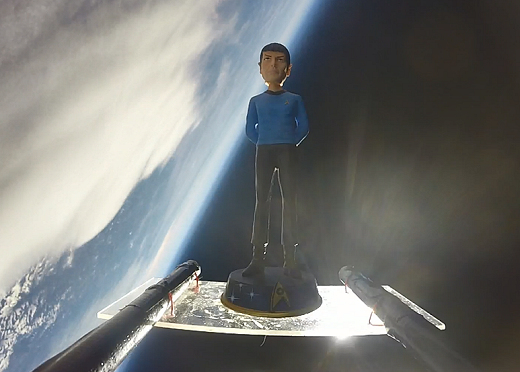
You can have it for $170.10 (the serial number of the Enterprise divided by 10). The bobblehead is made of high-quality resin and hand-painted. It cannot be purchased from Amazon; this rare collector's item is available only from the Earth to Sky Store.
The students are selling Mr. Spock bobbleheads to support their cosmic ray ballooning program. Each one comes with a greeting card showing Spock in flight and telling the story of his journey to the edge of space and back.
Far Out Gifts: Earth to Sky Store
All sales support hands-on STEM education
Realtime Aurora Photo Gallery
Free: Spaceweather.com Newsletter
Realtime Comet Leonard Photo Gallery
Free: Spaceweather.com Newsletter