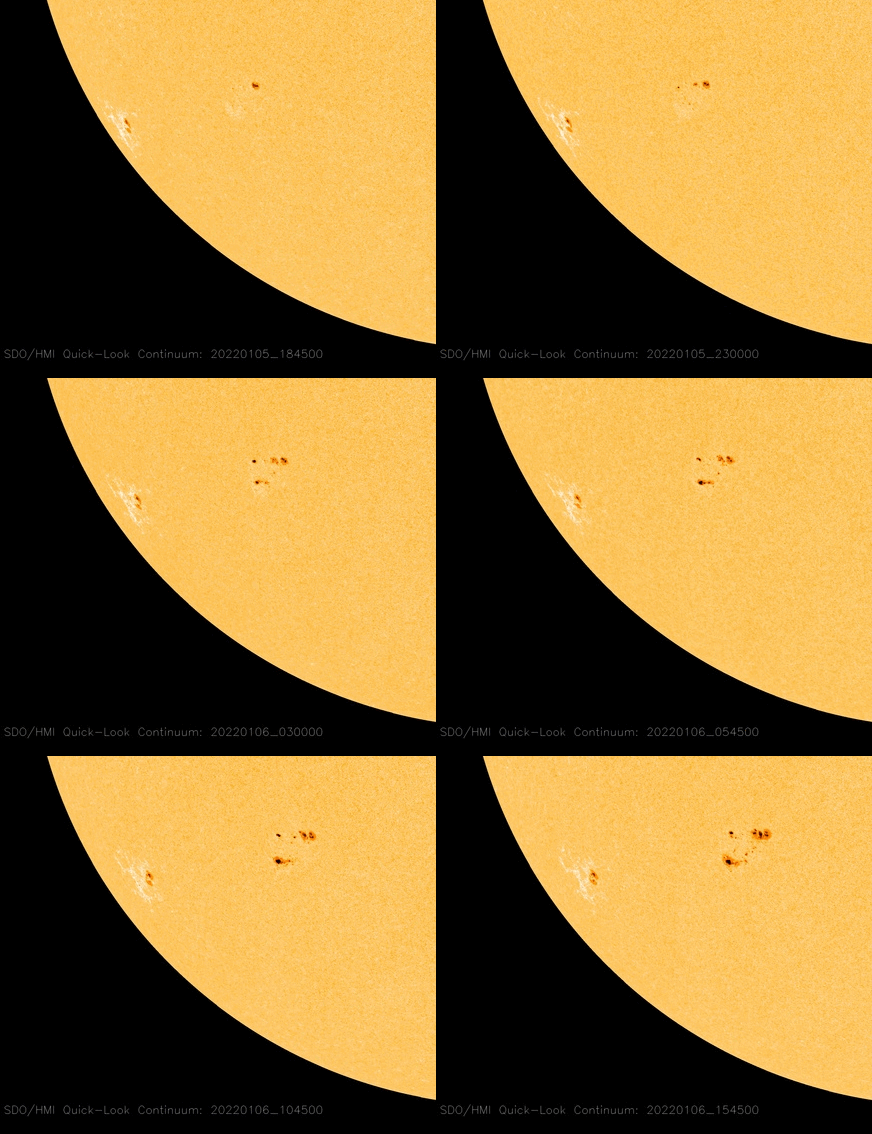
FAST-GROWING SUNSPOT (UPDATED): Since today began, new sunspot AR2924 has more than tripled in size. This movie from NASA's Solar Dynamics Observatory shows its rapid development. Solar flares may be in the offing if the growth continues apace. Solar flare alerts: SMS Text.
A RED FLASH FROM THE MOON: You've heard of the green flash--an emerald ray that lances out from the sun or Moon as they sink below the horizon. Now let us introduce you to the RED flash. Peter Lawrence of Thornton, England, saw one beneath the setting Moon on Jan. 5th:
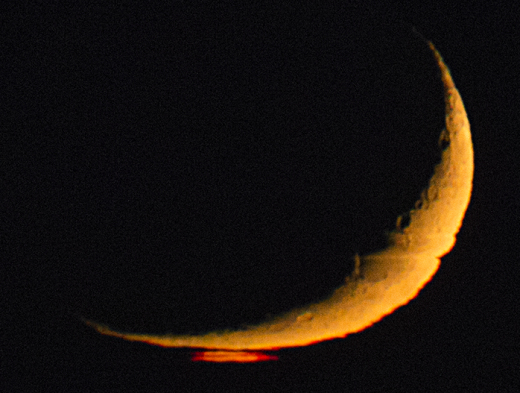
As the the crescent Moon approached the horizon, a slice of red seemed to detach itself and float away. "[It] looked amazing," says Lawrence.
Atmospheric optics expert Les Cowley explains what happened: "The technical name of this event is a 'Ducted Mock-mirage Red Flash.' As the Moon set, it dipped into a strong temperature inversion layer. A layer of warm air was sitting on top of cooler air. Light rays bend when they cross such layers, in this case strongly enough that 'ducting' occurred."
"Usually we see a green flash as the sun or Moon’s top dips down into the inversion," Cowley continues. "Here, Peter Lawrence caught the red flash at the Moon's lower edge. Solar red flashes occur, too, but they are hard to see because they are almost the same color as the sun."
Realtime Space Weather Photo Gallery
Free: Spaceweather.com Newsletter
INFERIOR CONJUNCTION OF VENUS: Venus is now dangerously close to the sun as it approaches inferior conjunction on Jan. 8th. "Venus can no longer be seen in our evening sky," reports Uğur İkizler of Bursa, Turkey. "Today at noon, I found Venus in my telescope only 6 degrees away from the sun and took a picture."
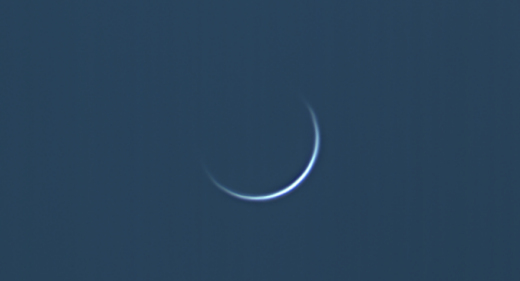
"Actually, this shot is pretty dangerous," says İkizler. "It's hard to keep sunlight out of the telescope tube, where intense rays reflect from the primary and secondary mirrors. There is always a risk when photographing Venus at this time."
At closest approach this weekend, Venus and the sun will be less than 5 degrees apart. This is a perilous time to photograph the planet--but also a beautiful time. Venus has transformed into a whisper-thin crescent with its night side facing Earth.
Anthony J. Cook, recently retired from the Griffith Observatory, urges observers to take precautions. "Find a tall building to shade your telescope at noon," he advises. "This should make observing Venus relatively safe to do from the northern hemisphere. Just be sure the telescope is entirely inside the building's shadow and observe within 15 minutes of local noon. Adding a mask to the front end of the telescope to fully shadow the optics from direct sunlight can mitigate the danger of internal reflections."
Realtime Venus Photo Gallery
Free: Spaceweather.com Newsletter
"I LOVE YOU MORE" MOONSTONE PENDANT: Valentine's Day is coming! Nothing says "I love you" like a moonstone from space. This one hitched a ride on an Earth to Sky Calculus cosmic ray research balloon, floating 112,201 feet above the Sierra Nevada mountains of central California:
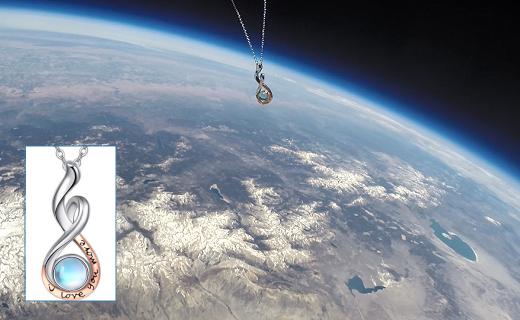
You can have it for $142.95. The students are selling these sterling silver infinity-wrapped moonstone pendants to support their ballooning program. Engraved with "I Love You More," it makes a romantic Valentine's gift. Each one comes with a greeting card showing the moonstone in flight and telling the story of its trip to the stratosphere and back again.
Far Out Gifts: Earth to Sky Store
All sales support hands-on STEM education
Realtime Aurora Photo Gallery
Free: Spaceweather.com Newsletter