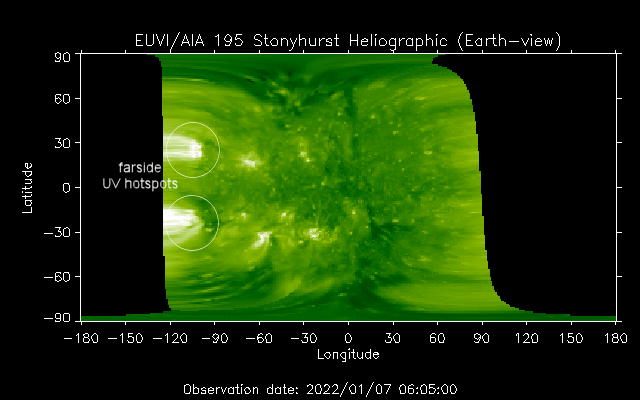
FARSIDE SUNSPOTS: NASA's STEREO-A spacecraft is monitoring two ultraviolet hotspots just behind the sun's eastern limb. These are potentially significant sunspot groups. The regions will rotate into view this weekend. Solar flare alerts: SMS Text.
BIG SOUTHERN SUNSPOT: Two days ago, sunspot AR2924 was barely visible. Now it is a behemoth many times larger than Earth. Eduardo Schaberger Poupeau photographed the fast-growing active region today in Rafaela, Argentina:
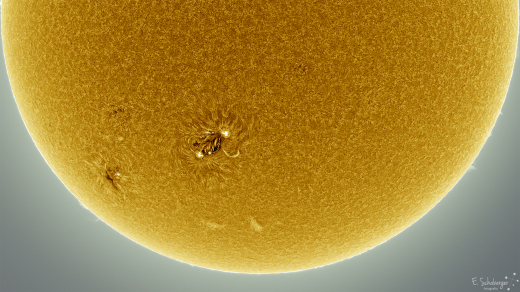
"To take this picture I used a Coronado Solarmax II 90mm aperture solar telescope and a ZWO 183MM camera," says Poupeau.
So far, the sunspot has not produced any major flares. However, it is developing a mixed magnetic field in which "+" and "-" polarities are in close contact. The stage is set for explosive magnetic reconnection. Solar flare alerts: SMS Text.
Realtime Space Weather Photo Gallery
Free: Spaceweather.com Newsletter
INFERIOR CONJUNCTION OF VENUS: A bright light is approaching the sun. It's Venus. The Solar and Heliospheric Observatory (SOHO) is monitoring the close encounter from the L1 Lagrange point, 1.5 million km from Earth:
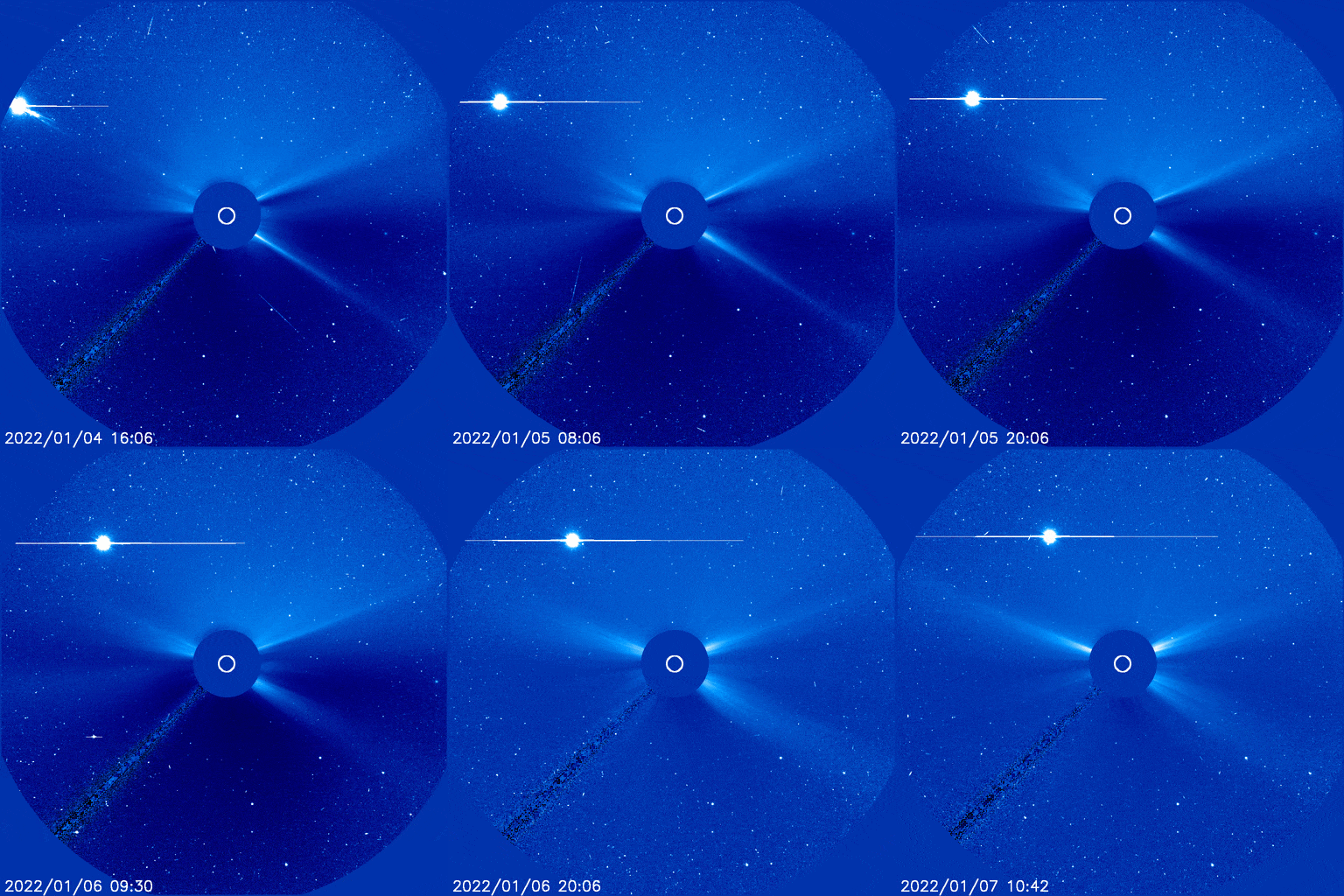
Venus is now passing almost directly between Earth and the sun--an event astronomers call "inferior conjunction." At closest approach on Jan. 8th the sun-Venus separation will be just under 5 degrees. SOHO is well equipped to observe the event. Onboard coronagraphs block the glare of the sun, creating an artificial eclipse that reveals the nearby planet.
Meanwhile on Earth, astronomers are carefully targeting Venus using telescopes masked and shadowed to keep out the sunlight. Bum-Suk Yeom sends this picture from Iksan, South Korea:
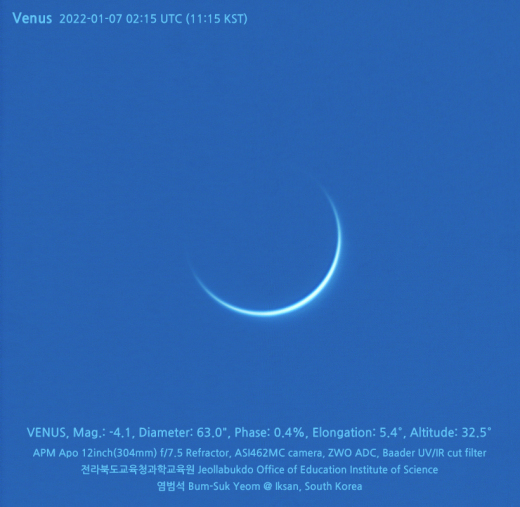
"Venus is a very thin crescent," says Yeom. That's because the planet has turned its night side toward Earth. The disk is outlined only by a narrow fringe of sunlight filtering through Venus's upper atmosphere.
This is a beautiful time to observe Venus, but also perilous. Anthony J. Cook, recently retired from the Griffith Observatory, offers these observing tips: "Find a tall building to shade your telescope at noon," he advises. "This should make observing Venus relatively safe to do from the northern hemisphere. Just be sure the telescope is entirely inside the building's shadow and observe within 15 minutes of local noon. Adding a mask to the front end of the telescope to fully shadow the optics from direct sunlight can further mitigate the danger."
Realtime Venus Photo Gallery
Free: Spaceweather.com Newsletter
"I LOVE YOU MORE" MOONSTONE PENDANT: Valentine's Day is coming! Nothing says "I love you" like a moonstone from space. This one hitched a ride on an Earth to Sky Calculus cosmic ray research balloon, floating 112,201 feet above the Sierra Nevada mountains of central California:
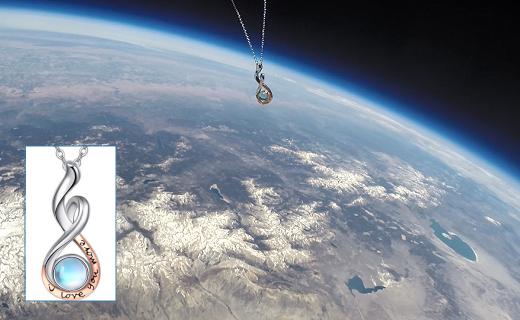
You can have it for $142.95. The students are selling these sterling silver infinity-wrapped moonstone pendants to support their ballooning program. Engraved with "I Love You More," it makes a romantic Valentine's gift. Each one comes with a greeting card showing the moonstone in flight and telling the story of its trip to the stratosphere and back again.
Far Out Gifts: Earth to Sky Store
All sales support hands-on STEM education
Realtime Aurora Photo Gallery
Free: Spaceweather.com Newsletter