ARCTIC AURORA WATCH: Arctic auroras are likely on Jan. 9-10 when a minor stream of solar wind is expected to hit Earth. The gaseous material is flowing from a southern hole in the sun's atmosphere. Aurora alerts: SMS Text.

THE HORNS OF VENUS ARE ALMOST TOUCHING: For the past few weeks, Venus has been transforming itself into a crescent as the planet passes between Earth and the sun. Now the horns of the crescent are almost touching. Alberto Vacca took this picture yesterday in Parma, Italy:
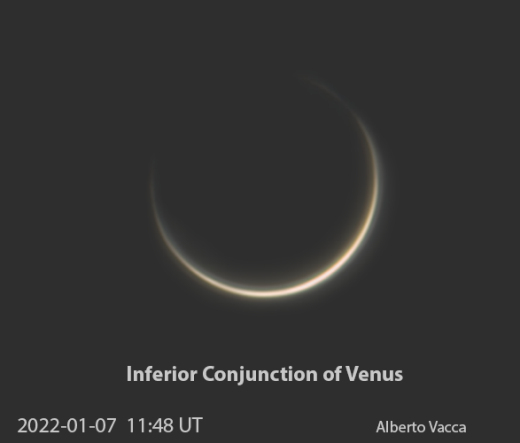
"An arc of 273 degrees is visible," says Vacca. "I took the picture in broad daylight while the sun was hidden behind a nearby building. Venus was only 5°09' from the sun at the time of the exposure."
The horns will be even closer today. On Jan. 8th, Venus reaches "inferior conjunction," almost perfectly between the sun and Earth. With Venus's nightside facing Earth, the only illumination we can see is a narrow arc of sunlight filtering through the top of Venus's atmosphere.
Will the circle close? Probably not. The sun-Venus-Earth alignment this year is not quite perfect enough for closure. But astronomers will be checking to see how close to 360 degrees it gets. Stay tuned.
Realtime Venus Photo Gallery
Free: Spaceweather.com Newsletter
BIG SOUTHERN SUNSPOT: One of the biggest sunspots of young Solar Cycle 25 is crossing the sun's southern hemisphere. David Leong photographed AR2924 this morning from Hong Kong:
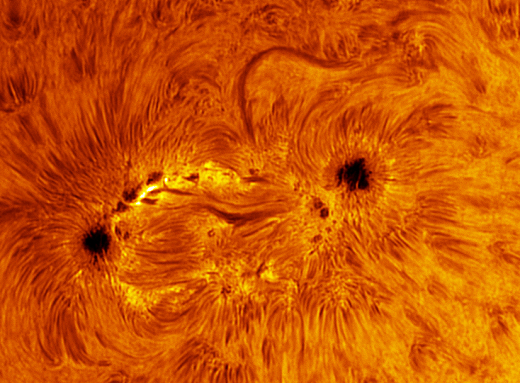
"The sunspots are huge," says Leong. "I took this picture during a minute of good seeing and--wow!--the details are astounding."
AR2924 has two dark cores as wide as Earth bookending a scatter of asteroid-sized spots stretching across 150,000 km of the sun's surface. These dimensions make it an easy target for backyard solar telescopes. "I used a Lunt LS100T," he says.
So far the sunspot has not produced any significant flares. If it does explode, however, the blast will be Earth directed. Solar flare alerts: SMS Text.
Realtime Space Weather Photo Gallery
Free: Spaceweather.com Newsletter
"I LOVE YOU MORE" MOONSTONE PENDANT: Valentine's Day is coming! Nothing says "I love you" like a moonstone from space. This one hitched a ride on an Earth to Sky Calculus cosmic ray research balloon, floating 112,201 feet above the Sierra Nevada mountains of central California:
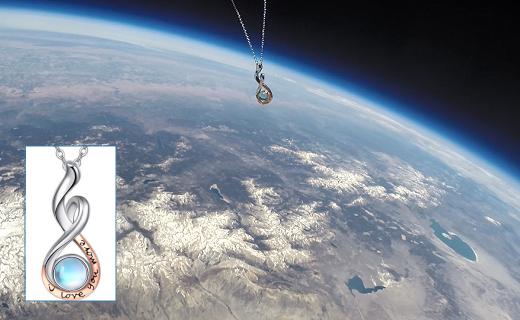
You can have it for $142.95. The students are selling these sterling silver infinity-wrapped moonstone pendants to support their ballooning program. Engraved with "I Love You More," it makes a romantic Valentine's gift. Each one comes with a greeting card showing the moonstone in flight and telling the story of its trip to the stratosphere and back again.
Far Out Gifts: Earth to Sky Store
All sales support hands-on STEM education
Realtime Aurora Photo Gallery
Free: Spaceweather.com Newsletter