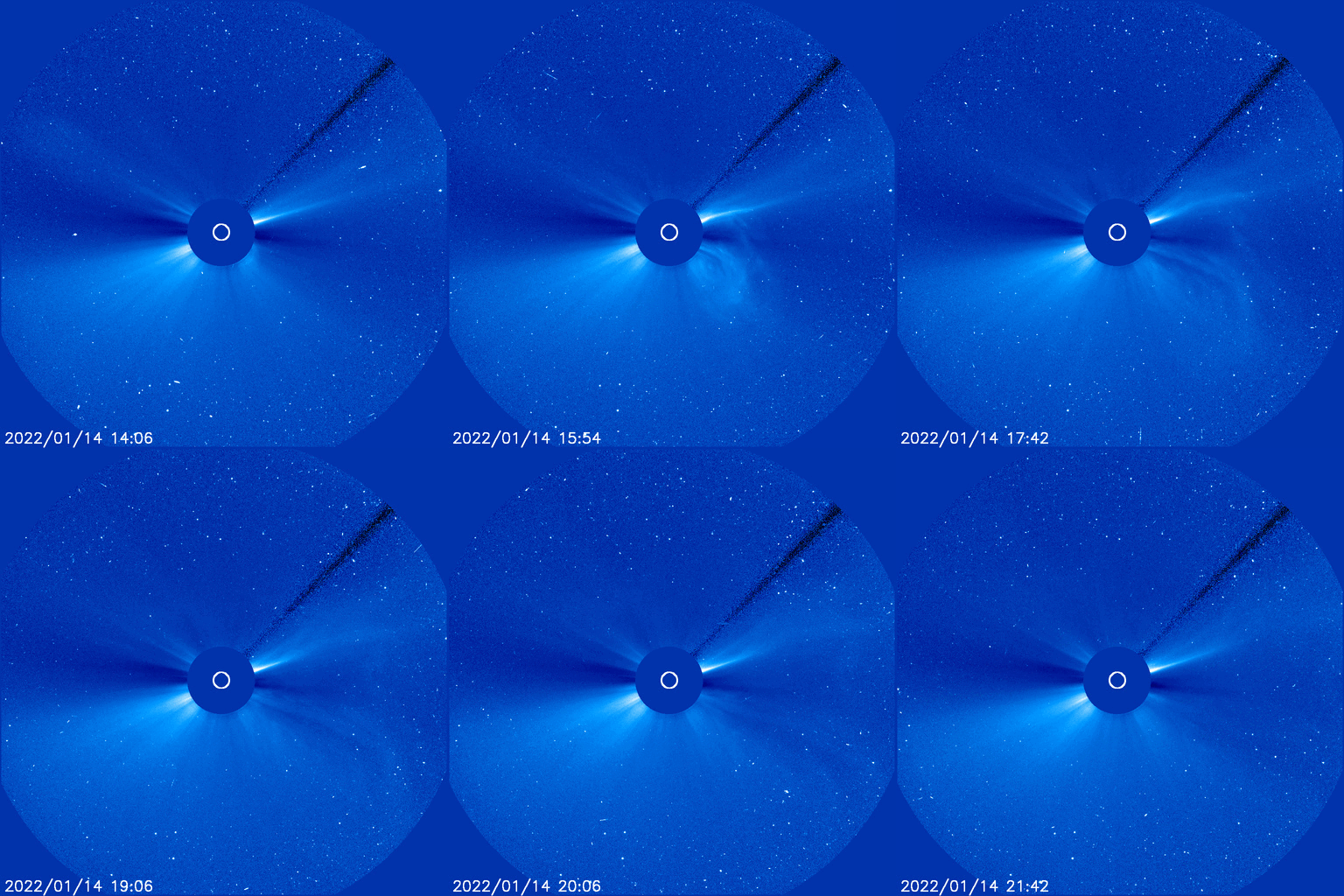
GLANCING-BLOW CME: As predicted, a CME brushed Earth's magnetic field during the late hours of Jan. 17th. The glancing blow sparked a minor G1-class geomagnetic storm. The CME was hurled into space on Jan. 14th by a C4-class solar flare (sunspot AR2925). Storm conditions are subsiding now and should continue to wane throughout Jan. 18th. Aurora alerts: SMS Text.

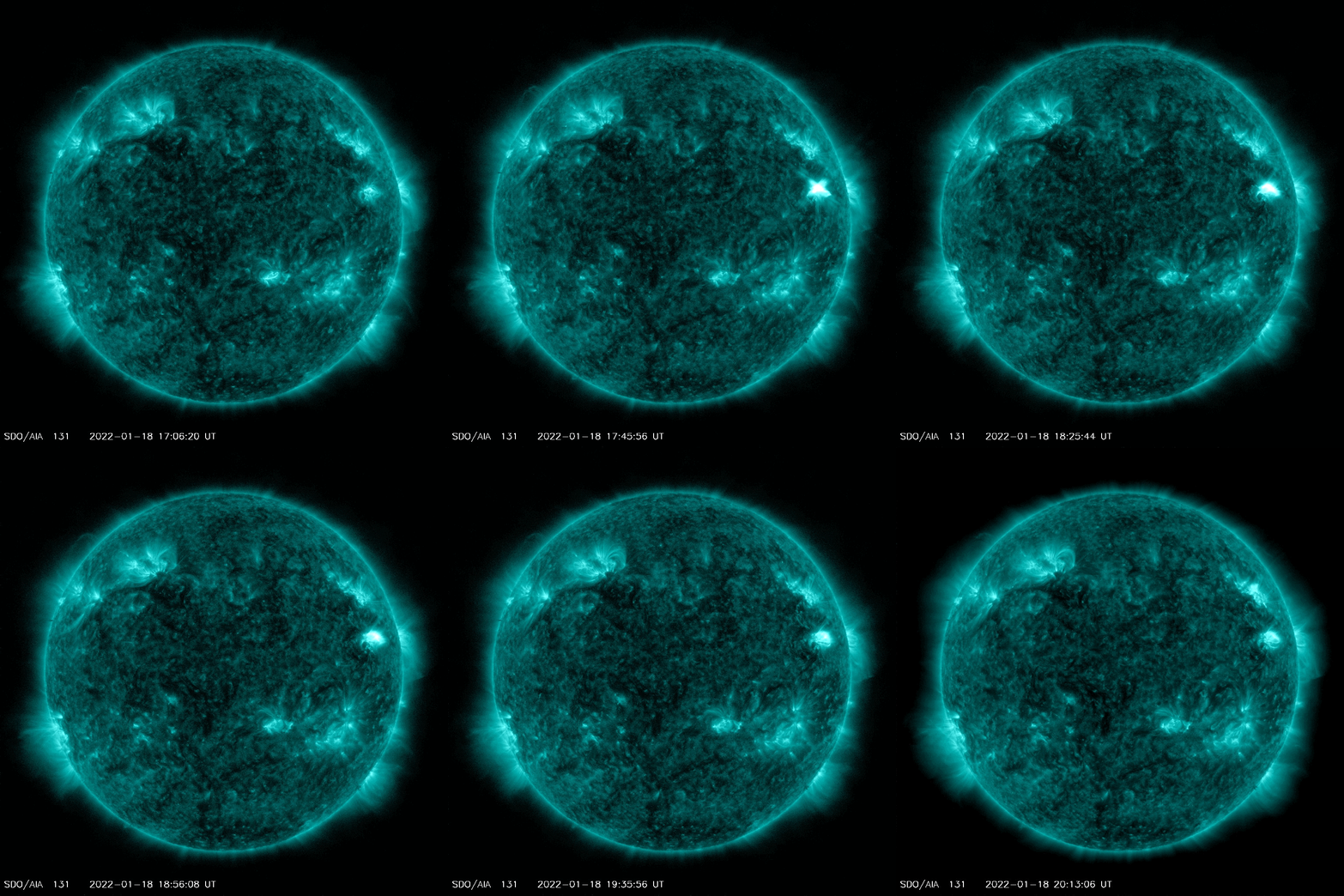
SOLAR FLARE AND RADIO BLACKOUT: Sunspot AR2929 erupted on Jan. 18th (1744 UT) producing an M1.5-class solar flare. In this movie recorded by NASA's Solar Dynamics Observatory note how a glowing current snakes away from AR2929 at the end of the flare and seems to ignite a smaller flare in neighboring sunspot AR2930:
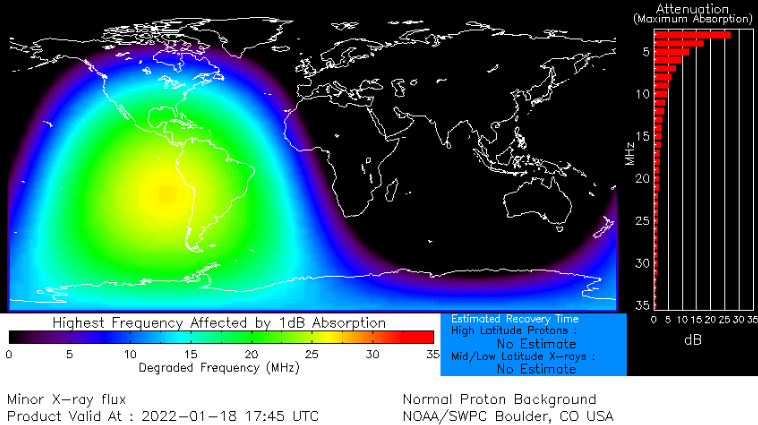
During the flare, a pulse of X-rays ionized the top of Earth's atmosphere causing a minor shortwave radio blackout over South America: map. Also, the flare might have hurled a CME into space. Confirmation awaits fresh data froom SOHO coronagraphs. Stay tuned!
VOLCANIC GRAVITY WAVES OVER HAWAII: The eruption of an undersea volcano near Tonga on Jan. 15th was even bigger than anyone thought. It nearly touched the edge of space. Hours after a mushroom cloud burst out of the Pacific Ocean, cameras at the Gemini Observatory on Mauna Kea recorded red waves rippling over Hawaii:
These are gravity waves, a type of atmospheric disturbance excited by intense thunderstorms and volcanic eruptions. Many gravity waves scud through the low atmosphere. The ripples caught by Gemini's Cloudcam, however, are in the mesosphere 85 km high--the realm of meteors, sprites, and noctilucent clouds.
Photographer Steve Cullen spotted the waves in online footage. "I had a hunch that Gemini Cloudcams might detect gravity waves produced by the eruption of Hunga Tonga-Hunga Ha'apai. So, I just took a look and there they were!"
"The volcanic eruption happened at 04:15 UTC, and the gravity waves passed Hawaii 4.5 hours later," notes Cullen. "This corresponds to a speed of ~1100 kilometers per hour"--a good match to the speed of sound in the mesosphere.
The waves are red because of airglow, an aurora-like phenomenon caused by chemical reactions in the upper atmosphere. Airglow is usually too faint to see, but gravity waves from the volcano boosted the reaction rates. Red is a sign of OH. This neutral molecule (not to be confused with the OH- ion found in aqueous solutions) exists in a thin layer 85 km high and can produce a pure red light.
Realtime Space Weather Photo Gallery
Free: Spaceweather.com Newsletter
A DRAGONFLY FOR VALENTINE'S DAY: Dragonflies have never been to the stratosphere. Until now. On Jan 12th, this sterling silver winged pendant flew 113,451 feet above the Sierra Nevada mountains of California, hitching a ride onboard an Earth to Sky Calculus cosmic ray balloon:
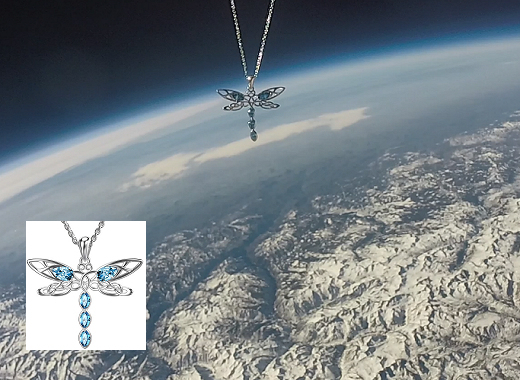
You can have it for $172.95. The dragonfly's heart is a Celtic love knot, and its wings are decorated with blue marquise crystals--all plated with 14k white gold. It's an exquisite ensemble for Valentine's day or any other romantic occasion.
The students are selling dragonfly pendants to support their cosmic ray ballooning program. Each one comes with a greeting card showing the pendant in flight and telling the story of its trip to the stratosphere and back again.
Far Out Gifts: Earth to Sky Store
All sales support hands-on STEM education
Realtime Aurora Photo Gallery
Free: Spaceweather.com Newsletter