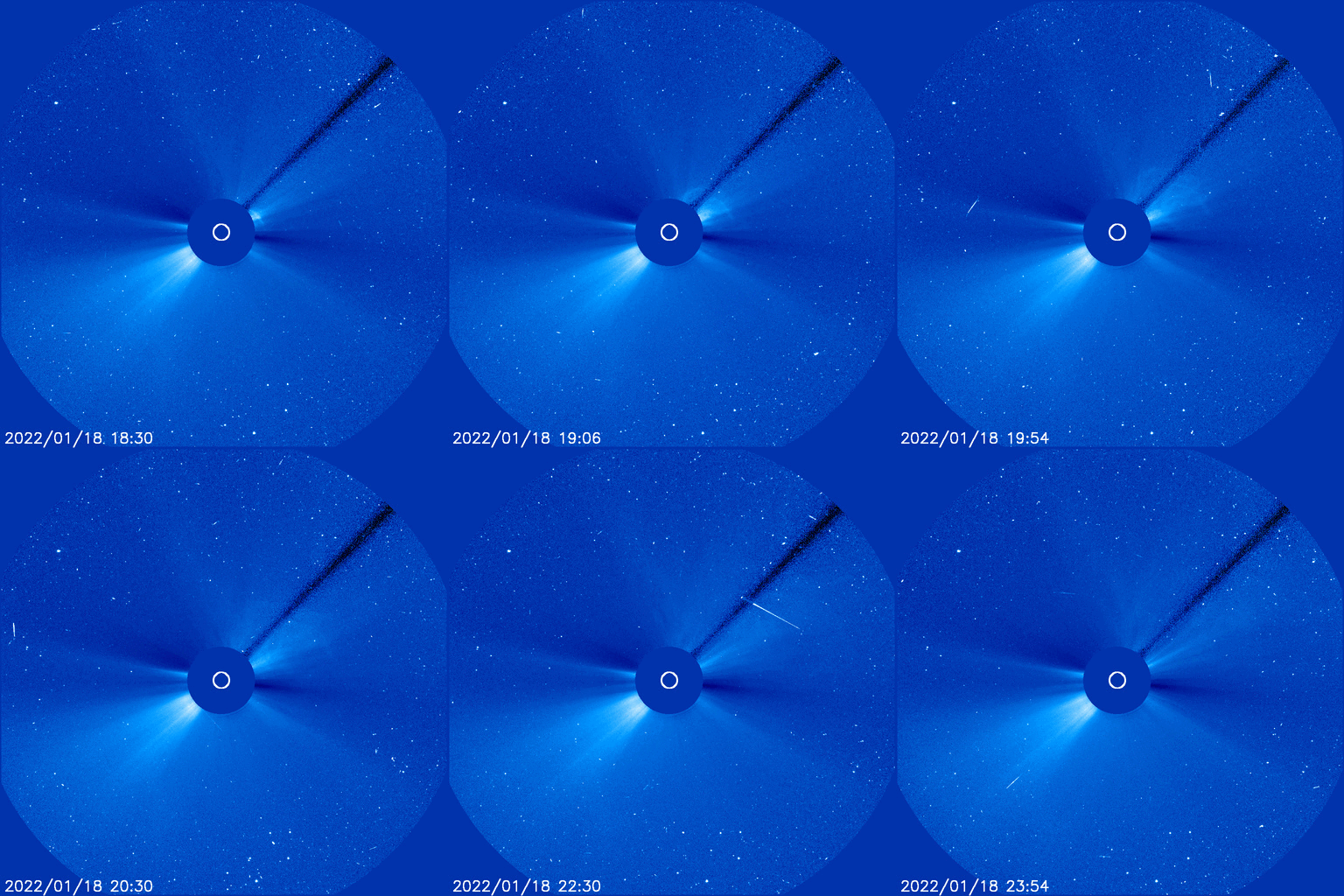
GLANCING-BLOW CMEs: In recent days, the sun has produced multiple coronal mass ejections (CMEs). None of them is heading directly toward Earth; nevertheless, they might touch our olanet. A series of glancing blows is possible beginning today, Jan. 22nd, when a CME thrown into space on Jan. 18th passes nearby. The close encounter could produce a brightening of Arctic auroras. Aurora alerts: SMS Text.
A QUIET EXPLOSION ON THE SUN: Yesterday, Jan. 21st, a magnetic filament connected to sunspot AR2934 became unstable and erupted. NASA's Solar Dynamics Observatory caught the filament hurling a piece of itself into space:

Forecasters call this a "disappearing solar filament" (DSF). DSFs typically occur without the electromagnetic flash of a solar flare. In this sense, they are "quiet" explosions.
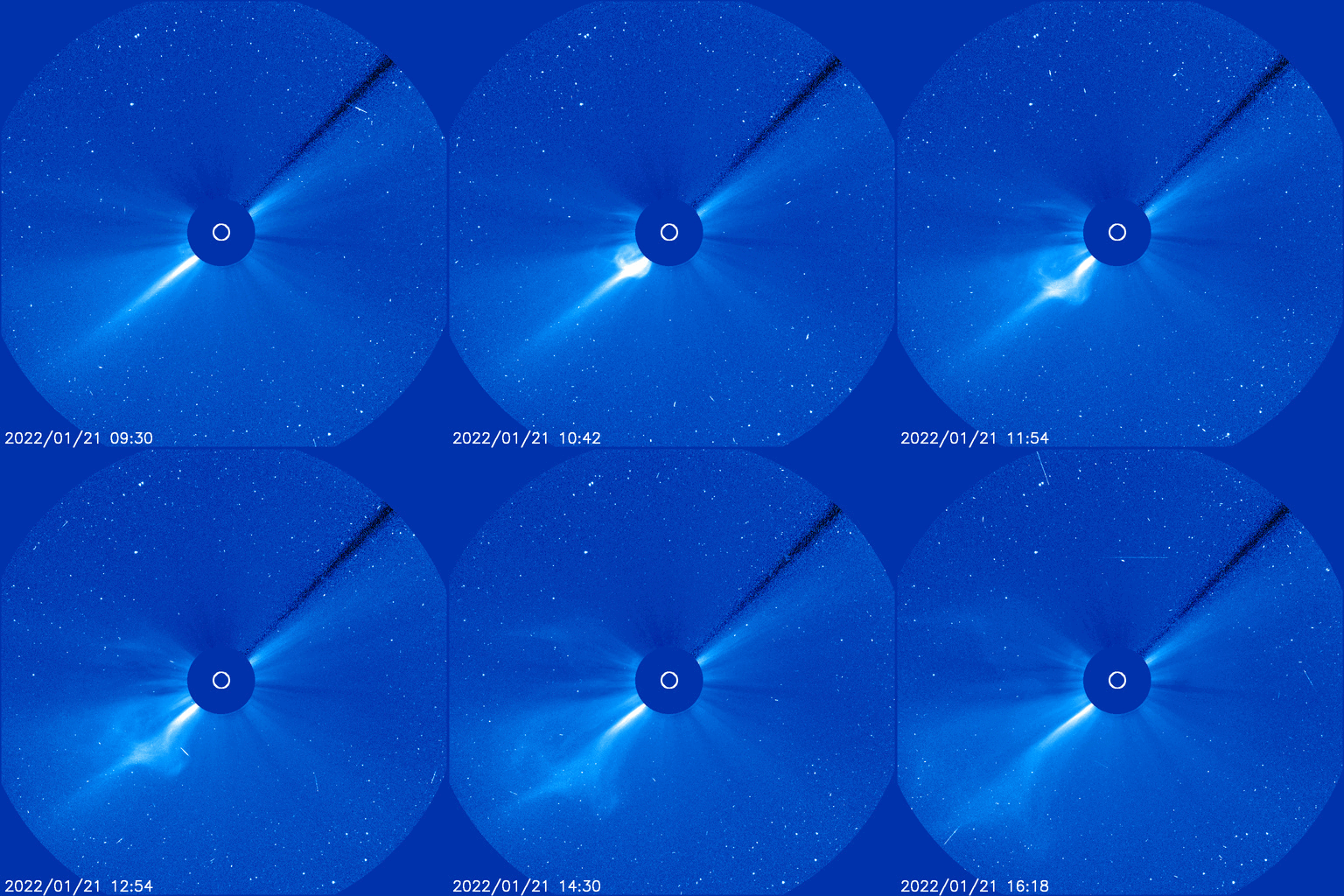
Debris from yesterday's DSF formed the core of an impressive coronal mass ejection (CME). Watch the movie from SOHO. The CME is near the edge of the Earth strike zone; it might hit us or it might not. NOAA forecasters say that a glancing blow is possible on Jan. 24th. Aurora alerts: SMS Text.
Realtime Space Weather Photo Gallery
Free: Spaceweather.com Newsletter
A SUNSET FROM TONGA? When the sun goes down tonight, take a look at the fading sky. If the twilight turns purple, you might have spotted a "Tonga sunset." Heiko Ulbricht photographed this example last night in Großopitz, Germany:

"A strong purple light appeared 26 min after sunset," says Ulbricht. "This could be aerosols from the eruption of the Hunga Tonga-Hunga Ha' apai volcano earlier this month."
Indeed it could. On Jan. 15th, the volcano hurled 400 million kilograms of sulfur dioxide into the upper atmosphere, reaching altitudes never before seen by NASA's fleet of Earth-orbiting satellites. A huge cloud of sulfurous aerosols passed over Australia and has since been spreading around the world through the stratosphere.
Purple sunsets may be a sign that these aerosols have reached you. Volcanic aerosols in the stratosphere scatter blue light which, when mixed with ordinary sunset red, produces a purple hue.
But purple isn't the only thing to look for. In addition, sky watchers should be alert for a bright yellow twilight arch, fine cloud structures in the arch, and long purple rays. These are all potential signs of a "Tonga sunset." If you see one, submit your picture here.
Realtime Volcanic Sunset Photo Gallery
Free: Spaceweather.com Newsletter
VALENTINE'S SPACE PUP: You've heard of Aphrodite, the Greek goddess of love. Now let us introduce you to Aphrodoggy. This lovable puppy just traveled to the stratosphere onboard an Earth to Sky Calculus cosmic ray research balloon:
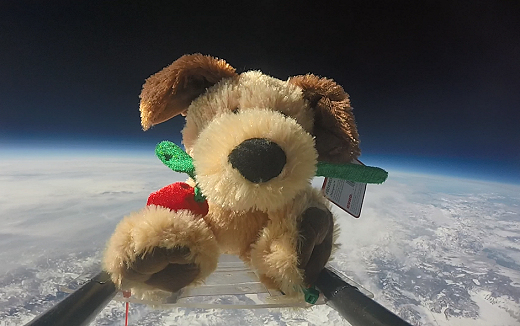
You can have it for $109.95. The students are selling plush pups to support their high-altitude ballooning program. Holding a red rose for Valentine's day, each snuggly canine comes with a greeting card showing the 9-inch tall puppy in flight and telling the story of her journey to the stratosphere and back again.
Far Out Gifts: Earth to Sky Store
All sales support hands-on STEM education
Realtime Aurora Photo Gallery
Free: Spaceweather.com Newsletter