CLOSE ENCOUNTERS WITH CMEs: There won't be any geomagnetic storms this week. However, there might be geomagnetic unrest. NOAA forecasters expect a pair of CMEs to pass by Earth on Jan. 26th delivering, at most, glancing blows. The two close encounters could be just enough to energize Arctic auroras without igniting a full-fledged storm. Aurora alerts: SMS Text.
AN OUTBURST OF NOCTILUCENT CLOUDS: Yesterday, skies over Argentina suddenly filled with noctilucent clouds (NLCs). A video camera in Rio Gallegos (Patagonia) recorded the outburst:
"What a surprise!" says Gerd Baumgarten of Germany's Leibniz Institute of Atmospheric Physics, who operates this remote camera to minotor southern skies for unusual events. "We haven't seen NLCs all year. Now, suddenly, they are very bright."
NLCs are Earth’s highest clouds. They form when wisps of water vapor rise up from the poles to the edge of space. Water crystallizing around specks of meteor dust create the electric-blue structures. NLCs are, literally, frosted meteor smoke.
Normally at this time of year, NLCs are confined inside the Antarctic Circle. So it is a surprise to see them bursting out to mid-southern latitudes; Rio Gallegos is at 51.6oS.
To confirm that these are truly NLCs, Natalie Kaifler of the German Aerospace Center (DLR) pinged the clouds using a laser radar (lidar) in Rio Grande. The echos returned from 85 km above Earth's surface:
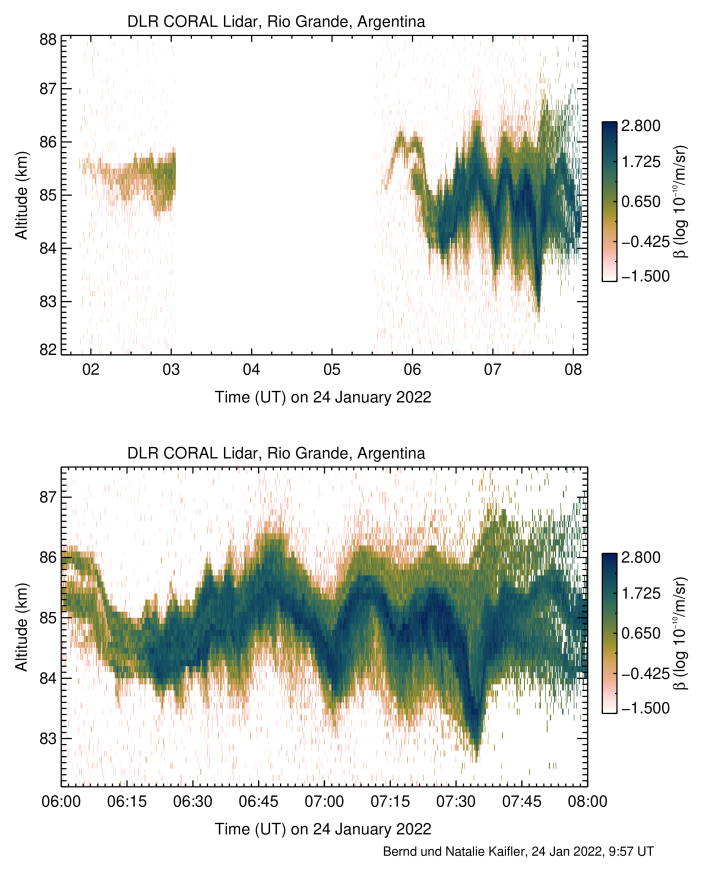
This is exactly where NLCs typically form. Reality confirmed.
Where did these clouds come from? Maybe Tonga. The eruption of the Hunga Tonga–Hunga Haʻapai volcano on Jan. 15th hurled a plume of ash, sulfur dioxide and (this is the important part) water vapor more than 55 km high. Baumgarten and others are investigating the possibility that water from the volcano has reached the mesosphere, creating an outburst of noctilucent clouds. Stay tuned for more information.
Realtime Space Weather Photo Gallery
Free: Spaceweather.com Newsletter
THE CRESCENT VENUS PENDANT: Valentine's Day is only weeks away. Nothing says "I love you" like a Venus Pendant from the edge of space. This one flew to the stratosphere onboard a cosmic ray research balloon on Jan. 8, 2022:
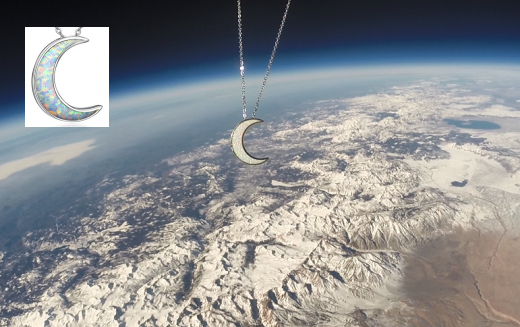
You can have it for $142.95. The opal crescent is framed by sterling silver with a matching hypoallergenic chain. It comes with a greeting card showing the pendant in flight and telling the story of its journey to the stratosphere.
Why is it a crescent? Because Venus itself was a crescent on the date of the flight. On Jan. 8, 2022, the second planet was at inferior conjunction with the sun. From Earth it looked like a slender crescent--the most beautiful phase of the Goddess of Love.
Far Out Gifts: Earth to Sky Store
All sales support hands-on STEM education
Realtime Aurora Photo Gallery
Free: Spaceweather.com Newsletter