CHANCE OF FLARES TODAY: Sunspot AR2940 has a 'beta-gamma' magnetic field that harbors energy for strong M-class solar flares. NOAA forecasters say there is a 25% chance of such an eruption during the next 24 hours. The sunspot is almost directly facing Earth, so any flares will be geoeffective. Solar flare alerts: SMS Text.
SOLAR CYCLE 25--A DIFFERENT POINT OF VIEW: Sunspot numbers for January have just been tabulated and, once again, Solar Cycle 25 is outperforming the official forecast. This would seem to suggest that Solar Cycle 25 (SC25) is going to be strong when it peaks a few years from now.
"Not so fast," cautions Dr. Ron Turner, an analyst at the ANSER research institute in Virginia. "It may be too early to anticipate a strong solar cycle." This graph explains why:
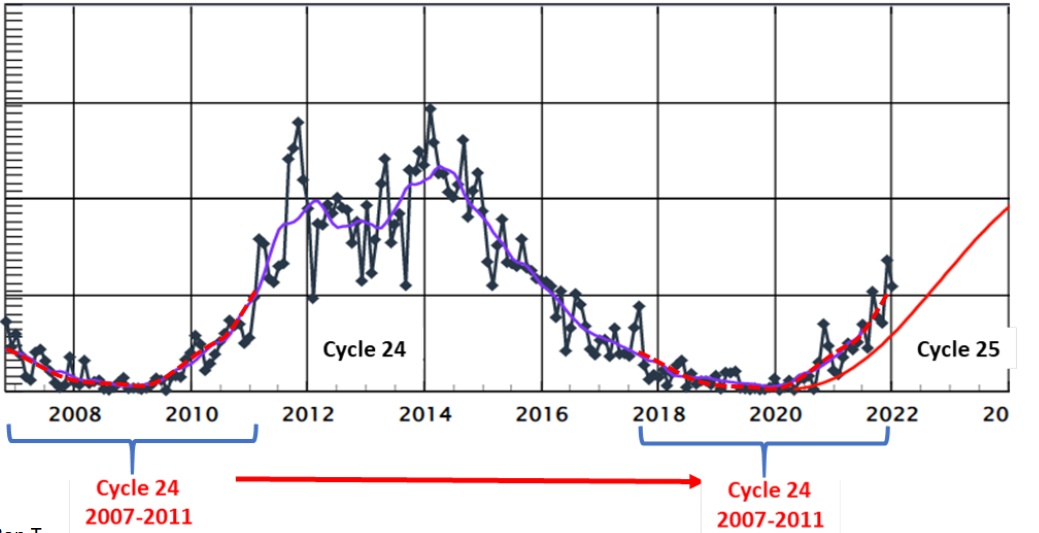
Turner has been studying the solar cycle for many years, and he remembered something about old Solar Cycle 24 (SC24). It heated up quickly much like Solar Cycle 25 is doing now. "I took sunspot numbers from the early years of SC24 and overlaid them on SC25," he says. "They're an almost perfect match."
Solar Cycle 24 went on to become one of the weakest solar cycles of the past century. Its fast, hot onset did not lead to a strong maximum. Turner isn't saying that Solar Cycle 25 will likewise be a dud. But, rather, "these early sunspot numbers are not enough to guarantee a strong cycle," he cautions.
Déjà vu, anyone?
Realtime Space Weather Photo Gallery
Free: Spaceweather.com Newsletter
AFTERGLOW OF A CME: A CME hit Earth's magnetic field on Feb. 1st. Almost 24 hours later, the sky was still glowing over Tromsø, Norway. Marcus Åhlund took this picture at 5 pm local time on Feb. 2nd:

"These were our first sunset auroras of the year," says Åhlund. "It was a beautiful display."
Many observers inside the Arctic Circle reported a surge of Northern Lights after the CME arrived. The initial blow may have failed to produce a geomagnetic storm, but the afterglow was sublime.
Realtime Aurora Photo Gallery
Free: Spaceweather.com Newsletter
STERLING SILVER "I LOVE YOU MORE" PENDANT: Valentine's Day is less than 2 weeks away. Nothing says "I love you" like a moonstone from space. This one hitched a ride on an Earth to Sky Calculus cosmic ray research balloon, floating 112,201 feet above the Sierra Nevada mountains of central California:
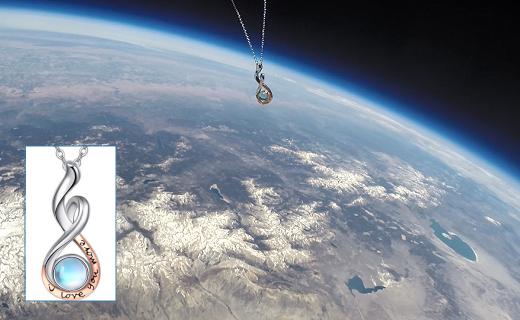
You can have it for $142.95. The students are selling these sterling silver infinity-wrapped moonstone pendants to support their ballooning program. Engraved with "I Love You More," it makes a romantic Valentine's gift. Each one comes with a greeting card showing the moonstone in flight and telling the story of its trip to the stratosphere and back again.
Far Out Gifts: Earth to Sky Store
All sales support hands-on STEM education